
How to transplant hydrangea emphasizes the need to gently handle the flower, considering that it’s quite sensitive. When the plant’s bushes go dormant in fall, it is the ideal time to grow hydrangeas.
The start of winter is also the recommended time to plant hydrangeas due to the season’s cool temperatures that promote the plant’s dormancy. If you have been searching for comprehensive information on transplanting Hydrangeaceae family plants, this article has you covered.
What Steps Are Involved in Transplanting Hydrangeas?
The steps that are involved in transplanting hydrangeas start off with watering the soil around the plant to soften it prior to uprooting the bush. Thereafter, sink a shovel into the soil to lift the plant. Carefully transfer the plant to its new location.
1. Uproot the Hydrangea Plant From Its Native Soil
Hydrangea plants tend to develop a massive root system that can be very heavy to lift from the ground as the plant grows bigger. If you cannot lift the hydrangea bush from underneath its roots using a shovel, you can consider using a crowbar to leverage the weight and apply less work. Alternatively, you could also ask someone to assist you to lift the plant from its opposite end, while you are at the other.

If you still cannot lift the plant, or if you realize that it is too big for the new site, you can trim this beauty down to a suitable size. Carry the plant to its new site, with the native soil still wrapped around the root ball. The soil around the root ball helps the plant to quickly acclimatize to its new environment.
2. Dig a Hole at the New Site and Plant the Hydrangea
Dig a planting hole that is about the same size as the one left after uprooting the hydrangea plant. When planting the hydrangea, the apex of the root ball must be slightly above the ground surface. Therefore, it’s important to have a hole that is sufficient to accommodate the plant. Avoid planting the hydrangea deeper than it was at its initial location to avoid stem deterioration.
Plant the hydrangea and fill up the spaces that remain in the hole with organic material. Ensure that the root ball is completely soaked with water immediately after transplanting hydrangea. If you carried sufficient soil around the root ball from the native location where the plant was, then it is less likely to experience hydrangea transplant shock in its new location. You can do similar steps when planting hydrangeas from pots.
3. Plant Care for Your Hydrangea Flowers
To bring out the best flowering, prune the hydrangea’s old material lightly, as the flowers will need that plant matter for them to bloom. During the winter, do not prune off old flowers as they provide a covering to protect the new flowering buds that develop underneath them.

Remove some stems from the plant’s base if the hydrangea has visibly overgrown. Be sure to regularly prune your hydrangea to a height of about four feet, as the plant tends to grow very tall if left unchecked. It may even end up producing flowers that are beyond your reach.
Black vine weevils, mealybugs, Japanese beetles, four-lined plant bugs, and aphids are the common pests that disturb hydrangea plants. To control them, prepare neem insecticide solution and apply it to the visibly affected areas. You could also use liquid insecticidal soap mixed with water to directly remove beetles from the plant leaves.
Factors That Ensure a Successful Hydrangea Transplanting Procedure
The factors that ensure a successful hydrangea transplanting procedure include an environment with soil that retains moderate moisture, good sunlight, proper plant spacing, and adding fertilizer to the plant. Also, carefully monitor the acidity or alkalinity of your soils because the color of hydrangea flowers depends on the pH.
– Ideal Soil Type
Hydrangea flowers are not very particular about their soil requirements. However, they do well in loamy soils that are regularly watered to cater to the relatively rapid moisture loss that is characteristic of this soil type. At the same time, these plants do not do well in soil types that retain excessive water for too long as this can damage delicate plant buds and roots.
To alter your soil’s water retention capacity, you can add variable amounts of organic matter to either sandy or clay soil. This helps to adjust the soil’s compactness. You could also amend the soil with compost to add the nutrients that the plant requires, along with beneficial acids and enzymes.
– pH Requirement
Hydrangea does well within a wide pH range. Transplanting hydrangea flowers in moderately acidic soils or weakly alkaline ones will sufficiently sustain the plants. However, hydrangea is more biased toward the acidic side, as the recommended pH range for the plants to flourish is between 5.5 and 7.5.

You can regulate the soil pH depending on your preference with regard to the hydrangea flower color. The flower colors range from blue to pink, and purple. Neutral to weakly alkaline soils with pH values of 6.5 and higher favor the development of pink flowers.
A purely acidic pH that is below 5.5 favors the production of blue hydrangea flowers. A moderate one that ranges between 5.5 and 6.5 inclines toward the production of a color mixture between pink and blue, which appears as purple.
– Soil Nutrients and Fertilizers Requirements
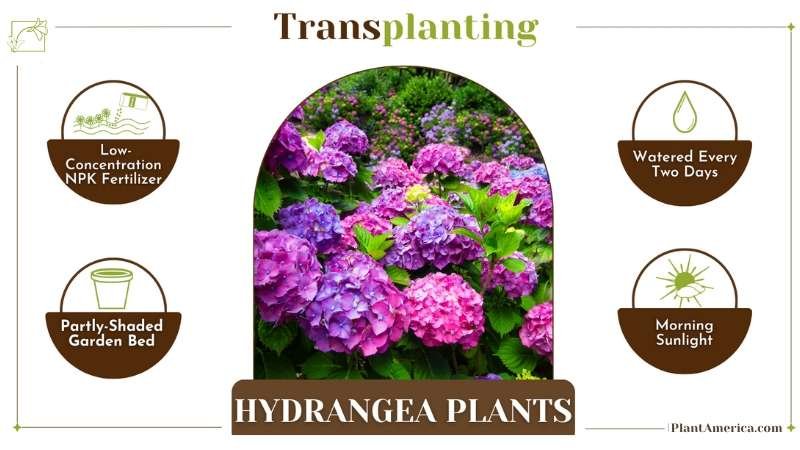
Add nutrients to hydrangea plant soils once in early spring and again in autumn to promote the development of flowers. A 10-10-10 low-concentration NPK fertilizer will be enough to allow healthy plants to keep flowering. If your hydrangea has not been flowering for some reason, the plant requires a higher phosphorus content fertilizer like a 10-30-20 type, which aids blossoming.
Hydrangea also requires secondary micronutrients like sulfur and calcium for its metabolism. These micronutrients also help your plants to develop healthy structural parts like the stems and roots. Boron- and iron-rich soils also supply important micronutrients that the hydrangeas need for enhancing the color intensity of their flowers.
– Water Requirements
Hydrangea plants need to retain adequate moisture after watering, especially if they are planted outdoors. Be sure to water your hydrangea at least once every two days to maintain moist roots. For the first four weeks after you transplant hydrangeas, water the plant once every day, preferably early in the morning just before sunrise.

Be sure to plant indoor hydrangeas in a well-draining pot that prevents them from sitting in damp soil for too long. Standing water causes hydrangea leaves to lose vibrancy before they develop a brown or yellow discoloration. In such cases, de-clog the drain blockage from the pot and allow the soil to dry, before resuming normal watering patterns.
Each time you intend to apply inorganic fertilizer to hydrangea, begin by deeply watering the plant about six hours prior to the procedure to prevent the leaves from burning. If you ever notice that your hydrangea’s leaves are drooping, it’s time for you to water the plant to retain soil moisture. Add some mulch around the plant base toward the roots to enhance moisture retention.
– Hydrangea Sunlight Requirements
Hydrangeas are very sensitive to direct sunlight. The heat from the direct sun can easily scorch their leaves and make them a bit curly. As such, if your hydrangeas are potted, place them where they have good access to sunlight. Also, ensure that your spot of choice has abundant circulating air. This makes it easy for the plant to benefit from the sun’s light while being protected from its heat.
Hydrangeas prefer dappled, indirect sunlight for up to three hours each day to maintain beautiful flowers. The flowers also thrive when exposed to gentle morning sunlight, before letting them absorb obstructed sunlight throughout the rest of the day. We recommend a partly-shaded garden bed if you are transplanting hydrangeas outdoors. Indoor plants will benefit if you can move them from one spot to another to control their exposure to sunlight as you deem fit.
The sunlight requirements of hydrangeas also differ between varieties, with the Smooth, Panicle, and Mountain types thriving in overly sunny conditions. Contrastingly, the Mophead, Oakleaf, and Climbing hydrangeas thrive better in partially shaded gardens.
– Spacing Outdoor Hydrangeas
The general rule for spacing hydrangeas is to add a distance of one foot right around the anticipated width of the mature plant. For example, if the hydrangea variety has a mature width of four feet, then you may add a buffer of one foot to determine the overall spacing that you will allow between plants, which is five feet.

Overcrowding hydrangeas causes competition for nutrients and water, thereby limiting the full growth potential of these plants. It also results in leaf suffocation, which significantly affects the hydrangea’s aesthetic appeal. Overcrowding your hydrangeas also promotes the development and rapid spread of fungal infections.
Conclusion
We are confident that you can now boldly take up the task of planting hydrangea without much difficulty. Following these handy nuggets will ensure excellence in transplanting your plants:
- Be sure to transplant hydrangea in soils with the right pH according to your flower color preferences.
- Remember to propagate hydrangea with a space allowance of about a foot between plants, in addition to the projected area that a fully matured plant will occupy.
- Expose hydrangea to about three hours of full morning sunlight to prevent the leaves from getting scorched by the sun.
- Lightly prune hydrangea so that the developing flower buds can have a platform to bloom considering that they do so on the older plant material.
- Use neem pesticide or insecticidal soap to get rid of plant pests that may affect hydrangea.
Planting hydrangea will surely add a welcoming aura around your home. Go ahead and have a good time creating a breathtaking landscape with these stunning hydrangea flowers!
References
- https://extension.oregonstate.edu/gardening/flowers-shrubs-trees/general-care-hydrangeas
- https://extension.missouri.edu/news/hydrangeas-the-bold-chameleon-of-plants-3358
- https://extension.unr.edu/publication.aspx?PubID=2578
- http://extension.msstate.edu/publications/publications/hydrangeas-for-mississippi-gardens