
Philodendron Florida Ghost care is simple and straightforward, and you will be rewarded with unique and beautiful foliage for your effort. This plant is a recently introduced hybrid of philodendrons — more specifically, it is a hybrid between Philodendron Squamiferum and Philodendron Pedatum.
Philodendron is a broad genus of flowering plants in the family Araceae with 489 species and is the second-largest member of the family Araceae, after the genus Anthurium. Without further ado, let’s get started with the care of your Florida Ghost!
Philodendron Florida Ghost Plant Care Guide
 Soil Requirement
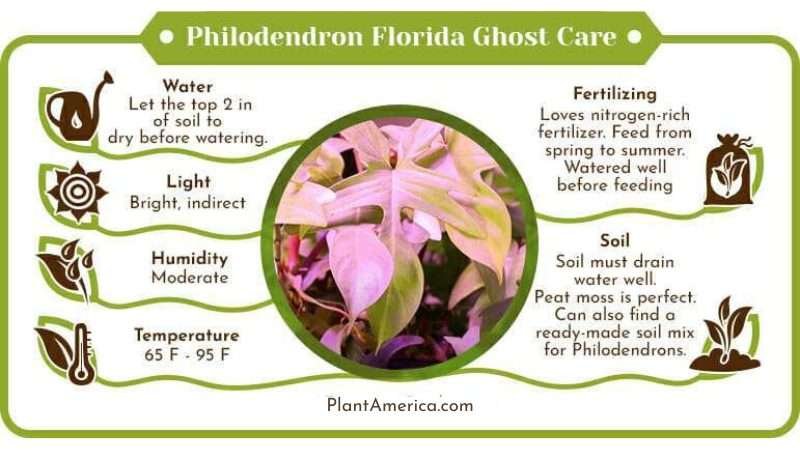
Philodendron Florida Ghost plants appreciate a well-drained soil mixture. You can create your own or buy a ready-made bag. Keep in mind that the soil must drain water well but also allow the plant to soak water. Adding more organic matter to the soil can help you achieve this balance.

Peat moss is a perfect material to grow your Philodendron Florida Ghost plants.
You can use it without adding anything else to it. It has a coarse structure that allows good aeration. It also encourages drainage, which Philodendron Florida Ghost plants love.
You can also find a ready-made soil mix for Philodendrons in the market. It contains bark, charcoal, and peat. Note that this soil mix will also be a little more acidic than the neutral pH of the peat moss. Both will work, but some other factors also impact the growth of the plants.
 Light Requirement
Philodendron Florida Ghost grows best in the bright indirect sunlight. Direct light may cause scorching on the leaves besides other problems like withering of leaves. Place your Philodendron Florida Ghost close to a window that gets indirect light. This source will be enough to encourage photosynthesis and avoid direct sun rays.
If you are using grow lights, then place the plant at least five inches away from the light. The plant must be right under the light. Make sure that the Philodendron Florida Ghost receives a consistent amount of light during the day and night. It means twelve hours of light followed by twelve hours of darkness.
 Water Requirement
Philodendron Florida Ghost plants need moderate watering. Do not overwater it, and do not let it try. Weekly watering can bring that right balance. But always check Philodendron Florida Ghost plant soil. It may need water more frequently in a drier environment.
You can check it by sticking your finger into the soil. Allow the top two inches of the potting mix to dry before the next watering. If the soil remains dry for too long, it will kill the plant. On the other hand, wet soil with poor drainage can develop root rot in your Philodendron Florida Ghost plants.
If the soil is wet, then let it dry out a little before you water. In case it is dry, then you water it immediately. Remember, the Philodendron Florida Ghost plants will need water only thrice a month in the coldest months. Isn’t it great?
 Temperature
Philodendron Florida Ghost prefers a temperature between 65-95 degrees Fahrenheit. Since it is a hybrid of a tropical plant, it is sensitive to cold weather. Make sure the temperature around them is maintained during winter so that they thrive even in colder months. Do not place it close to the air conditioner or an open window during the cold season.
 Humidity
Philodendron Florida Ghost plant needs a moderately humid environment to thrive and survive. The surrounding needs to be highly humid, mimicking the natural tropical setting, for the best growing conditions. Here are simple ideas to create that:
- Place the humidifier close to the plants.
- Spray your plants when you water them.
- Grow other plants close to the Philodendron Florida Ghost plant. It will create more humidity.
- Make a pebble tray for your Philodendron Florida Ghost plants. You can place pebbles in a tray and add some water to it.
Place your pots on top of the pebbles. The plants receive more moisture when the water from the tray evaporates. You can easily refill the tray when it dries out. Amazing, right?
 Fertilizer
Philodendron Florida Ghost plants love nitrogen-rich fertilizers. When you are picking fertilizer for your plants, make sure you get the one that has more nitrogen. Nitrogen helps plants grow larger, healthier leaves. It is a safe fertilizer for your plants for regular feeds. The best time to fertilize your plants is from spring to summer.
Remember, the plants should be watered well before feeding them with any fertilizer.
Repotting
Philodendron Florida Ghost plants can grow up to five feet tall. The leaf can be as big as four inches in length. It depends on how the plant is grown.
Philodendron means tree hugger in Greek. Remember, these plants are climbers. As a potted plant, they will need some kind of supporting structure to hold on to. It will love to cling to a moss pole to grow stronger and look good as a houseplant.
The exotic-looking climber grows white-as-ghost leaves. The multi-lobed leaves change colors from white to yellow-green. Finally, take on a green hue when they mature.
The Philodendron Florida Ghost plants rarely produce flowers. You are lucky if your plants grow beautiful 12-inch-long purple flowers. The plant is also a slow grower and will take its time to mature. Be patient!
Philodendron Florida Ghost plants will not need repotting before two or three years. When roots begin to come out from the drainage hole, it is a sign that the plant needs a pot. The new pot must be 2 inches bigger to allow the Philodendron Florida Ghost plant roots to spread and breathe.
The roots of the Philodendron Florida Ghost like to breathe. This condition means the soil must remain moist, not soggy. Now let us look at some propagation methods for your Philodendron Florida Ghost plants.
Propagation
Philodendron Florida Ghost plants can be propagated by using the stem cutting or air layering method. Let us learn more about both of these methods.
Spring is the time to propagate your Philodendron Florida Ghost plants. This season is the time when plants are growing and will root and adjust to a new location.
If you are a beginner, choose the stem cutting method to multiply your plants.
Propagating Using Stem Cuttings:
- Use sterilized pruning shears for getting the Philodendron Florida Ghost stem cuttings. You can easily clean your shears using isopropyl alcohol.
- Cut exactly above the leaf node, making sure it has two leaves attached to it. Take stem cuttings that are two to four inches big. Don’t worry; it’s alright if the cut is imperfect.
- Cure your cuttings to create a calloused end. To do this, allow the cutting to dry out for a week.
- Once the cutting is cured, you can begin potting your cuttings. Add peat moss to the pots with drainage holes.
- Make a hole in the peat moss using your hands. Gently place your stem cuttings into the soil, making sure the leaves are above the surface of the soil.
- Pack the soil around it.
- Water your cuttings and place them close to the mother plant. It will offer it the perfect growing conditions.
Propagating Using Air Layering:
- Use a sterilized knife to wound your plants.
- Cut into the stem of the plant. Make sure it doesn’t go all the way through but should reach the middle of the stem. The cut can be two inches deep and two inches long.
- Hold it open, and take a handful of wet peat moss to rub around the cut on the stem.
- Allow peat moss to fill the space between the cut and around it.
- Take a plastic wrap and roll it around the wound covered with peat moss.
- Use duct tape to hold the plastic wrap tightly around the stem.
- Wait for a few weeks until the roots begin to sprout from the wound.
- Once you can see the roots through the plastic wrap, cut the stem to separate your cutting.
- Remove the plastic wrap carefully.
- Plant the baby plant in a well-drained soil mix. The pot must have good drainage holes.
- Remember, the Philodendron Florida Ghost plants are slow growers; be patient, and you will see results soon.
Problems
Philodendron Florida Ghost plants may show signs of some illness or problems that you can resolve. The trick is to identify the problem in a timely manner and take action.
Here are some common problems of the Philodendron Florida Ghost plants.
– Fire Blight
This disease affects the Philodendron Florida Ghost plants. A bacteria called Erwinia amylovora that upon contact will plant spread. The fire blight can make the branches turn brownish or black. It can kill your plants if left untreated.
The best way to control the blight is to remove infected branches right away. If you do not do this as soon as it begins to invade your plants, then you might lose the entire plant very fast. Always use sterilized pruning shears for this. In case your plant is under attack by fire blight, then it’s time to reduce your nitrogen fertilizer as well.
– Mealybugs
Mealybugs also like to attack the Philodendron Florida Ghost plant. They like to feed on the sap of your plant. The sap is nutrient-rich and a source of hydration for your plants. Mealybugs multiply very fast and can soon leave the plant dull and weak.
Neem oil helps reduce the problem if applied at the beginning of the invasion. This organic remedy works in most cases.
– Aphids
Aphids can also multiply very fast and can leave the plant weak. Use insecticidal soap spray or a strong blast of water to wash away the bugs. This solution usually stops the problem. It is also a good idea to test the soap on a section of the plant first.
– Root Rot
Root rot happens because of overwatering. If the roots remain soaked in water for a longer time and the soil doesn’t drain well. It will cause the roots to rot, and the plant will die. The only solution in the worst cases is to take cuttings and restart.
To prevent the problem, make sure the pot has good drainage, and the soil is right.