
The Peperomia Verticillata of the Piperaceae family is most commonly known as Red Log or ‘peperomia with red underside’. It is a lovely succulent and vibrant houseplant that develops attractive red-shaded foliage.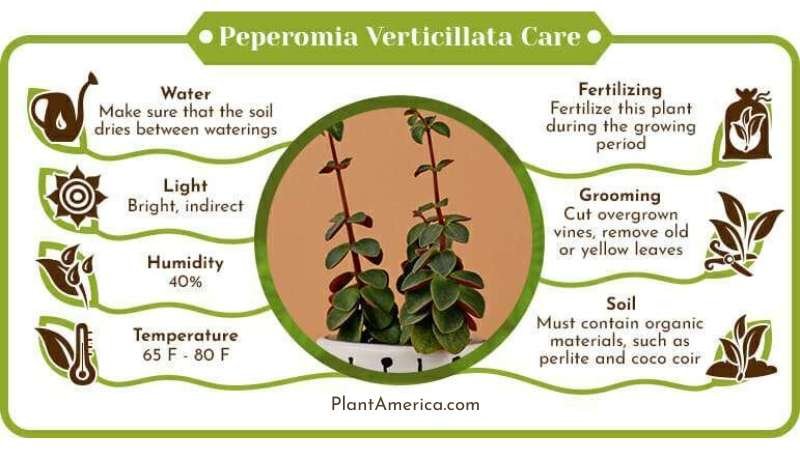
Taking care of peperomia plants is easy if you know all the requirements. Let’s find out how to properly take care of this peperomia variant.
What Is a Peperomia Verticillata?
A Peperomia Verticillata or Red Log is an outstanding variant of peperomias making four small oval leaves per cluster on a stem. Each leaf is unique and contains two beautiful colors: green on top and red on the underside. It is native to Haiti, the Dominican Republic, Cuba, and Bolivia.
Peperomia Verticillata Care
The proper care for Peperomia Verticillata requires the plant parent to remember some requirements to grow a stunning variant of one of the rare peperomia varieties. Let’s check what hose requirements are.
 Water Requirements
Just like the other plants, you need to be careful when watering Peperomia Verticillata. It is very important to make sure that the soil dries between waterings. Water the soil evenly and carefully to avoid overwatering the plant. This plant doesn’t like its roots to be drenched with too much water, so it is advised to use a pot with good drainage.

Make the soil your guide for watering. The top of the soil dries faster than the bottom of the soil, so always pay attention if it’s still wet.
You can water this plant every seven to ten days, but it is advised to make the soil your guide before watering. If the soil crumbles when you take a small handful of it, then the plant is ready for watering.
Nonetheless it is important to know that if you are still having a hard time checking the soil moisture level of your Peperomia Verticillata, some peperomia growers advise using a moisture meter. You have to remember that this peperomia variant is partly succulent, so watering is quite easy.
Furthermore, setting a once-weekly watering schedule for Peperomia Verticillata is enough. Remember to check a few inches of the soil before watering, and make sure it’s dry.
During the winter season, room temperature is the best for your peperomia plant. If ever you are hesitant to water your Peperomia Verticillata, check the soil. Remember that it is more advisable for the soil to be too dry than to be too wet.
Use the recommended pot size with enough drainage holes. The water should flow and drain easily. Discard the water from the saucer to prevent the soil from absorbing the water.
 Light Requirements
The Peperomia Verticillata needs bright, indirect sunlight. Avoid placing the Peperomia Verticillata under direct sunlight.
Choosing the right location for Peperomia Verticillata is very important as this can help the plant become healthier and produce more leaves. This peperomia can be placed near a window or anywhere it can receive enough sunlight. If there will not be enough light in the house, the use of an artificial growing light is recommended; filtered sunlight can also work for this plant.
This plant grows toward the sunlight. It is important to have a balance of light on every side of the Peperomia Verticillata because it will bend naturally toward the sun if only one side is exposed to sunlight. Turn the plant regularly so every side of the Peperomia Verticillata leaves will receive enough sunlight.
 Soil Requirements
The type of soil that you need for this plant is well-draining soil. Soggy soil is highly unfit for this plant. The soil must contain organic materials, such as perlite and coco coir, to help it drain well.
The choice of soil for your Peperomia Verticillata plant is very important to achieve good quality and health for this peperomia variant. Remember to avoid overcrowding your potting mixture to prevent the plant from suffering suffocation and death.
 Temperature Requirements
Being a tropical plant, Peperomia Verticillata prefers moderately warm environments that range from 65 to 80 degrees Fahrenheit (18 to 26 degrees Celsius).

Indoor plant owners of this peperomia variant are very lucky because households typically have environments with the required temperature, so caring for this plant will not take too much time and effort.
However, is your house location, your area’s climate, and your plant’s position inside the house are not ideal, you have to be extra careful with your Peperomia Verticillata plant.
Adding a temperature gauge in a room is an advantage and very useful, especially during the summer and winter seasons. You can simply add a fan to the room to lower the temperature during the summer, or if it’s too cold in winter, you can bring the Peperomia Verticillata to a heated room.
 Humidity Requirements
While most of the peperomias like high levels of humidity, Peperomia Verticillata is different in that it only requires a low level of humidity. Peperomia Verticillata growers make sure that the choice of location is far from any heating system in the house.
Some plant owners prefer to have a 40 percent level of humidity, and instead of using a humidifier, as long as you have a dry level of humidity in your home, Peperomia Verticillata can thrive in this environment.
 Fertilizing Requirements
The Peperomia Verticillata needs moderate fertilization. For this peperomia variant, balance is very important. The best time to fertilize this plant is during the growing period; once every month or once every fortnight would do, but during the winter months, you should stop fertilization completely.
This is the time when your plant hibernates, and it will have enough time and nutrients to produce new growth in spring.
To prevent any problems with this peperomia variant, remember not to over-fertilize it. Over-fertilizing this plant will cause more critical problems than under-fertilizing it.
However, also keep in mind that when your peperomia plant is over-fertilized, give your plant enough time for rest. Do not apply any additives to your peperomia for several months for your plant to recover.
 Pruning Requirement
Seeing your plant with its lovely and fully blooming appearance is such a wonderful feeling for a plant grower. You have to prune your plant to make it look charming and beautiful to everyone’s eyes. It’s a good thing that frequent pruning is not a problem for Peperomia Verticillata.
You can always groom your peperomia plants. You can cut the vine if some of the peperomia plant’s leaves have become overgrown, and when plants show a lack of nutrition, such as brown or yellow leaves, it’s time for pruning or grooming your peperomia.
It is a must to sterilize planting tools like pruning shears to prevent any other problems that might cause disease on your Peperomia Verticillata plant if you use unsterilized and unclean equipment.
Propagation
There are several ways through which you can propagate Peperomia Verticillata. It’s a good thing that this peperomia variant is very easy to propagate. Stem cuttings and leaf cuttings are the most common and effective ways of propagating this plant. Any of these two ways to propagate peperomia verticillata is advisable.
– The Leaf Cutting Method
When you are going to begin to propagate the beautiful plant, start by preparing the soil mixture ahead of time. After which, you must cut a selection of healthy leaves of the plant, and cut each leaf in half across the with.
From this point, you may start adding some rooting powder to produce new roots. Place the leaf-cutting into a potting mix with half an inch of a diameter hole on it. Compress the potting soil all over the cutting using your fingers. After doing the givens, you would want to start watering the plant thoroughly.
Now, you must prepare a propagation tray, and cover the cutting. After which, it is advised to place the Peperomia Verticillata in an area with bright indirect sunlight and then uncover the Peperomia plant every day for a few hours.
At this stage, the toots that emerge from the cutting edge of the leaf would, later on, produce new leaves. You can continue growing the plant inside the existing container.
– The Stem Cutting Method
To start the propagation by a cutting method of the stem, you would first have to cut a stem from the plant that has three to four leaves. Keep in mind that these would leave a part of the stem exposed by removing the bottom pair of leaves.
Now, you will dip the cut stem with rooting powder, as you would have to place the cutting in a pot and compress the soil around the cutting.
Lastly, what you have to do is water the plant thoroughly. You want to keep an eye on and monitor the plant for new growth and don’t forget to let the plant grow in its current pot.
– Propagating in Soil
When propagating the peperomia in soil, the first step and most important onesies to pick the healthiest stem of Peperomia Verticillata, and then cut it carefully using a sterilized knife so that it would leave any infections to the new sprouting plant.
Remove all the leaves from the stem carefully, and if you would like, you may use rooting hormones in this step, however, this is completely optional within your preference.
Carefully place the cutting into the soil, and water the plant. Don’t forget to place it in a bright place so that it receives proper light and grows even further.
– Propagating in Water
To propagate this beautiful peperomia in water, first and foremost you would have to begin by choosing the best stems from the plant, and afterward carefully you have to remove all the leaves from the base.
Place the stems into a small cup filled with water, and place this cup in a location where bright indirect sunlight is available so that the plant receives a good amount of light and not too much light.
After a couple of days, if you notice that the color of the water is changing, and becoming turbid, you would have to change the water so that the plant doesn’t die. Furthermore, it would be ideal to do so in order to avoid any type of pest infestations that may appear in the turbid water which would harm the propagation.
Once you notice that the roots are visible, that means that the plant is ready to be placed in a potting mix and start growing. Water it, and provide proper sunlight, so that the plant thrives and lives happily.
Problems
Like any other plant, Peperomia Verticillata is prone to other problems. Luckily, those problems can be easily solved by using the right solutions and remedies.
– Yellowing of Leaves
The Peperomia Verticillata leaves may start turning yellow because of overwatering. Always remember to water your peperomia when the soil is dry, and ensure that the excess water in the saucer is totally discarded to prevent root rot on your peperomia plant.
Lack of nutrients is another cause of yellowed leaves on your Peperomia Verticillata. To solve this problem, consider the use of fertilizer that is high in potassium and nitrogen.
– Drooping, Curling, and Falling of Leaves
Underwatering your peperomia plant can be the cause of leaf drooping. Overwatering and underwatering can both affect peperomia, so it is important to have a consistent watering schedule.
If the plant is not getting enough humidity, that can also be a reason why the leaves are drooping. Just increase the level of humidity by using a humidifier or a pebble tray.
Also, these are indications that a peperomia plant is affected by pests and diseases, as well as stress.
– Discoloration of Stems
Overwatering, incorrect watering, poor drainage, and over-fertilizing are the main causes of discoloration or blackening of the stems of your peperomia plant. It is important to know the basic requirements needed to grow beautiful peperomias to prevent the discoloring of stems.
– Wilting
Wilting is one of the serious problems of Peperomia Verticillata, and the main causes are overwatering, underwatering, and low humidity. Overwatering the peperomia plant is a more serious problem than underwatering it.
When this happens, there will be a big possibility of losing your peperomia plant. To avoid this problem, only water the plant when the soil is completely dry.
– Leggy Peperomia
The main reason why Peperomia Verticillata becomes leggy is the lack of light. To prevent this, always check if your plant is getting the right amount of light.
– Root rot
The Peperomia Verticillata does not like it when its roots are swimming in the water, as overwatering the plant will cause its roots to rot. Overwatering the Peperomia Verticillata is the main cause of many of the problems of this Peperomia variant.
– Undrained Soil
One of the main reasons why the roots of the Peperomia Verticillata start to rot is poorly draining soil. If water remains in the soil, the root of the plant will not be able to receive oxygen and might thus suffocate.
– Low Humidity
This species of peperomia does not need a high level of humidity, but if the humidity is too low and dry, the leaves of this plant will begin to curl. Air conditioners and heaters are among the reasons why the air inside a room becomes drier. You can monitor the humidity by using a humidity tray or a humidity monitor.
– Light and Heat
Peperomia Verticillata prefers to receive indirect light. Too much direct sunlight will heavily affect the plant. You can place the plant close to a window sill that is facing west.
Balance is the key to fixing this issue. Place your peperomia plant in a bright area but not under direct sunlight. The best suggestion is to place it near a window.
– Peperomia Pest and Diseases
Pythium causes root rot, and not properly looking into it can cause the plant to die. This type of disease won’t give some early symptoms. You will only see the symptoms later when black spots on the plant’s stem become evident, an indication that it could possibly be too late for you to save your peperomia plant from dying.
Avoid overwatering your peperomia plant, remove all the soggy roots that you will observe, and repot.
Fungus Gnats are little black flies that can be found in the plant’s soil. To avoid this, do not overwater your Peperomia Verticillata.
You can identify mealybugs through the white masses on the lower surfaces of leaves and roots that will, later on, produce molds. Get an insecticidal soap to eliminate them.
The symptoms of mites are stunted leaves, curled leaves, and leaves with serrated edges. Use pesticides to control this pest.
The shore flies do not harm the peperomia plants. However, they can be unsightly. To stop this pest, control the buildup of algae in the soil.
These are very small insects in yellow to black color. They eat the leaves of peperomia and leave scars on the plant.
Before you apply any treatment on your Peperomia Verticillata, wash and cut the affected leaves. Use the insecticidal sprays that work for you. Lastly, check if your Peperomia Verticillata is getting the proper care to avoid any future infections.
Final note:
You now know how to grow your peperomia plant, specifically the Peperomia Verticillata. Observe your plant, as it will tell you what it needs. Give it time and affection, and be rewarded by a healthy plant.