
Mammy croton plants of the Euphorbiaceae family are tropical plants that have long, thick, and colorful leaves. The beauty of this plant can change an area from boring to exciting and it is a fairly easy plant to grow.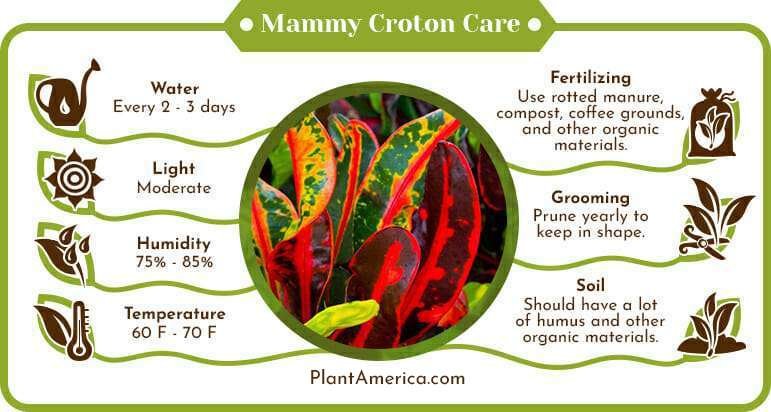 The secret of the Croton plant’s beauty is in its light exposure as it becomes prettier when it has more access to sunlight. Read this article to learn all you should about the care needs of the beautiful mammy Croton of the Codiaeum genus.
Mammy Croton Care
This plant is a fairly easy plant to grow, and you have nothing to fear. You just want to get the growing conditions such as light, humidity, and temperature correct. If you can grow your plants in the right environment, you can grow them with no problems. Here are some useful plant care tips for growing your mammy croton plants:
 Water Requirements
This plant needs a lot of watering. Just make sure that you do not overwater it. You should water your mammy croton plants every two or three days and never wait until the substrate goes dry before you water the plant again. Mammy croton plants love when their substrate is consistently moist. Well, you can help them to retain their moisture by mulching the substrate.
The container in which you are growing your mammy croton plants should not be too big as bigger containers store more volume of water. Also, it should have drainage holes (about two or three) so that your mammy croton plant will not grow in water-logged areas.
 Soil Requirement
The soil or the potting mix of mammy croton plants should have a lot of humus as well as other organic materials to keep moisture and nutrients in the substrate. Well, you want to make sure that the substrate can drain water quickly so that your Croton plants do not die of overwatering or root rot.
You can buy a suitable substrate or potting mix from garden supply shops, as the soil where the plant will inhibit. Additionally, you can also make it by yourself by mixing sand and any nutrient-rich organic matter. Note that you can use regular garden soil to grow your outdoor mammy croton plants. Well, try not to use regular garden soil for potted mammy croton plants.
 Light Requirements
Light is important for all plants as they use it for photosynthesis. Well, your mammy croton plants use light for photosynthesis as well as getting more color splashes on their leaves. If you want brighter colors in the leaves of your mammy croton plants, expose them to more sunlight.
Even though the plant’s colors are intense when you grow them outdoors with a lot of suns. You should prevent the hot afternoon sun from reaching them.
You can give them shade in the afternoon or keep them in a place where they can receive only morning and noon sun. For example, you can keep your mammy croton plants in the southern or eastern windows of your home or office.
 Humidity Requirements
Humidity is a key factor for mammy crotons as well as other plants. Plants can only absorb water and nutrients when you grow them in a place with proper humidity. Many gardeners do not pay attention to humidity and it affects the health and growth rate of their plants. You must pay attention to the humidity of the place you keep your plants.
Well, mammy croton plants can tolerate a slightly wide range of humidity. Note that their optimal range of humidity is between 75 and 85 percent.
However, they can grow in 40 percent humidity but you might notice a slower growth rate. If you can, adjust the humidity of the room to be around 80 percent.
Adjusting humidity can be easy when you have a humidifier. You can use the device to increase the humidity of the room for your plants that love higher levels of humidity. Do not grow mammy croton plants with other plants that cannot tolerate lower levels of humidity.
 Temperature Requirements
Temperature is important because it helps to regulate every life process in plants. No matter how healthy they may be, your mammy croton plants can die if you grow them outside their preferred temperature range. You can only grow this plant at 60 to 70 degrees Fahrenheit.
USDA hardiness zones 10 to 11 are the best zones to grow mammy croton plants as their temperature preference falls within the ranges of these zones.
Note that even though mammy croton plants are not winter-hardy, they do not hibernate or stop growing in cold temperatures. They only rest or grow slowly as long as the temperature is not too low, else they can die.
 Fertilizing Requirements
Just like you need food, your mammy croton plants need nutrients in their substrate. While you can buy fertilizer and feed your plants regularly, a more convenient approach is to plant your mammy croton plants on a nutrient-rich substrate so that you do not need to feed them regularly.
You can make their substrate with rotted manure, compost, coffee grounds, and other organic materials that boost the nitrogen content of your plant’s substrate. Remember that you should add more perlite if you use organic products in the substrate so that the substrate can drain easily.
You can tell that your mammy croton plants need more nutrients when the green coloration in their leaves is becoming pale. While you may prefer other colors to the green in their leaves, do not allow the green color to go pale. Well, make sure that your mammy croton substrate is rich, else you should feed the plants with half-strength indoor plant fertilizer regularly.
 Pruning
Pruning croton mammy plants is very important if you want them to stay bright and beautiful. Mammy croton plants can grow a lot of leaves, so pruning them involves removing some leaves that make the plant grow out of shape. You should prune the plants yearly before the start of their active growing season.
Do not prune your crotons in autumn or winter so that they can heal from the stress quickly. When pruning the leaves, remove the petiole of each leaf that you remove. Also, you should make sure that your pruning tool is clean and disinfected. You can remove leaves with colors that you do not like.
You may notice that your plants become weaker after you prune them, however this is normal and should not be any cause for alarm. They should get back to normal in a few hours or days as long as you are growing them in the proper conditions.
Propagation
Propagating your croton plant is not a difficult task. As long as you have a matured plant with multiple stems, you can propagate your mammy croton plant with ease. There are two major methods of propagating mammy croton plants. Here they are:
– Stem Cuttings
Propagating your croton plant using its stem cuttings is super easy. Use a knife to collect a part of the stem. You can collect the stem six inches away from its upper leaves.
When you get the stem, leave it exposed to the wind or sun for a few hours so that its wound can get dry. You should wait until the wound is dry before you plant it so that the plant does not get attacked by microbes.
When the wound is dry, you can plant the stem three inches into a suitable substrate and then wait for it to grow roots. Rooting this plant’s cuttings might take a long time, so consider using a rooting hormone before you plant it. Well, the cuttings will show signs of growth in less than three weeks.
If the cutting is dead, you should see that the lower end of the stem will start rotting slowly. As long as you cannot see any sign of rot, wait for the plant to grow as it is still developing some roots.
– Propagating In Water
You may want to consider starting your mammy croton cutting in water. This will help you to see the growth of the roots with your own eyes plus it is an exciting thing to see. When you get your mammy croton cutting, make sure that the wounds are dry before you dip them in water.
You should dip the bottom two to three inches of water in a clean and clear bottle of water. Keep the bottle in a place where it does not get hot or direct sunlight. If you notice that the water is becoming dirty, you should replace it quickly with a clean one. You should see roots growing from your mammy croton cutting three to five days.
When there are enough roots in the cutting, you can remove it from the bottle and then plant it in a suitable potting mix. With this, you can be sure that your plant will grow as long as its growing requirements are met.
Common Problems
Here are some common problems faced by people who grow mammy croton plants:
– Pests
Croton plants may resist mammalian pests, but they are vulnerable to little pests such as Mealybugs, Red Spider Mites, Scales, and Thrips. These pests can make holes in your mammy croton leaves and the plants can get infected from those holes (also is it possible that the leaves might start falling). You must prevent pests from reaching your croton plants.
While you can use neem seed oil or soapy water to repel or kill pests, a more convenient method is to buy pesticides for indoor plants in a gardening shop. You do not have to worry about other types of pests aside from invertebrates.
– Root Rot
Mammy croton is a hardy plant that will not get infected quickly, but it can easily get root rot if you do not water it properly. Overwatering your croton plants can lead to their roots dying and the decomposing roots will be attacked by harmful microbes. Without care, the entire mammy croton plant will start to wither and die.
If you notice that your mammy croton is weak, and it looks dying, remove it from its substrate to reveal its infected roots. A mammy croton plant suffering from root rot should have roots that are darkish brown and you should see that they can fall off easily.
To save your plant, prune off the dying roots, use running water to rinse the entire root system, and then leave the plant exposed to the sun for two hours at least before you plant it in a new substrate.
– Toxicity
This is a toxic plant that mammalian pests will avoid. The plant has some toxins that can make you and others in your home sick. The leaves may be beautiful to look at, but they are not so pleasant to eat. Do not eat your mammy croton leaves or even take them close to your mouth. Also, prevent and warn your children and pets from eating the leaves.
– Sunburn
One reason mammy croton plants get sunburned a lot is that people purposely put them in the sun so that their leaves can become more colorful. While this will work, overexposure of mammy croton plants to the sun can lead to sunburn. Your plants can radiate when they have around six hours of daily sun.
You can kill your plants or heavily damage the beautiful leaves if you leave them under the sun for far too long. If you have to keep the plant in a location where it receives a lot of sunlight, you should increase your rate of watering it so that it does not dry out quickly.
– Over-Fertilizing
The beautiful croton plant does not need too many nutrients to be beautiful. A substrate with quality nutrition is sufficient for the plant, so you do not need to always add more nutrients by fertilizing it. You can burn your mammy croton plant’s leaves if you feed it with too many nutrients. In the croton plant’s growing season, you can feed it if you think that the nutrition in the substrate is becoming depleted. You can use half or quarter-strength fertilizer for the mammy croton plant to avoid over-fertilizing. If you notice that the croton leaves are burning after you feed the plant, you should flood the substrate with clean water.
Now you are capable and ready to grow and propagate your mammy croton plants. Congratulations!