
Monstera laniata of the Araceae family is a South American large variety of Swiss cheese easy to care for so long as you water it when it needs water and grow it in the right levels of light, temperature, and humidity.
The Monstera Laniata is the big-leaved variation of the Monstera adansonii plant and another name for it is Monstera adansonii var. Laniata. However, Monstera Laniata is the most common plant among all the types of Monstera plants in the United States.
Read this article to learn everything you need to know about Monstera adansonii.
What Is Monstera Laniata?
Monstera Laniata is native to South America and can grow in tropical and subtropical regions. It is a hemiepiphyte, hence, it grows on trees in some stages of its lifecycle, while it grows on the ground in other states. Even though this plant is difficult to find, it is very easy to care for, furthermore, Monstera laniata is a fast-growing plant so long as you can meet all its needs.
Monstera Laniata Care
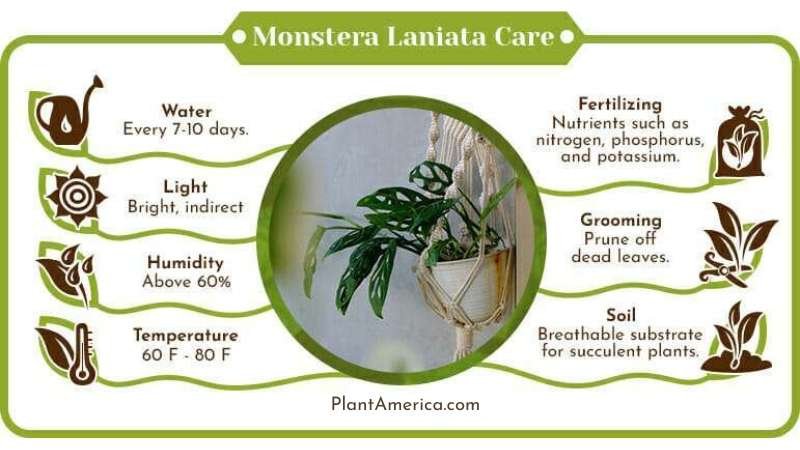
Monstera laniata is an easy plant to grow as it is low maintenance. It also tolerates a wide range of various growing conditions but will grow fastest when you give it exactly what it wants. The major growing conditions that you should focus on when growing Monstera laniata are its substrate, available nutrients, watering, and light needs.
You should also pay attention to its temperature and humidity. What are the specific requirements of your Monstera laniata plant? Would you like to grow this beautiful Monstera variety? You surely need some care tips.
– Water Requirements
The watering needs of the Monstera laniata plant are a bit tricky. Monstera plants love a consistently slightly-moist soil and may have stunted growth or even root rot if you overwater them. To satisfy your plant water needs, wait for every seven to ten days before you water it. If your Monstera suffers from guttation you should definitely change your watering schedule.
You can also inspect the Monstera laniata substrate to know if you should give your plant water or not. Dip your finger or any pointy (not sharp) object into the substrate. If the top four inches of the substrate are dry, you should water your Monstera laniata plant.
Do not fail to water your Monstera plant when you should as you may harm the plant by weakening it, additionally, do not water the plant earlier than you should.
– Light Requirements
Light availability is another important factor that you should consider before growing your Monstera laniata plants. Plants need light to thrive, however, Monstera plants are a bit unique because of their light requirements.
Monstera laniata plants need a medium to bright indirect light. Remember that Monstera plants are hemiepiphytic plants. This means that even if they grow in a place with full sun, they will not get direct sunlight as the tree canopy above them blocks a large amount of the sun from reaching them.
You should keep your Monstera laniata plants less than three feet from a window for them to thrive. You should also rotate your plant occasionally so that the sunlight can uniformly reach every part of the plant.
If you do not have access to at least five hours of sunlight daily, you can install grow lights so that your Monstera laniata do not have stunted growth.
– Humidity
Another growing condition that you should consider is the humidity level of the room. Humidity is important for Monstera plants and even if they can tolerate a wide range of humidity, you should always keep it on the high side.
Monstera laniata plants need 60 percent and above humidity to grow quickly. They can tolerate around 50 percent humidity, but they may not look healthy or fresh in such humidity levels.
You can install a humidifier in your room to supply your Monstera laniata plant with the right amount of humidity. You can also manually mist the surroundings of your plant to increase the humidity.
Note that you should not mist your Monstera leaves directly as doing so may be harmful to the plant.
– Temperature
Note that Monstera laniata is a plant suitable for tropical and subtropical regions. If you are in the United States, the best USDA hardiness zone to grow your Monstera laniata plant is 10b-12. Monstera laniata plants prefer high temperatures.
The optimum temperature for your Monstera laniata plant is 60 to 80 degrees Fahrenheit. Note that this plant is not winter-hardy, so you should not keep it outside in winter. Moreover, you should not keep your Monstera plants near any appliance that emits heat quickly as the plants do not like quick temperature changes.
You may need to change your Monstera plant location to give them their preferred temperature. If the afternoon summer sun gets hotter than 85 degrees Fahrenheit, make sure that the plant is not in direct sun in the afternoon.
– Fertilizers
If you want your Monstera laniata plants to grow well, you need to pay attention to what you feed them with. Nutrients such as nitrogen, phosphorus, and potassium are important for your Monstera laniata plant growth. Keep in mind that the substrate should be nutrient-rich.
You can use a general-purpose indoor plant fertilizer for your Monstera laniata plants in summer and spring. You should use a balanced fertilizer or one with slightly higher levels of nitrogen, nonetheless, fertilize your Monstera plants once or twice per month.
If you do not want to use inorganic fertilizer for your Monstera laniata plant, you should add more organic materials such as compost into the potting mix. Note that this can affect the composition of the potting mix, so you must add some extra perlite to keep the drainage ability of the substrate.
– Pruning
Sometimes, your Monstera laniata plant may grow out of control and you may have to prune it so that it can stay in shape. If you want to prune your plant, make sure that you do so in spring or summer. Do not prune your plant in autumn or winter as the growing conditions stress them and you do not want to add to that stress.
Additionally, you need to prune off dead leaves so that they will not decay on the substrate. Search for brown leaves below and remove them as well. Note to make sure that your plant looks green and fresh always.
Sooner or later, you will surely repot your Monstera laniata plant, the most common reason why you should repot your plant is the substrate. Remember that Monstera Laniata plants need breathable substrates, after a year or two, their current substrate may lose its drainage capability and host microbes, therefore you will need to change it.
Another reason why you need to repot your Monstera laniata is the available space for roots. After a year, you may notice that some of your Monstera laniata roots are emerging from the soil, in this case, you need to transfer the plant into a larger pot.
You should examine your plant roots while transferring it from one pot to another. Check your Monstera roots for pests and diseases (such as mosaic virus), hence you should prune off every damaged Monstera laniata root and rinse the remaining healthy roots with clean water before you transfer the plant into a new substrate and pot.
– Soil Mix
Growing your Monstera laniata in the right substrate is key to their quick growth. There are so many plant problems that you can avoid if you use the right substrate, hence you can use a breathable substrate for succulent plants to grow your Monstera laniata. Additionally, you can also mix the right substrate for your plant.
The best Monstera laniata soil or substrate has about 10-20 percent perlite. Perlite will help prevent your Monstera laniata roots from suffocating due to overwatering, the remaining part of the substrate should be sand, loam, bark, and compost. Note that the substrate should be well-drained, nutrient-rich, and can hold some amount of moisture.
We cannot overemphasize the use of a well-drained substrate for Monstera laniata. A well-drained substrate will prevent water from staying in the root zone so that your Monstera plant does not get root rot.
The substrate will also hold some moisture and nutrients so that your plant can grow consistently. If you cannot make the potting mix by yourself, you should get one from a garden supply store nearby.
– Suitable Mulch
Mulching is important for Monstera laniata as it prevents the substrate from completely getting dry. It also prevents weeds from competing with your Monstera plant for nutrients. You can mulch your Monstera laniata plant with various materials.
You can use bark, wood shavings, rocks, pebbles, and other similar materials to mulch your indoor plants. Inorganic mulch such as pebbles can beautify your home, so you may choose to use inorganic mulch. Note that organic mulch such as bark can slowly increase the nutrients in the substrate.
You must not use mulch on the plant, but mulch comes with a lot of advantages for your plant so you want to consider mulching the plant.
Propagation
All you need to propagate your Monstera laniata plant is its stem, you should collect at least six inches of Monstera stem for proper propagation. You can plant the seeds, but that might take a longer time to get your plants.
There are two major ways to propagate your Monstera laniata stem or cutting; you can either plant it directly in a suitable substrate or start it in water. Let us discuss the two major methods of propagating Monstera laniata plants.
– By Direct Planting
You should collect the cutting and leave it exposed for about a week, it will be callous during this period. When the cutting is dry at the end, plant it in a suitable substrate so that three or more inches are in the substrate. You should also pack the substrate tightly so that the cutting can be erect.
Gently spray water on the base of the cutting. Do so every two or three days. In less than a month, you should see signs of growth as a new leaf will appear. When the juvenile Monstera laniata is about 10 inches taller than it was during planting, you can start watering it the normal way.
– With Water
After allowing the cutting to callus for a week, you should dip it in a clean glass of water, the water should cover around four inches of the Monstera laniata stem. Continue to monitor the stem for growth and always replace the old water with a cleaner one every three or four days. The stem should produce roots and in three weeks, become ready for transferring.
You should wait until the root system is about three inches tall before transferring the stem. You can transfer the stem into a new substrate and pot just the way you planted your first Monstera plant. Make sure that you keep the plant in the right growing conditions.
Now you know how to propagate and care for your Monstera laniata plants. Continue reading for some tips to help you solve some Monstera-related problems.
Problems
Growing Monstera laniata is easy, you just need to avoid certain problems. Here are some problems that you can avoid:
– Cutting Not Growing After Propagation
If your cutting is not growing if you planted it directly into the substrate, you should wait an extra week or two to be sure. Monstera laniata plants usually grow their roots underground first before they grow their leaves.
Make sure that you wait for the stem to be callus before you plant it, else it may be decaying from below.
– Irregular Hole Edges
If you can see that the edges of holes in your plant leaves are not smooth or look scattered, you should check the plant for insects. Get rid of insects such as aphids, spider mites, and mealybugs as they can destroy your plant leaves and make the plant unattractive. However, Monstera plants have holes in their leaves, so do not mistake them for holes from pests.
– Toxicity
Remember that Monstera laniata plants are toxic, so you should prevent your children and pets from consuming the leaves. Additionally, do not consume the plant fruit and seeds.
What more is there to know about Monstera laniata? You are now a pro in growing the plant.