
Mosaic Virus monstera is a viral infection of the plant that can be caused by vectors such as mites, fungus, soil or pollen as a medium. It is a parasite that can cause damage at the cellular level of the monstera plant and manifests as mosaic patterns, green blisters and colored spots on the surface of the leaves.
If you are seeking information on why this is happening and want to know how to fix the condition then this comprehensive article is all that you need to read now.

Our experts list out the main reasons for the mosaic disease here, give you tips to tackle the condition and also how you can prevent mosaic virus occurrence.
JUMP TO TOPIC
- Why Does Mosaic Virus Monstera Occur?
- How To Fix the Mosaic Virus?
- – Quarantine as Soon as Possible
- – Dispose the Infected Part
- – Get the Plant or Seeds From a Reliable Source
- – Sterilize the Soil
- – Use Sterilized Containers
- – Sterilize Tools
- – Maintain Hygiene Around the Plant
- – Keep the Monstera Nourished
- – Keep Pests at Bay
- – Avoid Overwatering Your Plant
- – Using a Floating Row Cover
- – Prune Perennial Weeds
Why Does Mosaic Virus Monstera Occur?
Mosaic virus monstera occurs due to the plant’s contact with infected pests, nematodes or roundworms in the soil, fungal infections, contact with another infected plant, through seeds and even contaminated soil. It can also come from pests, transmission through seeds, soil transmission, and through propagation.
– Pest Infestation
The monstera may be an easy-to-care-for plant, however, it is not immune to viral infections like this.
Note that common garden pests such as aphids, leafhoppers, grasshoppers and mites are the biggest carriers of such viruses, acting as vectors, which easily infect multiple sections of the plant. However, it is a common cause for the occurrence of the mosaic virus on monstera.
When these pests feast on an infected plant and later move over to another healthy monstera, the virus gets transported through them. The insect spreads the infection to all the plant hosts it comes in contact with.
So in the process, if the monstera comes in contact with the infected insect, the virus will enter the plant’s cellular stream, and this could be one of the key triggers.
– Fungus
The mosaic virus has thousands of different strains, and it constantly is in search of a host to thrive and multiply on, and fungus is one such host.
A rather indirect cause though, however, the fungi’s growth on your monstera plant can make it susceptible to developing mosaic virus infection. Note that this would happen as the plant viruses are capable of thriving and infecting fungi and bacteria.
So basically, if there are fungi on your plant, there is a possibility that the virus will cross-infect from the fungus to the plant. The mosaic virus spreads through the fungi host onto the plant and infects it at the cellular level.
Nonetheless, you will very often notice infections occurring when the weather is damp or if there is excess moisture in the plant. This is because the extra hydration puts the plant at risk of developing fungal infections or root rot, which in turn attracts the virus as a host.
– Nematodes or Roundworms
Nematodes are parasitic roundworms that look like fine threads and thrive deep in the soil. The worms often enter the root sections, feeding on them and causing substantial damage to plants. The most devastating damage they can cause is making the plant susceptible to the mosaic virus.
As plant viruses can easily infect tiny living organisms, nematodes are seldom spared. Once infected, they can easily transmit the virus through the soil to the monstera plant.
– Contact With an Infected Plant
The mosaic virus can be transmitted through mechanical means such as contact of a healthy plant with an infected one, in several neighboring plants. This would typically be when the juice of an infected plant rubs against a healthy one.
Moreover, it could also happen when the same pruner that was used to prune an infected plant is used on your monstera, without sterilizing.
The two common kinds of viruses that would easily infect from one plant to the other are the Tobacco Mosaic Virus and the Cucumber Mosaic Virus. Both of these are variants and can easily be spread when the environment for the monstera plant is compromised, and they would be from being in contact with infected plants.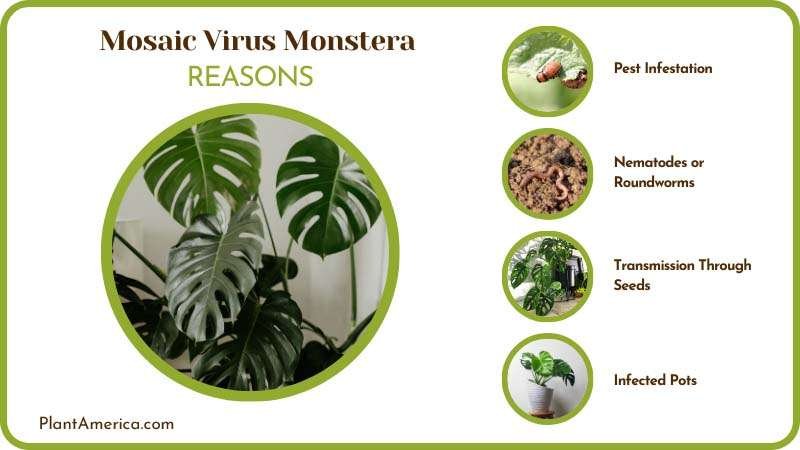
The intermingling of roots below the soil, especially when the plants are in proximity also causes the spread of the virus. Mosaic virus is highly contagious, thus the quicker you spot it on your monstera it is better to move it away to prevent contact with another plant in your garden, and the virus from jumping into that collection.
– Pollen
Pollen from infected plants can be carried by the wind or agents of pollination such as bees and butterflies and can settle on healthy plants.
As they would come to sit on your monstera, they might be contaminated from another plant, and come and transmit this virus to your monstera. These infected deposits then find a pathway into the monstera plant and tend to transmit the virus to the plant as well as to the next-generation seeds.
Virus particles do not thrive independently and depend on a host or vector to be transmitted from one plant to another. So apart from insects and fungi, pollen too can move from one plant to the next, spreading it all through the wind.
– Transmission Through Seeds
Seeds of infested plants are a major cause of the spread of the virus. They carry a high percentage of the virus in them and transmit it to the new plant from the germination stage itself.
In comparison to all the other diseases that are known to infect plants, the mosaic virus makes up one fourth of it, which means there is a large chance they will manifest in your seeds as well. There can be an early infection of the germinating seeds, which would be the result of low seed mortality and even seed rot.
– Soil Transmission
The mosaic virus can also be soil borne, as it is capable of infecting the monstera through the soil. It can happen through mechanical means, through nematodes or intermingling of roots.
This virus commonly occurs deep within the tissues of the plant, making it cause extensive damage to the foliage and is noticeable with its mottled appearance in the form of a mosaic pattern.
The virus thrives and gets easily transmitted through the soil as a medium, entering through the root channel and slowly transported to the entire monstera foliage, infecting it in totality. Note that this virus movement can be so quick that from the soil, an entire leaf section can be infected, and ultimately the complete plant will be taken over by it.
– Infected Pots
Starter pots or containers can also be a medium through which your monstera can contract the mosaic virus. If you are reusing such pots of a previously infected plant for your monstera now, then it could be a cause for its viral infection.
It is interesting to know that the mosaic virus can thrive outside the plant on any surface, or even when its host is dead. It is persistent and easily survives on pots, containers and even dried plant material for over a decade, hence easily entering your monstera system.
– Transmission During Propagation
If you have propagated your monstera using stem cuttings from an infected plant, then it is a strong cause for mosaic viral infection. A stem section from an infected plant carries the parasite at a cellular level and as it develops independently the virus remains and spreads throughout the foliage.
Over time it will arrest growth leading to the death of the monstera plant. Look out for stem sections with crinkled or wavy leaves or other deformities and stay away from using them for propagation.
How To Fix the Mosaic Virus?
To fix the mosaic virus in Monstera you must first quarantine the plant, and dispose of the affected part, get the seed from a trusted local garden, sterilize the soil and the tools, maintain proper hygiene, keep pests away, don’t overwater, prune the perennial weeds, and use floating row covers.
– Quarantine as Soon as Possible
If you have been able to detect the presence of the virus very early on the plant, then quarantine the plant as soon as possible. Remove all infected sections and destroy them as mentioned above to stand a chance to save the plant, in case it hasn’t spread much.
This snipping away of sections may work in case the virus isn’t in the roots or the soil. Always make sure you wash your hands before and after you handle a plant. On another note, make sure that it isn’t around any other plants, and you will be placing the key problem away.
– Dispose the Infected Part
Dispose of your Monstera plant as soon as you detect the mosaic virus. There is no other chemical cure for the infection as mentioned above, thus this is the only way out. If you do not dispose of your infected monstera plant, you run the risk of getting all your plants in your garden contracting the virus. In addition, there is no fungicide or spray to treat this viral disease.
Throw the infected plant away from your garden or burn them completely as a plant that has been infected with the virus will continue having it for the rest of its life.
Once destroyed, run a thorough check for signs of the viral infection on other plant foliage to make sure the situation has been tackled. Do not toss the infected plant into the compost pile as the virus thrives in the plant matter and can enter the stream again to infect.
– Get the Plant or Seeds From a Reliable Source
On another note, if you don’t have a plant yet but you are planning to bring a monstera into your home, then source it from a reliable store or nursery, especially if you are going to propagate it. Inspect the plant for any signs of disease and walk around the place looking for any signs of wilting or disease on other plants as well.
If, in general, all plants look happy and healthy, you could go ahead with your purchase. Be aware that it is easy for the virus to spread to whole sections in gardening centers, so plants can contract it.
If you are purchasing the plant or the seeds online then read the seller’s reviews before you place that order. Additionally, once you bring your plant home, isolate it for a few days to check if any problem manifests in it. This will better equip you to deal with it and if possible you get to contact your seller at the earliest about it.
– Sterilize the Soil
It is recommended to sterilize your soil before you plant your monstera as repeated use of the same soil over and over again can result in a build-up of pathogens. Viruses can thrive for over five years in unused soil, thus if you don’t sterilize your soil before reusing it, you are putting it under great threat.
The best way to sterilize your soil is to steam it for thirty minutes under a temperature of 180 degrees Fahrenheit so that all the pests would perish from the heat. Alternatively, you could also sterilize the soil chemical treatments or heat it in an oven.
– Use Sterilized Containers
Soil-borne viruses like the mosaic virus cling to pots and containers for a long time. Even in dormant winters, the virus can survive on the inside surfaces and emerge to damage your monstera when the warmth comes out.
The best way to prevent this is to sterilize your pot or container. Soak the pots in a diluted solution of household bleach, followed by running them through dish detergents, to bring out all the microbes.
Clean all debris with steel wool. Alternatively, you can also use white vinegar diluted in hot water and soak the pot for at least two hours. Rinse the container properly after this and let it dry well under the sun before you use it to pot your plant.
– Sterilize Tools
All garden equipment and tools need to be sterilized properly before you use them for pruning or cutting back on the foliage. Sterilize the tool using a diluted solution of isopropyl alcohol. Alternatively, you could prepare a solution with 10 percent bleach in a large container.
Immerse all tools in this for an hour and rinse them thoroughly before you use them again. Remember that the Mosaic virus is extremely contagious and not sterilizing tools can increase the risk and chances of the diseases being transmitted to the plant.
– Maintain Hygiene Around the Plant
Maintain proper hygiene around the plant to prevent the occurrence of mosaic viruses. Regularly clear debris of dead and decaying matter, as the virus can thrive in old leaf piles for years and infect your monstera if it is around.
Note that you should avoid causing damage to the plant leaves as much as possible, as this would make them susceptible to the virus. Practicing such preventive maintenance is beneficial in the long run to keep the monstera plant healthy and thriving throughout the year.
– Keep the Monstera Nourished
after you have pruned the virus away, note that a weak plant is yet again an easy victim to the virus. Fertilize your monstera regularly along with providing it with adequate light. A well-nourished and healthy monstera has a strong immune system and is thus less likely to contract the virus.
A nitrogen-based formula will work wonders for the monstera and will help it to develop in a disease-free way. It aids in the process of production, thereby enhancing its stored energy to give the plant a higher chance to resist the contraction of the virus.
– Keep Pests at Bay
It is important that pests not infect your plant which is a primary vector in transmitting the virus. And so, keep your plant pest free by regularly inspecting colonies. As soon as you spot any sort of insect infestation, apply an organic solution of neem oil whose odor tends to repel the pests and they fall off the plant.
You can also use other natural pest control applicants such as Bon-Neem, Safer Soap and diatomaceous earth. This will reduce the insect infestation that is potentially carrying the disease. Additionally, clean your monstera leaves using a soft-bristle brush, a hose pipe, moist clothes or a shower to keep them dust free. Dust can attract pest colonies.
– Avoid Overwatering Your Plant
Never over-hydrate your plant as it indirectly attracts viruses in this case. The extra moisture makes it susceptible to fungal growth which in turn tends to play host to the virus, because it is the medium that they would thrive in.
Hence, make sure that your monstera soil is not constantly damp so that the risk of the viral transmitters is reduced to a large extent, in addition, the soil is a well-draining one that won’t let any water stay in.
– Using a Floating Row Cover
Install a floating row cover to protect your monstera plant if you feel a threat from potential virus-carrying garden pests. Nonetheless, these are finely spun woven plastic that can be placed over plants. It keeps the pests away, however, permits permeability of air, water and light.
– Prune Perennial Weeds
As part of your regular maintenance, remove or prune all perennial weeds growing around your monstera which may potentially transfer the virus. You could use an organic or less toxic herbicide to do the job. This will control all plant viruses as removing any potentially symptomatic plant along with controlling the vectors, reduces the passing of the virus to your monstera.
Final note:
There are clear-cut signs that indicate that your monstera adansonii or your monstera deliciosa has been infected with the virus. These signs and symptoms are evident on the surface of the leaves, which may at first look like overexposure to sunlight or a nutrition deficiency. 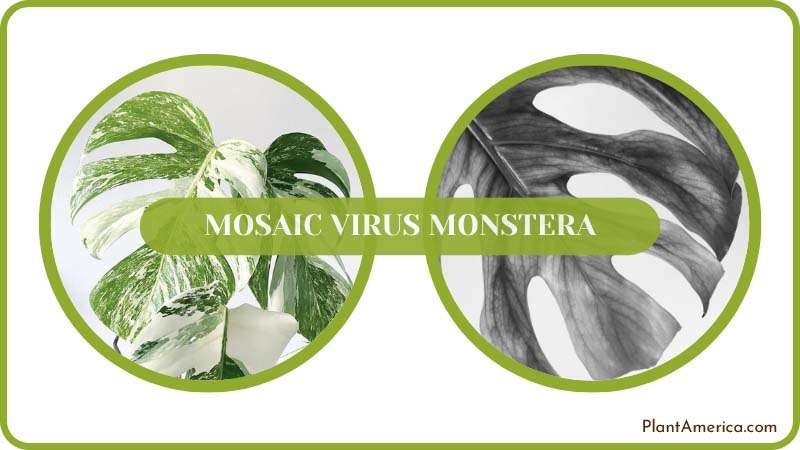
The signs of Mosaic Virus are White, yellow or green spots on the foliage, a mosaic pattern on the leaves. This affects the plant’s process of photosynthesis. some curled and wrinkled leaves and prominent yellowed variegation on the leaves. Slow and stunted growth.
Variegation in monstera is a naturally formed beautiful pattern with large holes on the leaves. It has a marble-like texture and can be in varied colors such as white, yellow, or green.