
Mealybugs on Crown of Thorns are an unpleasant sight, and we don’t blame homeowners for getting annoyed when they see these pests.

To help combat these unwanted garden residents, we’ve identified what makes them stay and what makes them go away!
Why Are There Mealybugs on the Crown of Thorns Plant?
Mealybugs are on your crown of thorns plant due to its structure and physiology. If there’s a stressed state, lack of predators, environmental conditions, nearby infestations, and lack of vigilance, mealybugs will be more attracted to the plant as opposed to when it’s healthy.
– Plant Structure and Physiology
Crown of Thorns, scientifically known as Euphorbia milii, possesses succulent and fleshy stems that store water. This type of succulent creates a perfect environment for its survival in dry conditions. However, it also becomes a cozy home for mealybugs. The plant’s soft stems have plenty of nooks and crannies where mealybugs can hide.
These protect the pests from the outside and predators. The succulent’s thick stems and dense leaves give mealybugs lots of space to attach to and feed on the plant’s nutrient-filled sap. Because mealybugs feed on sap, having easy access to food helps them thrive and spread throughout multiple Crown of Thorns varieties..
– Plant Stress
Stress can stem from factors like inadequate watering practices, fluctuations in environmental conditions, or poor soil quality. When stressors hit, the plant’s natural defense mechanisms can get weaker, making it hard to fight off pests like mealybugs. These bugs are smart opportunists since they take advantage of these weak points.
As the plant’s overall health takes a hit, it might not produce as many protective compounds and chemicals, which means it becomes an easier target for infestations. Stress can even change how the plant grows and works on the inside, affecting its sap that might attract mealybugs looking for a good meal, creating complex Crown of Thorns problems.
– Natural Predators Absence
One of the factors that can contribute to mealybug infestations on your Crown of Thorns is the absence of natural predators. In their original habitats, mealybugs are normally kept in check by helpful insects like ladybugs, lacewings, and parasitic wasps. These insects either consume the mealybugs or lay their eggs inside them.
However, when these helpful insects are not present in the environment where Crown of Thorns are cultivated, mealybug populations can grow rapidly. This situation allows mealybugs to reproduce quickly, spread throughout the plant, and harm its overall well-being.
– Environmental Conditions
These pests thrive in warm and humid climates, which provide an ideal setting for their rapid reproduction and establishment. Elevated humidity levels help mealybugs keep their moisture in check and avoid drying out. Meanwhile, higher temperatures speed up their growth and reproduction processes.
Plus, when the Crown of Thorns houseplant is closely packed with other plants, and there’s limited air movement, it can lead to small pockets of air that mealybugs find particularly welcoming. In these cozy spots, these pests can easily spread between plants, making it tough to rein in infestations.
– Transportation and Infestation Spread
Mealybugs are adept at hitchhiking on various carriers, including air currents, human activity, pets, or even other plants. As pests release their soft egg masses, the wind can swiftly carry them to nearby plants, triggering fresh infestations. Plus, humans unknowingly aid the movement of mealybugs while tending to plants.
Under this circumstance, they can unknowingly transport these pests in their hands, attire, or tools. When plants infested with these bugs are brought into a new setting, they can introduce mealybugs to regions that were previously unaffected. This opens doors for the infestation to spread rapidly.
– Lack of Vigilance
Mealybugs are small, mobile insects that tend to hide in concealed areas, such as leaf axils, crevices, and the undersides of leaves. Because they’re not easily noticeable, these pests can quietly take root on the plant.
If you don’t regularly check visually, you might not spot them until their numbers grow and you see visible signs of harm. Not realizing their presence can result in the infestation getting a strong hold, which then becomes harder to control efficiently, causing complicated plant diseases.
How Can You Control Mealybugs on Your Crown of Thorns Plant?
You can control mealybugs on your Crown of Thorns plant by pruning, isolating it from another plant that may already be infected, water sprays, insecticidal soap, neem sprays, and horticultural solutions. Let’s check each solution to help you determine which one works best for you.
– Pruning
When dealing with mealybug infestations on your Crown of Thorns, pruning becomes a crucial control method. Start by closely examining the plant. Look for spots where mealybugs are gathered, such as on stems, leaves, and in crevices.
Grab clean and sharp pruning shears or scissors to carefully remove the infested parts. Remember to take these removed bits away from your other plants so the mealybugs don’t spread.
Before you move on to the next plant, make sure to clean and disinfect your pruning tools. Pruning isn’t just about getting rid of mealybugs and their eggs. It also improves air circulation and lets more light in. This creates an environment that’s not so great for those pests.
– Isolation
When introducing new plants to your collection, it’s essential to quarantine them first. This simple precaution involves placing the new plant in a separate area, away from your current plants, for around two to three weeks.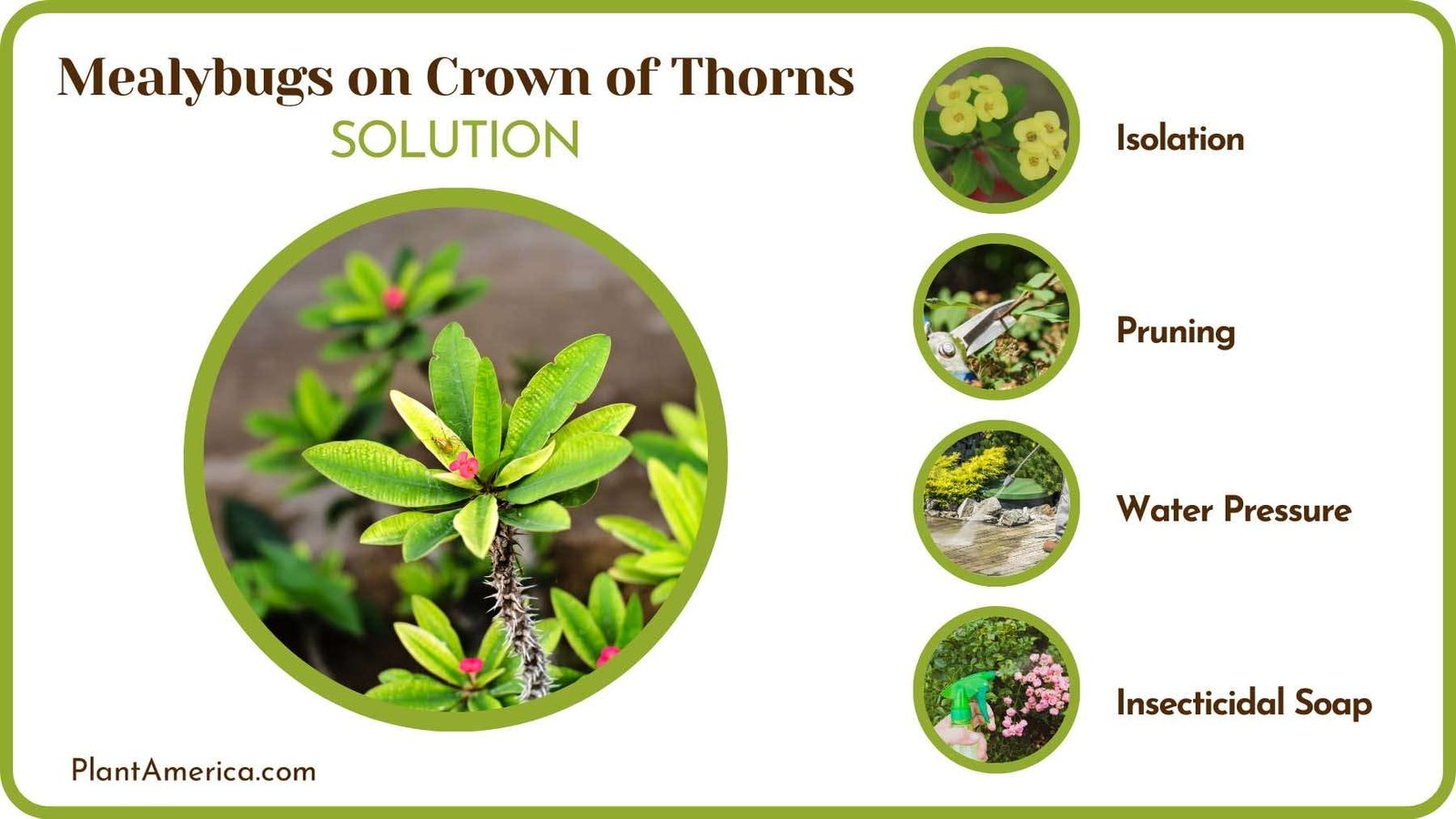
Monitor the solitary plant closely during this period for any indications of mealybugs or other pests. This waiting phase assists you in identifying any infestations that might emerge prior to introducing the new plant to your current ones. If no signs of pests manifest following this isolation period, feel free to incorporate the new plant into your collection.
– Water Pressure
This technique involves employing a focused water stream to dislodge pests from the plant’s surfaces. Mealybugs, which have soft bodies, can be easily dislodged without causing harm to the plant.
To use this approach, begin by relocating the infested plant to an area where water runoff will not result in harm or the spread of pests to neighboring plants. Then, connect a nozzle to a hose and generate a potent yet controlled water stream. Gently direct the water stream towards the plant’s leaves, stems, and the areas where mealybugs are present.
Make sure to thoroughly cover both the upper and lower leaf surfaces with the water, using enough force to eliminate the mealybugs without causing any damage. The pests will be dislodged and carried away by the water.
This approach works well for managing mild to moderate infestations and preventing mealybug populations from taking hold. It may be necessary to conduct regular checks and apply water pressure multiple times to ensure complete elimination of mealybugs.
– Insecticidal Soap
Insecticidal soap is a mild, plant-friendly solution used to control pests like mealybugs on plants, such as the Crown of Thorns plant. This soap functions by disrupting the insects’ cell membranes, leading to their dehydration and demise. It proves effective for managing mealybug infestations, particularly during the initial stages.
To use the insecticidal soap, start by ensuring the plant is adequately watered without being waterlogged. Prepare the soap solution following the instructions provided by the manufacturer. With a spray bottle, thoroughly cover the affected portions of the Crown of Thorns.
Include the undersides of leaves and even the Crown of Thorns flower clusters, as these are usually where mealybugs commonly conceal themselves. Allow the soap solution to remain on the plant for the recommended duration, typically around an hour. Subsequently, rinse the plant with water to eliminate any lingering soap residue.
Repeat this process as necessary, generally once a week or as directed on the product label. Prior to the application of the soap solution, test a small section of the plant to check for any unfavorable reactions.
– Neem Oil
Neem oil, sourced from the neem tree, offers a natural and efficient remedy for tackling mealybug issues on Crown of Thorns. This natural oil disrupts the growth, feeding, and reproduction of mealybugs while also acting as a repellent.
To use neem oil on your Crown of Thorns, make sure it’s stress-free and not exposed to direct sunlight. Mix neem oil with water, typically at a concentration of one to two percent, following the manufacturer’s instructions. You can also add a few drops of mild liquid soap to help the mixture stick to the plant’s surfaces.
Apply the neem oil mixture to the affected areas of the Crown of Thorns, covering both the upper and lower sides of the leaves, stems, and any crevices where mealybugs may be hiding. It’s advisable to reapply the solution every seven to fourteen days or as directed on the label.
Before treating the entire plant, perform a patch test, as some plants may be sensitive to neem oil. To avoid sunburn, apply neem oil during cooler parts of the day. Consistent and regular use is critical for effectively managing mealybug issues and preventing their return.
– Horticultural Oil
Horticultural oil is a pest control method used to combat mealybugs and other pests on plants. It functions by suffocating these soft-bodied pests, disrupting their membranes. This method works especially well against mealybugs since they are particularly susceptible to being smothered.
To apply, simply dilute the horticultural oil as per the manufacturer’s instructions, usually a one- to two-percent solution. Make sure to apply it evenly across your Crown of Thorns plant, covering areas where mealybugs are found, like the undersides of leaves and crevices. Be mindful not to oversaturate.
For ongoing management, reapplication every seven to fourteen days is recommended to address new hatchlings and effectively handle the infestation. To ensure safety, it’s a good idea to test the oil on a small section of the plant before applying it fully. Avoid using the oil on plants that are already stressed.
Apply the solution during cooler parts of the day to prevent the risk of sunburn. Always adhere closely to the instructions provided by the manufacturer and consider wearing protective clothing.
FAQs
– Can Mealybugs on a Crown of Thorns Spread to Other Plants?
Yes, mealybugs on a Crown of Thorns can spread to other plants. They can be transported by wind, human activity, or even on the backs of other pests. Isolate new plants and regularly inspect your collection to prevent the spread.
– Can Chemical Insecticides Be Used to Treat Mealybugs on Crown of Thorns?
Yes, chemical insecticides can be used to treat mealybugs on Crown of Thorns. These can be effective but should be used cautiously. Some chemicals can harm the plant. If choosing chemical control, opt for ones specifically labeled for mealybug control on Crown of Thorns and follow instructions carefully.
Conclusion
Now that we’ve covered how to eliminate mealybugs on Euphorbia milii extensively, let’s make a quick recap of everything:
- Mealybugs infest Crown of Thorns due to their structure, stressed plants, and nutrient-rich sap.
- Natural predators, environmental conditions, and human activity contribute to mealybug spread.
- Pruning, isolation, and manual removal are effective non-chemical control methods.
- Insecticidal soap, neem oil, and horticultural oil offer chemical solutions if used properly.
- Regular monitoring, plant health management, and proper plant care help prevent and manage mealybug infestations.
Use these techniques as part of your holistic plant care, and your garden residents will thank you for it!