

Echeveria afterglow of the Crassulaceae family is one of the most popular succulents that people grow as a houseplant.
We have collected tips from those who have extensive experience growing this Echeveria genus hybrid. Read ahead to find out what they are.
Echeveria Afterglow Cultural Needs
In order to grow and look after this ornamental succulent at home, you need to take care that it is kept under temperature and humidity conditions that mimic its natural environment.

You can learn how to do so here:
 Temperature
Echeveria Afterglow succulents grow best under warm conditions. Ideal temperatures are above 50 degrees Fahrenheit.
This plant does not tolerate extremely cold climates very well. While temperatures as low as 35 degrees Fahrenheit are well-tolerated, in case of further lower temperatures or a frost you will need to cover them up or move them indoors.
 Soil
Soil
Grow this succulent in well-draining soil to prevent potential fungal infections. We love planting ours in soil made up of cactus potting mix and sand. You can also plant it in the ground if the weather outside doesn’t get too cold.
Echeveria Afterglow Care
Caring for and growing Echeveria afterglow is very simple. You can do it all by yourself at home. Continue reading ahead to find out how.
 Light Requirements
- Afterglow Echeveria succulents love loads of bright light and full sun. This brings out their full color, which is a beautiful purplish pink with a brighter pink or red along the edges.
- Even if you don’t put this under direct sunlight, it grows well under partial shade too. When grown indoors, keep it near a window where it receives adequate enough light.
- We suggest placing afterglow succulents near an eastern or a western facing window. An eastern-facing window receives bright early morning sunlight whereas a western-facing window receives bright afternoon sunlight.
- Your plant should receive at least six hours of light whether planted indoors or outdoors.
- Keep rotating your plant every few days for uniform exposure to light.
 Water Requirements
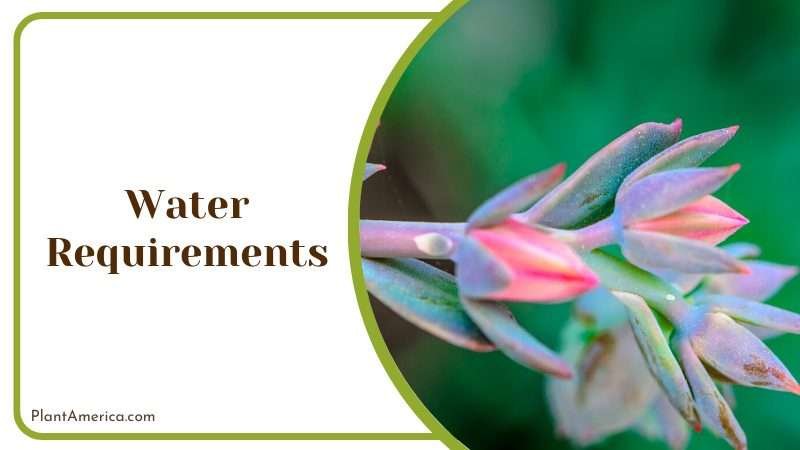
- Like all other succulents, afterglow too has stringent water requirements. Only water them once the soil is dry. At least the top 2 inches of soil should be completely dry.
- Use water that is not too heavily laden with chemicals. We always water our succulents with clean rainwater or distilled water. Don’t worry if you only have tap water to use. Just make sure it is cleared by the community guidelines to be safe enough.
- When watering, pour water on the soil and not the plant. Water thoroughly and make sure that it drains out completely. Your pots should always have drainage holes at the bottom.
- Most overflow plants need to be watered only once or twice a month during summer.
- In winter, you will need to water them even less. Once every two months should be sufficient.
- Misting is not a practice we recommend with any succulents. It can lead to brittle leaves, roots and also lead to fungal infections.
Propagation
You can propagate Echeveria afterglow either via offsets, stem cuttings, or leaves. All methods work equally well and effectively.
We usually recommend propagating through offsets or leaves. This is because a lot of people end up damaging the stem while cutting it.
– Propagating Afterglow by Offsets
- New offsets grow at the start of spring. Propagation is also best done during the April to May time period.
- Remove offsets using either clean hands or a sterile knife.
- Wash it to remove all remnants of the soil.
- Allow it to dry for a couple of days before planting it in the pot.
- Choose a pot that is of the appropriate size with a proper drainage hole.
- Water only as required to prevent overwatering.
– Propagating Afterglow by Leaves
- Choose a medium-sized, healthy-looking leaf for this purpose. Again, warmer weather is the best time to do this.
- Cut the leaf and clean it.
- Allow it to dry until calluses form on it.
- Now you can plant this leaf in the newly mixed soil.
- Put under bright light and water accordingly.
- If everything goes well, in a couple of weeks new roots and shoots should emerge.
Repotting
Over time, your succulent will outgrow its current pot and the soil will also run out of nutrients. Echeveria afterglow should be repotted every two years and not before that. The most suitable time to repot is during warmer periods.

Here are some useful pointers for repotting:
- Allow the soil to become thoroughly dry before repotting. This way the soil can easily be removed from the plant.
- Remove old dead and decaying roots. Be careful not to damage healthy ones.
- If there are lacerations in the roots, cover them with a fungicide to prevent potential fungal infections.
- Repot the plant in a new potting medium and keep dry during the first couple of weeks.
Problems
Echeveria afterglow, like all succulents, is a plant that can survive the harshest conditions. However, sometimes people do struggle with them as well.
Here are some common problems and how you can deal with them:
– Leaves Falling off Due To Overwatering
More often than not, leaves falling off is a sign of overwatering. You yourself will notice that the fallen leaves appear moist and mushy. Even the stem of such plants appears swollen up.
What To Do:
If you notice these danger signs, immediately hold back on watering before your succulent succumbs to the more serious problem of fungal rot. Allow the soil to become thoroughly dry and only then water your plant. If your potting mix is not well-draining, repot the plant immediately using a suitable one.
– Falling Leaves Due To Extreme Heat
Although afterglow is a warm growing succulent, very extremely hot conditions will also cause its leaves to shed off. This is sort of a survival mechanism of the plant to conserve water and energy.
What To Do:
In the event of very hot or dry weather, move Echeveria afterglow from direct sunlight to a shadier place. Preferably move them indoors. Water the plant as soon as the top layer of the soil starts appearing dry.
– Yellowing of Leaves
The leaves of Echeveria afterglow will turn yellow in case of both over and under-watering. If the yellowed leaves are swollen and mushy, then it is being caused by overeating. Conversely, underwatering causes yellow leaves that are wilting and shriveled.
What To Do:
Notice the condition of the yellowed leaves. Adjust watering accordingly. If overwatered, wait till the soil becomes dry to water it again. If underwatered, increase the frequency of watering.
– Fungal Rot
Fungal rot is a serious infection you can encounter as a result of prolonged overwatering or exposure to high humidity levels.

What To Do:
Remove the old dead and decayed part of the plant. Wash with a strong fungicide and keep from watering excessively.