
Winter will not be sad and gloomy anymore when you look around and find the stunning Cattleya trianae.
Flor de Mayo or Cattleya trianae is a beautiful orchid that is also the national flower of Colombia. The flower’s lip has hues of yellow, red, and blue, just like Colombia’s flag.
This easy-growing orchid is endemic to Colombia but can be found in many different countries today because of its widespread cultivation and transportation. It is one of the most widely cultivated Cattleya orchids.
Cattleya Trianae Care: Growth Requirements
Like most Cattleya hybrids, Cattleya trianae is also easy to grow. Follow our guide to know the exact requirements of this orchid and enjoy the blooms for years to come.
 Location and Light Requirements
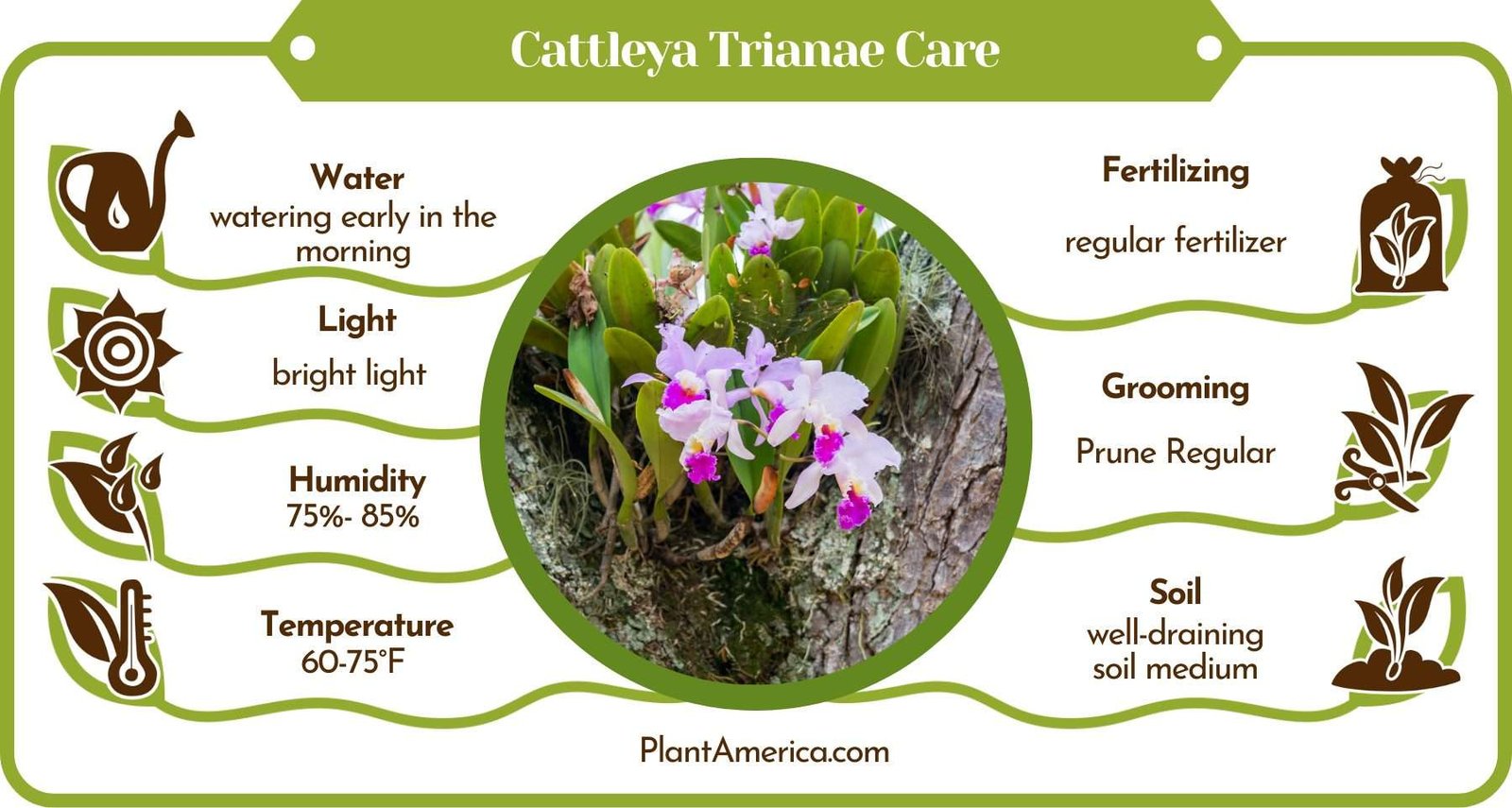
Flor de Mayo (May flower) loves to be in bright light. Bright light will help the plant to be healthy, which shows in the color of its leaves and pseudobulbs. Try to provide the morning sun to your plant for the best results.
However, never put your orchid in a spot that receives afternoon sun. Midday sun is harmful to the plant. If you are keeping your orchid indoors, keep it near a window sill where it manages to receive bright light throughout the day.
Avoid south-facing balconies and windows to prevent the leaves from burning. If you are keeping it in a south-facing window, ensure that you draw the curtains during noon.
Bright yellowish-green leaves and orange to red pseudobulbs are a sign that your plant is receiving the right amount of light.
 Water Requirements
Cattleya trianae likes to dry out a bit in between two successive waterings. Cattleya trianae is one such orchid that handles overwatering better than most other orchids. It is quite resistant to root rot.
As a basic rule, water your orchid when the top half an inch of soil has dried. Allow the soil mix to dry 60 to 80 percent in between watering, but it should not be completely dry.

Reduce the watering frequency when the plant is dormant and inactive. Increase the watering sessions as the orchid starts to grow again. Also, keep your orchid slightly dry during the rest period in the winter season to prevent root rot.
The gap between subsequent watering sessions has to be more than summertime watering. However, never let the soil mix completely dry out.
There is no particular time that you should follow to water your Cattleya orchids. But we recommend watering early in the morning as it gives the plant enough time to absorb moisture and helps in preventing problems like root rot and plant decay. Water your orchid using lukewarm or room temperature water.
 Ideal Temperature
Cattleya trianae is a hot to cool growing orchid. Stable temperatures without excessive heat or cold are the ideal temperature conditions for this orchid. Try to replicate the conditions that the orchid lives in its natural habitat.
The temperature should lie between 60 and 75 degrees Fahrenheit. It cannot tolerate temperatures lower than 50 to 55 degrees Fahrenheit and higher than 85 to 90 degrees Fahrenheit.
Cattleya trianae does not need a big difference in daytime and nighttime temperatures.

 Soil Mix and Type of Pot
Cattleya trianae grows well in light, well-draining soil medium consisting of fir or pine bark. Mix some perlite or charcoal to the bark chips to maintain enough drainage and ventilation around the root system.
Clay and terracotta pots are perfect if you are an over-waterer. Both these pots absorb the excess water from the soil mix. But if you want to keep a watch on your orchid’s root development and monitor the growth beneath the soil, plastic pots are the one for you.
Cattleya trianae is not too fussy, so you do not need to monitor the root development. We would recommend you to grow them in clay or terracotta containers.
Coming to the size of the pot, while repotting, make sure that the new pot is not too large. It should be about 2 inches bigger than the previous one. If the pot is too big, the orchid will focus only on developing the roots instead of flowering. As a result, there will be fewer blooms.
 Humidity Requirements
Cattleya trianae prefers a humidity level between 40 and 70 percent. If you have lower humidity levels in your home, try to increase the humidity around your orchid by grouping several plants, misting daily, and placing a humidifier near the plant.
Even though Cattleya trianae does not get root rot easily, keep the airflow high around the plant roots. The higher the humidity, the higher the ventilation around the root system should be.
To prevent problems like fungal infections and diseases, maintain good ventilation with high humidity. The plant is prone to get fungal infections if there is high humidity and no air movement.
In humid areas, use a fan to keep the air moving around your orchids. In dry areas, use more humidifiers than fans. The higher the temperature, the higher the humidity level should be, and vice versa.
 Fertilizer Requirements
Cattleya trianae is not a heavy fertilizer feeder. But regular fertilizer application will help increase the blooming. Use a well-balanced orchid fertilizer once every 15 days or so to keep the plant healthy.
A nitrogen-rich fertilizer helps promote leafy growth and less bud development. So avoid using a fertilizer that is too heavy in nitrogen content. During the active growth period, use one-fourth to one-half of the recommended dose on the label.
Avoid over-fertilizing as it causes the roots to burn and, eventually, the plant to die.
-
Repotting Cattleya Trianae
Do not repot your orchid unless absolutely necessary. If you want the blooms to be of the highest quality, then avoid repotting frequently. Unnecessary transplanting can make the plant go into shock.
Post autumn and winter, when you begin to see new growth in your orchid, it is a good time to transplant the orchid to a bigger pot.
If you notice that there are four to five pseudobulbs while shifting the plant to a bigger pot, you can divide the plant and propagate. Do not divide the plant if the pseudobulbs are less than four.
During the process of repot, be careful while handling the roots. Untangle them gently from the old soil mix and remove all the debris, moss, and bark chips before transplanting.
If there is any rotten or wounded root, cut it off and apply some cinnamon powder as it helps in recovery. Transplant the orchid in the new pot in bark chips and perlite and let it sit in the shade for a few days to let it recover from the transplant shock.
Problems
Cattleya trianae is a tough orchid, but sometimes it is prone to get infected by pests like aphids, mites, and mealybugs.

– Aphids
Aphids are quite common and attack the orchid’s new growth. You can avoid this problem by spraying soap water on the plant.
If there is a heavy infestation, use chemical treatment by applying pesticides before flowering occurs. If the orchid is outside, attract beneficial insects such as ladybirds and wasps that eat aphids.
– Red Spider Mites
Spider mites are so small that they are hardly visible to the naked eye. They thrive in warm temperatures and dry conditions. To prevent this problem, keep your gardening tools clean. In case of heavy infestation, apply insecticidal soap containing pyrethroids.
– Mealybugs
If you catch them early, mealybugs are relatively easier to get rid of. For light infestation, pick them up using tissue paper and wash the plant. If it is heavily infected, chemical soap application may be required.
You can also use organic neem oil mixed with water to eliminate all the pests mentioned above.