
Anthurium luxurians of the Araceae family has the largest and the fanciest leaves ever. It is also one of the most expensive houseplants in the world these days. We bring you fail-proof tips to propagate this Anthurium genus plant into several baby plants.
Give this guide a thorough read to learn how to reproduce as well as care for this tropical wonder plant.
What Are Anthurium Luxurians?
Anthurium Luxurians is one of the rarest and most spectacular-looking species out there. Its textured dark green leaves look a bit like Anthurium crystallinum except that they are heart-shaped. Their glossy appearance makes them one of the most sophisticated houseplants to own among the Anthuriums types.
Anthurium Luxurians Care
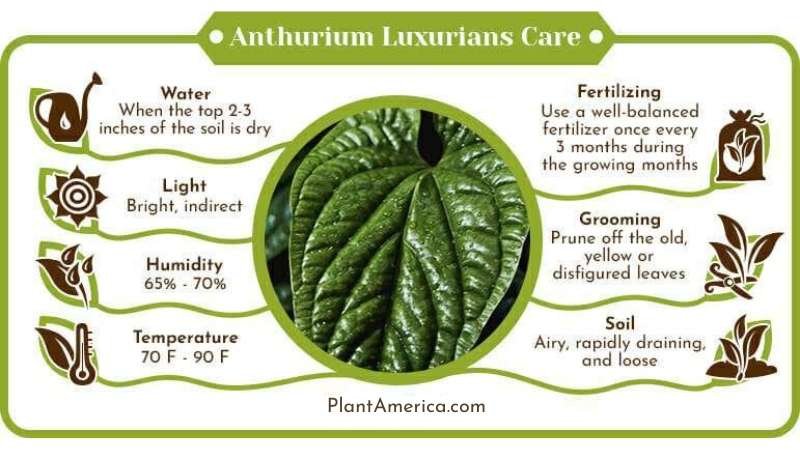
Luxurians’ plant care needs include putting it under indirect but bright light at 70 to 90 degrees Fahrenheit. Water this plant when the topsoil dries with filtered or distilled water. Humidity levels need to be high, up to 80 percent all year. Only fertilize every third month during the growing period with diluted fertilizer. All you have to do is keep reading all the care requirements in their respective sections below and keep your Anthurium plant for many years.
 Light Requirements
Bright but indirect light is the safest and most suitable for Anthuriums. When kept outdoors, ensure a shade or a more enormous tree to keep direct light from falling on it. Direct sunlight causes dry, thin, wrinkly leaves to turn brown at the edges.

Inside the house, you need a room with proper windows that let in sunlight for at least seven to eight hours per day. Keep two to three feet away from the eastern or the western windows. Keep four to five feet away from the harsher southern-facing window.
Artificial grow lights are equally effective for the growth of this plant. A cost-effective approach is installing a couple of LED lights above where the pot is kept. Artificial lights will have to be kept on for 13 to 14 hours straight to grow Anthurium luxurians size to its maximum potential.
 Water Requirements
Watering this plant is the trickiest part of growing this rare species. It needs a good amount of water yet does not tolerate overwatering. Instead of trial and error, use our guide to learn how best to water it. In a region with moderately warm summers, you will need to water Luxurians every nine days or so.
In a geographic region where the summers are extremely hot and dry, the watering frequency will have to be done every three days. Of course, in winter times, the watering frequency will have to be reduced much less than this. That is why you must make it a habit to always check your soil before watering.
One straightforward approach is to insert a finger in the soil up to the knuckle. This will estimate the dryness within the top two to three inches of the soil. A pencil or a stick instead will enable you to check the soil’s moisture on a much deeper level. Don’t just insert any blunt object blindly into the soil. Instead, insert it near the rims where the chances of root damage are lesser.
One hundred percent reliable results can only be obtained by a moisture meter. This instrument, too, has a rod that is inserted into the soil. It gives you a reading that you can then correspond with watering according to a given manual.
 Soil Requirements
What luxurians want is airy, rapidly draining, and loose potting soil. The soil should preferably be chunky, so there is no room for water accumulation. Spaces within the soil also make it easy for the plant to grow.

Start with taking 20 percent of the orchid potting mix from the market as the base material. In order to add more chunks to it, add medium to large pieces of bark to it. The bark should ideally constitute about 50 percent of the soil.
To increase porosity at a lower level, add 30 percent perlite and mix well. Perlite actually looks like small, round balls. Its additional advantage is that it contributes a little to water absorption and prevents the soil from drying too quickly.
Please cover the surface of your soil with a layer of moss; it is optional. This will again help retain a little moisture. Moss will also break up over time to provide nutrients to the soil. Lastly, pouring a layer of gravel into the pot before adding this soil mix will help prevent the blockage of drainage holes.
 Temperature Requirements
Keep the temperature within 70 to 90 degrees Fahrenheit. Maintaining these moderately high temperatures during the summer months will be easy. The problem arises when winter falls, and the temperature drops below 50.
It is optimal to move this plant indoors during this time. Inside the house, never keep an Anthurium directly under a vent or an air conditioner. One mistake we see people making is keeping the windows open at night. Your plant will go into cold shock and start dropping its corrugated leaves.
 Humidity Requirements
Bullate plants like Anthurium Radicans and luxurians like 80 percent humidity levels. High moisture levels keep their leaves healthy and plump. Most areas in the US have air humidity levels bordering around 65 to 70 percent. This will require you to put in some effort as you will have to artificially increase the humidity around your precious luxurians.

Some humidifiers may be a little costly, however, to take different measurements for the humidity, you may retain from humidifiers and instead, the easiest thing to do is to mist these big leaves regularly.
This will need serious commitment on your part, though. Use only a small nozzle to moisten the leaves from afar every third day lightly. The best time to mist plants is during the early morning hours.
Additionally, you could buy a pebble tray to put under the potted plant, additionally, you can also make your own tray, and it’s really easy. You will have to change the water in the tray weekly so it doesn’t get stagnant.
If you own a humidifier, your life will get so much easier. A humidifier will run 24 hours daily to maintain 80 percent humidity around the clock. Just get ready for slightly increased electricity bills.
 Fertilizing Requirements
The good news is that the luxurians plant isn’t big on feeding. We know many of you must sigh a breath of relief at this. You will only need to fertilize it once every three months and during the growing months. You and your plant can rest a bit for the rest of the year.
We recommend liquid fertilizer over solid forms. They can and should be diluted by adding water. Dilute them up to one-fourth of their initial strength. This makes them safer concerning over-fertilizing.
You can buy and use a well-balanced fertilizer for Anthuriums. This has equal quantities of the three main nutrients: nitrogen, phosphorus, and potassium. However, some of you may be more inclined towards blooms and want your plant to flower. Go for a fertilizer that has higher phosphorus and lower nitrogen content.
As we said above, you must dilute the fertilizer before use. It also helps to water the anthurium soil just before fertilizing. Pour fertilizer only on the surface of the soil. The leaves and stems can be sensitive when it comes to feeding.
For newly potted Luxurians, take a six-month break before feeding. This is because freshly mixed soil already has nutrients present. Nonetheless, if you cover the soil surface with moss or mulch, they tend to break down and provide nutrients.
 Pruning Requirements
Keep your plant clean by wiping it off with a dry or slightly damp almost weekly basis. It will keep this plant looking glorious and luxurious. Dirt accumulation on the leaves can also deter your plant from proper ventilation and photosynthesis.

Another aspect of grooming is to prune off the old, yellow, and disfigured leaves during the growing season. This will reroute water and food to newer stems and leaves. Your plant will see better growth with regular pruning and snipping.
Propagation
Given this plant’s rare and expensive, it is only natural that you should learn how to propagate it. Luckily, it can be propagated via three easy methods. We have explained each of these methods in a step-by-step manner below.
Collect seeds for propagation from Anthurium luxurians flowers at the end of the bloom season. You can also order them online but take care that it is from a trusted source. It is easy to pot the seeds in a few simple steps. Start by taking a small pot in the beginning and filling it with the same soil as an adult plant.
It is best to soak the seeds in water for a few hours before sowing. Sow the Anthurium luxurians seeds in the soil reasonably without burying them too deep. Lightly sprinkle water over the chunky soil to moisten it. Then, move the plant to a greenhouse or cover it with a plastic sheet to maintain the high humidity levels.
In two months, many of these seeds will germinate and sprout fresh shoots. When the shoots grow a little larger, carefully remove each tiny Anthurium plant and place it within its pot.
Problems
Because of high Anthurium Luxurians prices, even common problems can be distressing for the owner. Carry reading to learn how to deal with Luxurians’ toxicity, pests, and over-fertilizing.
– Toxicity
This rare plant is toxic to both eating and touch. You need to be watchful with it, especially if you have kids and pets at home. If your pets accidentally eat any part of this plant, they will suffer from mouthburn, vomiting, diarrhea, and cramps.
In humans, accidental ingestion can cause mouth burning and abdominal cramps, along with vomiting in mild cases. In severe cases, a life-threatening airway obstruction might ensue. Even touching this plant bare-skinned is not a good idea. Depending on your skin’s sensitivity, you might have to deal with redness, rashes, or blistering on the exposed parts.
Because of its bitter taste, it is unlikely that the pet or kid will chew a lot of this plant. Immediately wash the mouth and the area around it with copious water. Give the pet or kid milk to drink along with an anti-allergic medicine.
The milk helps alleviate the burning. Contact your vet or primary care physician and see if you need to visit them. If you are suffering from skin rash or burning, wash it first. Then apply a pain-relieving ointment to it. Do take proper preventative measures the next time.
– Pests
For Anthurium growers, pests are a recurrent problem. The pests you need to be on the lookout for are sap-sucking ones like mealybugs, aphids, and spider mites. Most of these bugs form colonies under the large, broad leaves and stem sheaths and proliferate abundantly.
Attentive plant parents who regularly keep their plants clean will be able to spot a pest infestation early on. You might catch the larger ones, such as mealybugs and spider mites lurking under the leaves.
In some cases, puncture points can also be spotted on the leaves if you look closely. The most common signs are the appearance of tiny yellow spots on the leaves. In prolonged cases, your plant will suffer greatly and lose its foliage and growth.
All the adult pests must be removed manually from the plant’s body. Wash the plant with water mixed with a good insecticidal soap. Use a soft-bristled toothbrush to scrub the large leaves over and under their surface. Make sure that all the pests that are being removed are washed off in a drain.
Secondly, take a DIY approach by using neem oil to kill the leftover pests and their larvae. Only apply a few drops using a Q tip on each leaf and under the leaves at a time. This application needs to be done once each week for about a month.
– Over Fertilizing
Because Luxurians isn’t a heavy feeder, it is easily susceptible to over-fertilization. If you are fertilizing it more than once per three months in the growing season or not diluting it, then this is a problem.

One possibility is that the plant will develop fertilizer-induced chemical burns. This causes an abrupt yellowing of the leaves. The edges turn brown and curl at the edges. In the case of a nitrogen-rich fertilizer that is not diluted, you will fail to see any flower bloom when the time comes. The leaves, on the other hand, turn a bit darker consequently.
Final note:
It is a tropical plant and difficult to propagate and care for in non-native regions. Secondly, most of the Anthuriums in the US are supplied from Hawaii. The high cost of transport naturally increases its price.