
Cattleya is one of the most popular types of orchids not just because they are commonly used to make corsages but because most orchid enthusiasts probably started growing them first as beginners.
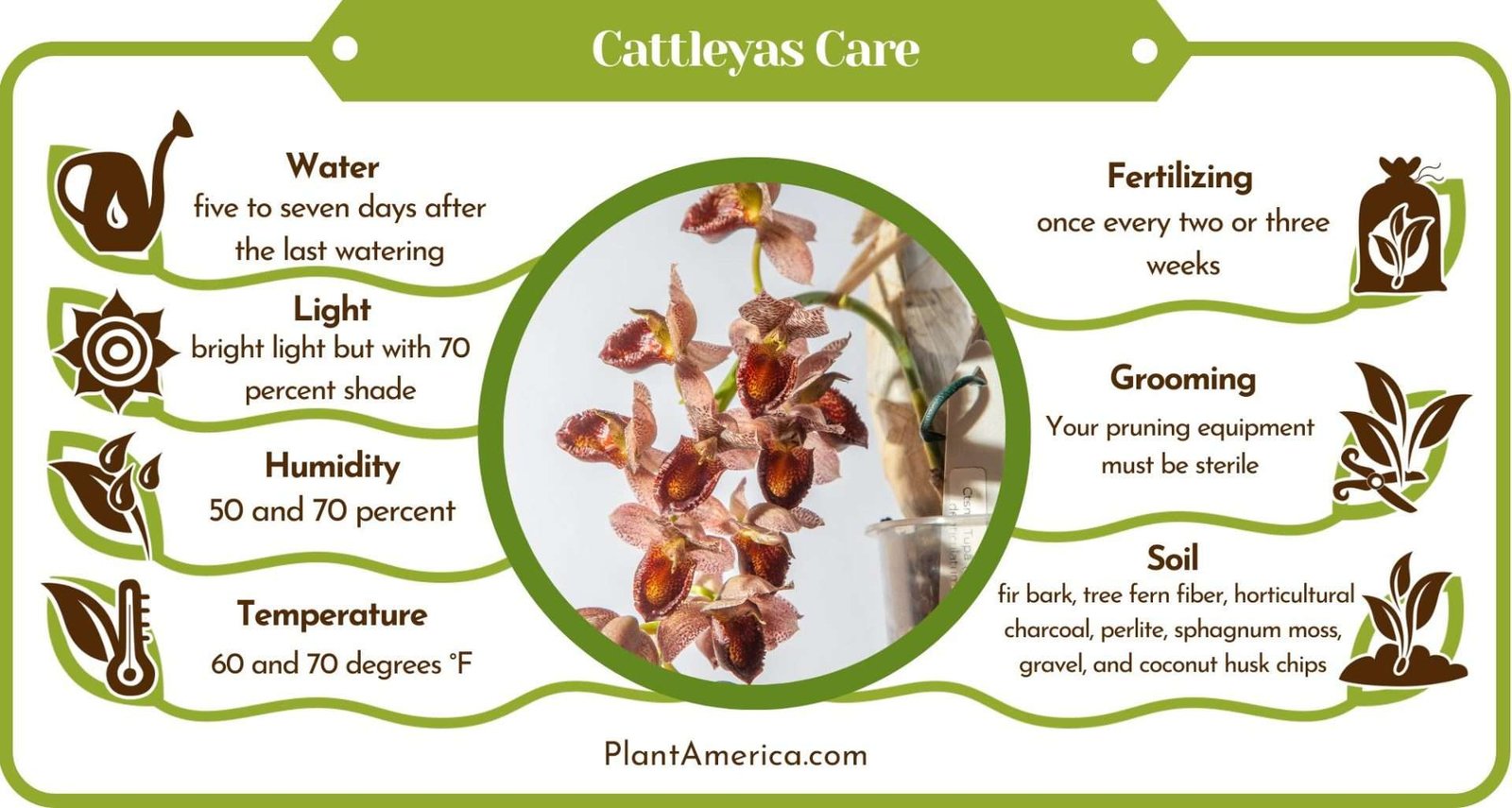
The “Queen orchids,” as they are fondly called, are big, bold, and beautiful and are more appealing because they don’t have complicated growth requirements. In our care guide we will explore everything you need to know to grow these orchids successfully.
Cattleya Care and Specific Conditions
- Soil: Use a well-draining mix of charcoal, sphagnum, and perlite.
- Watering: Provide consistent hydration.
- Light: Provide bright, indirect sunlight
- Temperature: Maintain temperatures between 60-75°F
- Humidity: Keep high humidity, around 50-70%
- Fertilizer: Feed with a balanced orchid fertilizer every 2 weeks
- Repotting: Every 2-3 years or when the pot becomes overcrowded.
 Water Requirements
The cattleya orchid uses pseudobulbs to store water, so they don’t have high moisture needs. They should only be watered when the potting medium has gone dry, typically about five to seven days after the last watering, which is why watering them weekly is sufficient. However, certain factors, such as low humidity and extreme heat, will require you to increase the frequency of watering.
You may also try to increase the watering needs to twice weekly when the orchids are in their growing season and are about to bloom. Never let the orchid sit in water to prevent them from developing root rot, and to encourage them, watering them in the morning is also best, giving them time to dry out before nighttime.
 Soil Requirements
As with many epiphytic orchids, these too must be grown in a coarse, well-draining medium that holds moisture.
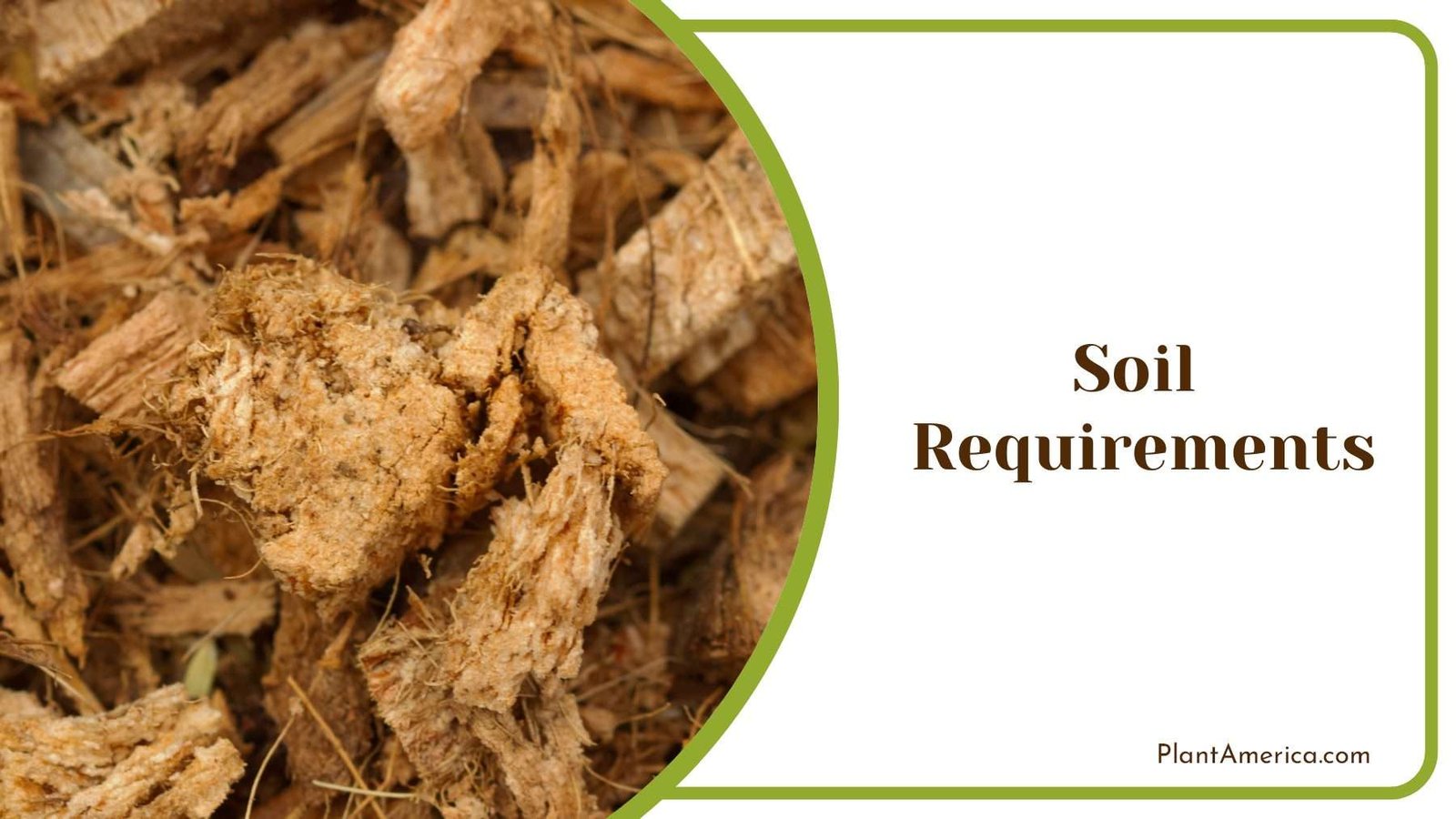
A suitable potting medium for these orchids can contain a mix of fir bark, tree fern fiber, horticultural charcoal, perlite, sphagnum moss, gravel, and coconut husk chips.
 Light Requirements
These are the type of orchids that will thrive in bright light but with up to 70 percent shade. Indoors, you can place them on an east-facing window but with a sheer curtain to dampen the light. They can receive direct sunlight from the early morning sun if grown outdoors; however, from midday, when the sun is most intense, they should be shaded, and when the season is colder, it is best to take them indoors.

Cattleyas will have dark green leaves when they are not receiving enough sunlight and might not flower. Their leaves will get burnt and turn bright yellow or black on the tips if the light intensity is too high. But with just the right amount of sunlight, their foliage will have a bright green color.
 Temperature Requirements
Although cattleyas are commonly found in tropical areas, they are adapted to inhibit in cooler temperatures. As a result of the latter, daytime temperatures in summer should range from 65 to 85 degrees Fahrenheit to 60 to 65 degrees at night. In winter, anywhere between 60 and 70 degrees Fahrenheit during the day and 55 to 60 degrees during the night.
Moreover, they can tolerate high temperatures for a short time, but prolonged exposure can cause their leaf tips to die back. Hence, they should be exposed to the maximum temperature is 100 degrees Fahrenheit, while the minimum is 55 degrees.
 Humidity Requirements
For this plant to thrive, the humidity levels should be maintained between 50 and 70 percent, and they also require good air circulation, which must be provided when growing them indoors. You can use a humidifier or place the orchids in a humidity tray filled with pebbles and water to achieve such humidity. Moreover, misting your plants regularly in the morning, significantly when intense temperatures, can help increase humidity.
 Fertilizing Requirements
For cattleyas, a balanced orchid fertilizer with a 10-10-10 formulation can be used weekly for quarter or half strength during the growing season. For best results, fertilize your orchids when you’re watering them. However, weekly feeding can accumulate salt, damaging the plant’s roots.
Remember that you must flush the potting medium with plain water every third watering. After the growing season, fertilizing can be reduced to once every two or three weeks.
 Pruning
When it comes to pruning, it can be done by cutting off the root or rhizome that looks weak already. Cut half of the rhizome open, in between two of its eyes. The plant will grow another eye in the wound created on the rhizome, which eventually becomes a new pseudobulb.
You should also remove dead or diseased leaves to keep your plant presentable and improve air circulation. Your pruning equipment must be sterile. Otherwise, your orchid could develop diseases and fungal infestations.
Propagation Ways With Success
– Division
You can propagate the beautiful orchid can be done by dividing their pseudobulbs after flowering. Mature plants usually develop many pseudobulbs, so you can remove the plant from the pot and divide it by the root into clusters, with at least two pseudobulbs in each group.
If there are dead or decaying roots, cut them off using sterilized equipment so they don’t develop fungal or bacterial diseases. Run the primary roots under tap water to clean out any old substrate still on the plant. Remember to spray with a fungicide and re-pot each cluster in its medium.
Problems and The Quickest Fixes
– Black Rot
Black rot is caused by pythium ultimum, and phytophthora cactorum fungi and cattleyas are particularly susceptible to this disease. The disease manifests as black spots or lesions on affected plant parts, such as the roots and leaves, and quickly travels to other parts. These pathogens often swim in the water of soggy plants and can easily infect other plants when water from infected plants is plashed on healthy ones.
New growths are more susceptible to attack by black rot, but the disease isn’t evident in them and will cause them to die. It manifests as small black spots in mature plants and eventually spreads out.
To keep away from this disease, it is crucial to maintain good hygiene around your cattleya orchids and allow enough air movement when humidity is high. You should also cut away and dispose of any affected plants at the first sign of the disease.
– Spider Mites
These pests are tiny insects related to spiders that damage cattleyas by sucking on the liquid nutrients in their tissues. They are usually often found on the undersides of leaves and produce a silk web where they are located.
Because these insects are as tiny as a pin’s head, it is difficult to identify them. The presence of silk webs on the underside of leaves is a good way to identify their presence. The orchids that are infested with these mites will have yellowed or bronzed leaves that eventually drop, and this is why you should go ahead and prune them out.
However, if the development of the plants gets heavily infested might become stunted and die. One effective way to get rid of them is to spray infested plants with a forceful jet of water regularly. Introducing their natural predators, such as lacewings and lady beetles, to feed on them can also be effective.
– Botrytis Blight
Botrytis, a commonly known mold that is called the gray mold, and it is a fungal disease that causes small spots on cattleyas. This disease is prevalent when the temperatures are low, humidity is high, and there is little air circulation. This mold does not manifest immediately; on the contrary, it infects the orchid. Instead, plants begin to develop symptoms a few weeks after infestation.

Initial symptoms appear as small, brown necrotic lesions on the foliage or flowers of cattleyas. As the disease progresses, the spots increase and develop pink edges, eventually allowing the plant to wilt and die. To control this disease, you must prune and dispose of infected cattleyas using sterilized equipment, and make sure that you would apply a fungicide on the remaining plants.
– Scales
Scales are some of the most notorious orchid pests that are common to the blossoming plant. This insect has many species, but the Boisduval scale is the specie common to cattleyas. They are brown, soft-bodied scales usually found on the undersides of the leaves and damage the plant by sucking on sap and leaving behind honeydew.
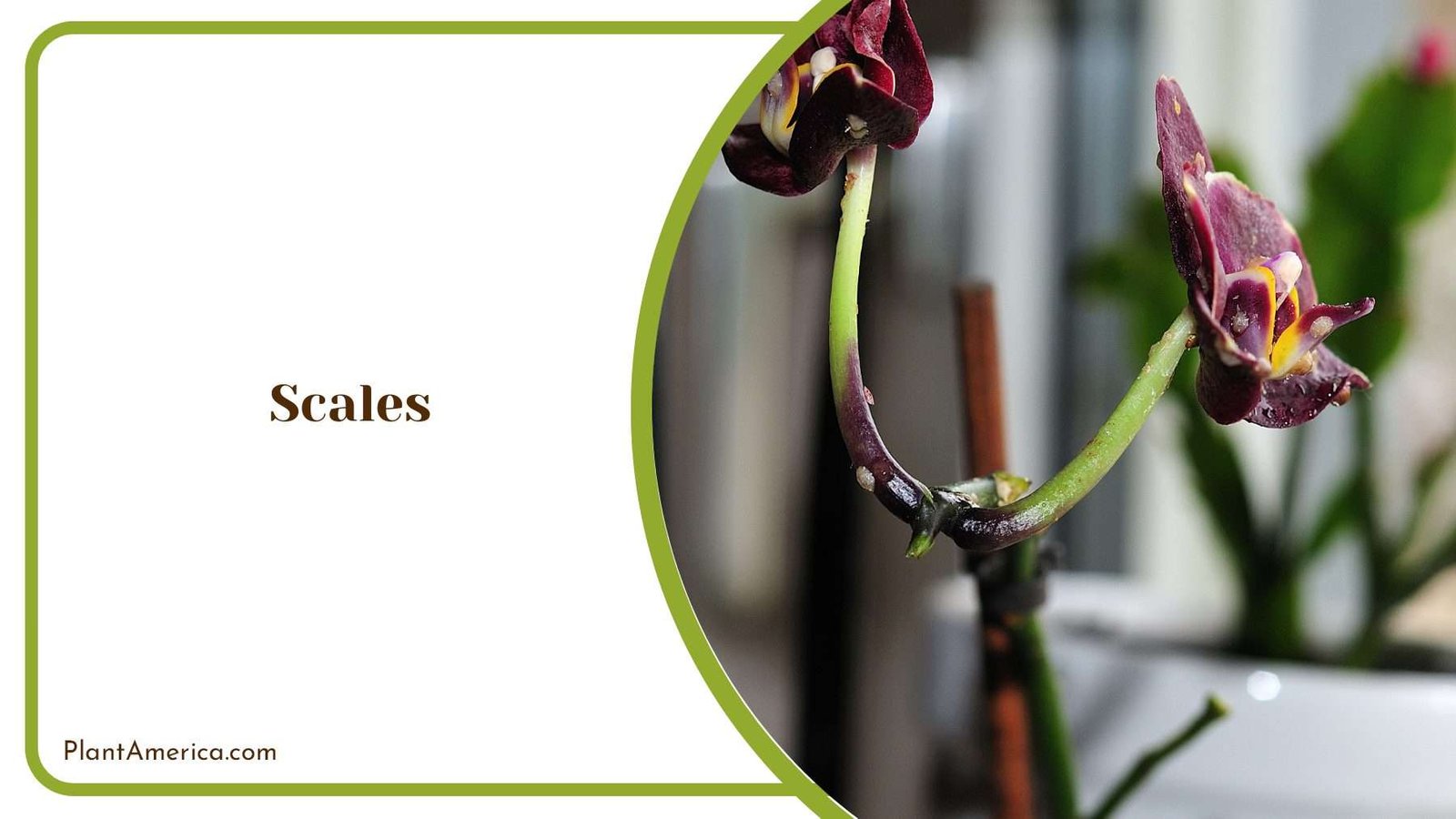
If your plant are infested with scales, you can treat them by spraying them with a mixture of alcohol and water. Or by applying Neem oil on the scales directly. For large infestations, you can purchase an insecticide.
Conclusion
Growing cattleya orchids is very fulfilling when you get the growing conditions right, and they begin to bloom with their magnificent flowers, filling your home with their sweet fragrance. To help you remember, here’s a highlight of what we’ve discussed the orchid’s plant care:
- The pseudobulbs of cattleyas are large, so they don’t have high moisture needs.
- High humidity, low temperatures, and little air circulation can result in the development of fungal diseases like black rot and botrytis.
- Cattleyas should only receive direct light from the early morning sun and should receive shaded light from midday.
Since cattleyas are so popular, their over 40 species are widely available for you to choose from. But you can get started with popular ones like the cattleya mossiae and cattleya labiata.