
When weeping willow tips are turning brown, you may be worried, as you are seeing your trees in distress. The problem is easy to fix, you just need to know the cause.
 Thankfully, these trees are easy to fix when they are sick. Read this article to learn how to fix your weeping willows with brown tips.
Why Your Weeping Willow Tips Are Turning Brown
Your weeping willow tips are turning brown because of unsuitable growing conditions, diseases, stress from external factors, or poor cultural practices. These majestic trees may be hardy, but bring out their beauty only in suitable environments. Therefore, always check the environmental conditions of your trees.
– Soil Quality Problems
This is especially true for young weeping willow plants. Did you check the soil pH, type, aeration, and other factors before planting your trees? If these majestic trees are not growing in the right soil, you can tell through the color of their leaves. You can only get perfect leaves in the perfect environment.
To know the exact quality of soil affecting your trees, you have to check your soil and compare its qualities with the requirements of your willows. For example, check if the soil pH is in the preferred pH range of willows. Also, try remembering when you last amended your soil.
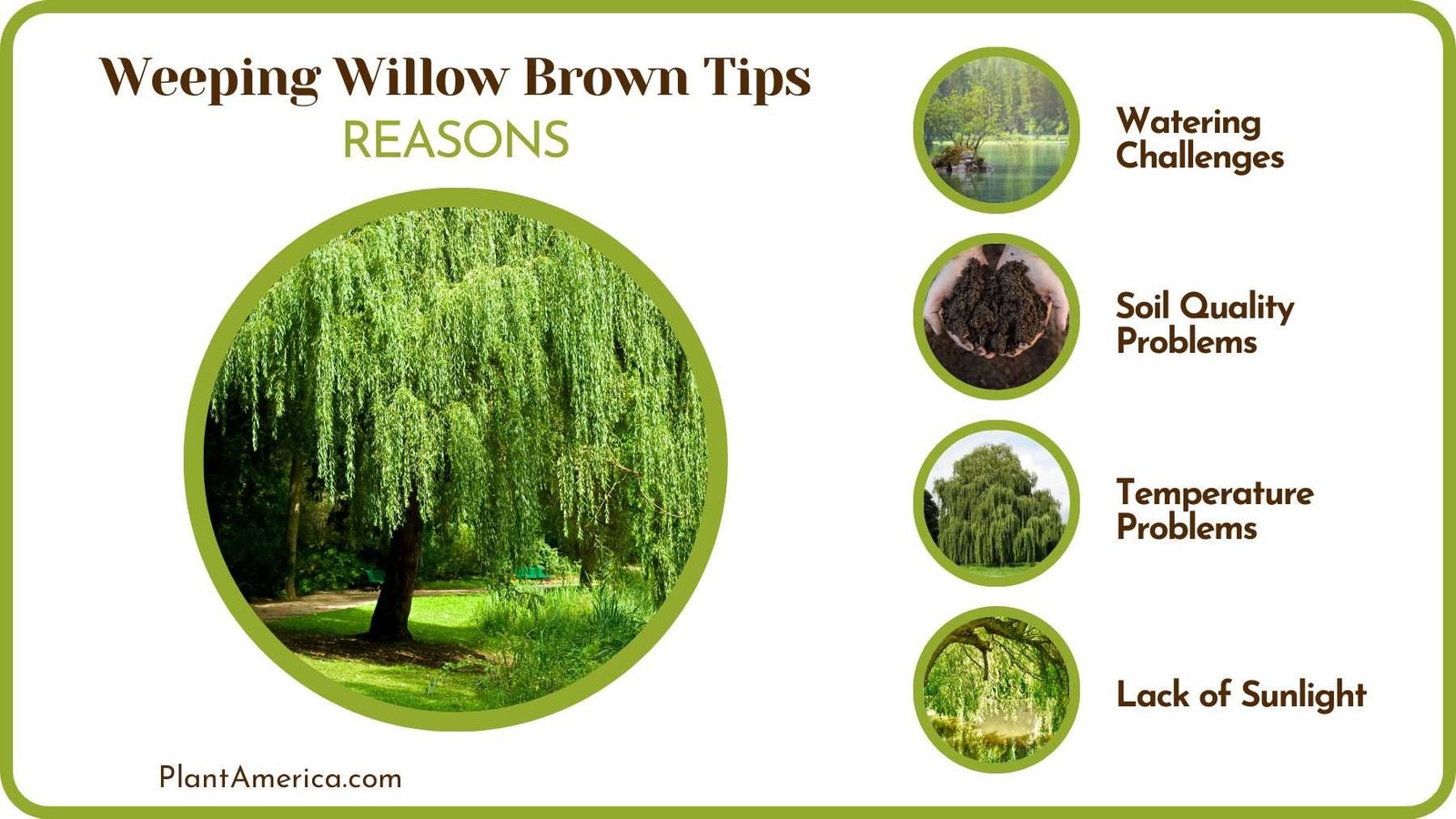
– Temperature Problems
Outside soil quality, temperature is among the most important weeping willow growing conditions to check. As a growing condition, temperature is responsible for most of the growth processes that occur in plants. In the wrong temperature, your plants will not just have brown leaf spots, they will also have stunted growth and die.
This is why you must consider the hardiness zone and temperature needs of your plants before you start growing them in the first place. As for young willows, you may notice that the summer temperatures might be too extreme for them. In this case, you have to come up with a strategy (stated below) to help them.
– Watering Challenges
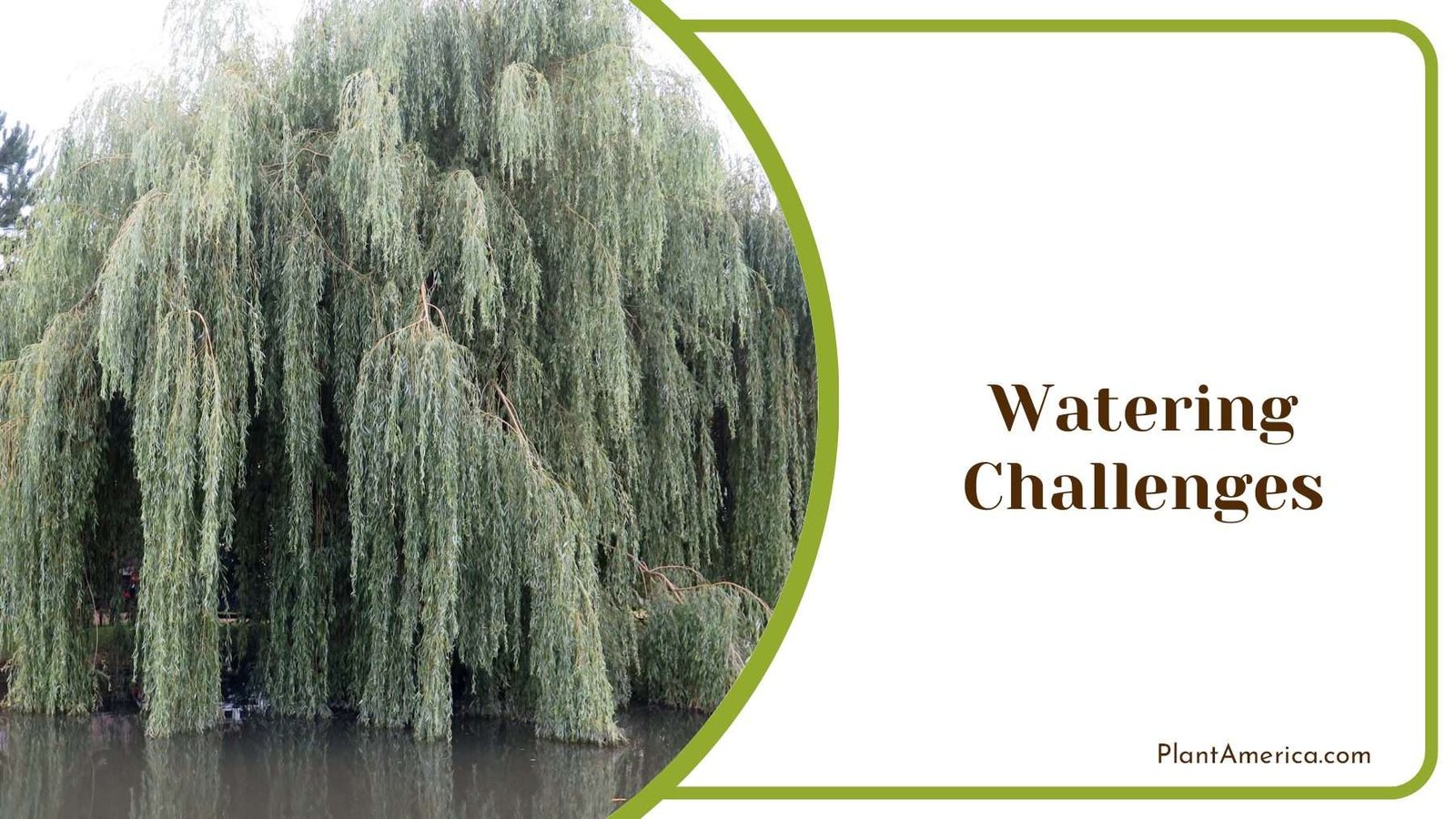
The watering needs of your weeping willow are also worth considering whenever you see the tree tips becoming brown. Remember that water is responsible for the hydration and freshness of your trees. If your trees are becoming brown, it is most likely because they are unable to collect water from the soil, make use of the water from the soil, or collect as much water as they consume.
For example, when the temperature increases significantly, plants collect more water to increase the rate of transpiration. If there isn’t water available in the soil, especially for young trees, the trees will get some brown to discolored tips. It is unlikely for mature trees because they have very long roots and can collect water from the soil even if the soil surface looks dry.
– Lack of Sunlight
When selecting the exact spot to grow your weeping willow, did you put the availability of sunlight into consideration? Remember that tree leaves are green mostly because of light availability. When there is enough light, photosynthesis can properly occur and the leaves will turn green. Without light, however, the leaves might become pale.
If, after a few days, there still is not enough light exposure for your trees, those pale leaves will either drop or turn brown. Therefore, if light insufficiency is the reason for your tree’s brown tips, the leaves might already be dying before you find out what the exact problem is.

– Overexposure to Sunlight
Considering the previous point, you might be tempted to think that your new weeping willow will grow better and fresher when you select a spot that has access to all the amount of light in a day. However, this is mostly bad for your trees, as willows cannot grow beautiful green leaves in a harsh environment. Their leaves will become brown.
When light gets too much, it might force the trees to increase their rate of photosynthesis. If the available light is still overwhelming for the cells in your tree leaves, the cells may die and this will lead to brown spots. Also, overexposure to light is associated with very high temperatures and this is harmful to plants.
– Stress From External Factors
If you have checked all the growing conditions and still can’t find what’s wrong with your trees, it’s high time to just sit and watch the trees. Sometimes, the problem can be humans (i.e., other people) and others in the tree’s environment. For example, people might pluck or cut some leaves of the tree. If this continues for long, your trees, especially young ones, will get stressed.
Aside from people, you also have to consider pests. To check for pests, you have to go close to the tree and observe their leaves. You may need to check your trees both during the day and at night, as the different types of pests attack trees at different times of the day. If you find pests that are known to eat willow leaves, you just might have found the culprit.
– Diseases
Diseases are worth considering for your weeping willow. This is because almost every disease will lead to brown tips appearing in your willows. For example, willow scab is a popular disease that discolors the tree leaves. Other popular diseases such as powdery mildew also affect your willows. These diseases come in different forms but will ultimately cause brown leaves or spots.
Some diseases are caused by bacteria while others are caused by fungi. Note that weaker trees are more susceptible to diseases than stronger trees. Therefore, check that the growing conditions of your trees are optimal for them. Trees growing in optimal conditions can easily fight diseases.
How to Fix Your Weeping Willow Tips Turning Brown
To fix your weeping willow tips turning brown, check and fix all the unsuitable growing conditions. Also, try to treat the disease of your trees. Note that you must know exactly what is wrong with your trees before you attempt to fix them.

– First Consider the Growing Conditions of Your Willows
Before you start fixing your weeping willow, check that its growing conditions are ideal. This is because even after you treat the plants, if they are still growing in the wrong conditions, they will still turn brown. To prevent this, you must first ensure that the conditions are ideal for your trees. Therefore, check as many growing conditions as you can.
Some growing conditions worth checking are temperature, humidity, soil pH, soil moisture, soil type, and others. If you find one unsuitable growing condition for your trees, try to fix it first. After fixing it, you can proceed to treat your trees.
– Feed Your Trees When They Need Nutrients
Don’t stop providing nutrients to the soil for your weeping willow even when the tree matures. Even though the tree has very deep roots and can search for nutrients, try to remember how the soil was when the tree was young. If the soil was not very nutritious and you had to regularly feed your trees when they were young, you have to occasionally feed the trees now that they are old.
 A soil that quickly loses its nutrients when your trees are young will quickly lose its nutrients even after your trees mature. Therefore, don’t entirely stop your feeding culture when your trees mature simply because you feel that with their long roots, they can get as many nutrients as they need from the soil. Continue feeding them occasionally.
– Regularly Water Your Young Trees
When your weeping willow is young, it still needs your full care. To prevent dehydration that will lead to brown leaves or tips, water your young trees regularly. This will help them stay fresh. Water them every three days or so depending on the season and how loose the soil is.
If you cannot regularly water your trees by yourself, install a sprinkler system for them. This will help ensure that your young trees have access to enough water. As they grow old, they will stop depending fully on you for their watering needs. Therefore, you don’t have to continue watering your trees for a long time.
– Check and Amend the Soil
There are so many amendment products for your willow tree. For example, compost will help boost soil nutrition, aeration, and count of good microbes. Some amendment products will help increase or decrease the soil pH. These products are important so that you can fix your soil by yourself.
However, note that you must know the exact condition that needs fixing. For example, if the soil pH is ideal for your trees and you increase it significantly, it will affect your trees. Therefore, ensure that you do a soil test. You can take samples of soil from your yard to a lab for full analysis or analysis relating to the growth of plants.
– Be Careful With the Tree Roots and Leaves
Remember that people can be stressors for your trees. For example, tree roots can be heavily damaged during the construction of a new building. This will surely affect your trees. However, if the roots grow back, the effect of the construction will be temporary on your trees.
The bottom line is that you should try as much as you can to avoid stressing your trees, especially their roots. As for the leaves, prevent people from plucking or cutting them at will. Doing this will prevent the tree leaves or tips from becoming brown. It will also keep your trees healthy and fresh for a long time.
– Treat Your Diseased Trees
If the brown and discolored leaves in your trees are caused by a disease, you have to treat it so that other leaves don’t become brown. As in the case of growing conditions, you first need to know what is wrong with your trees before you start treating them. Don’t use chemicals for a bacterial infection to treat a tree with a fungal disease.
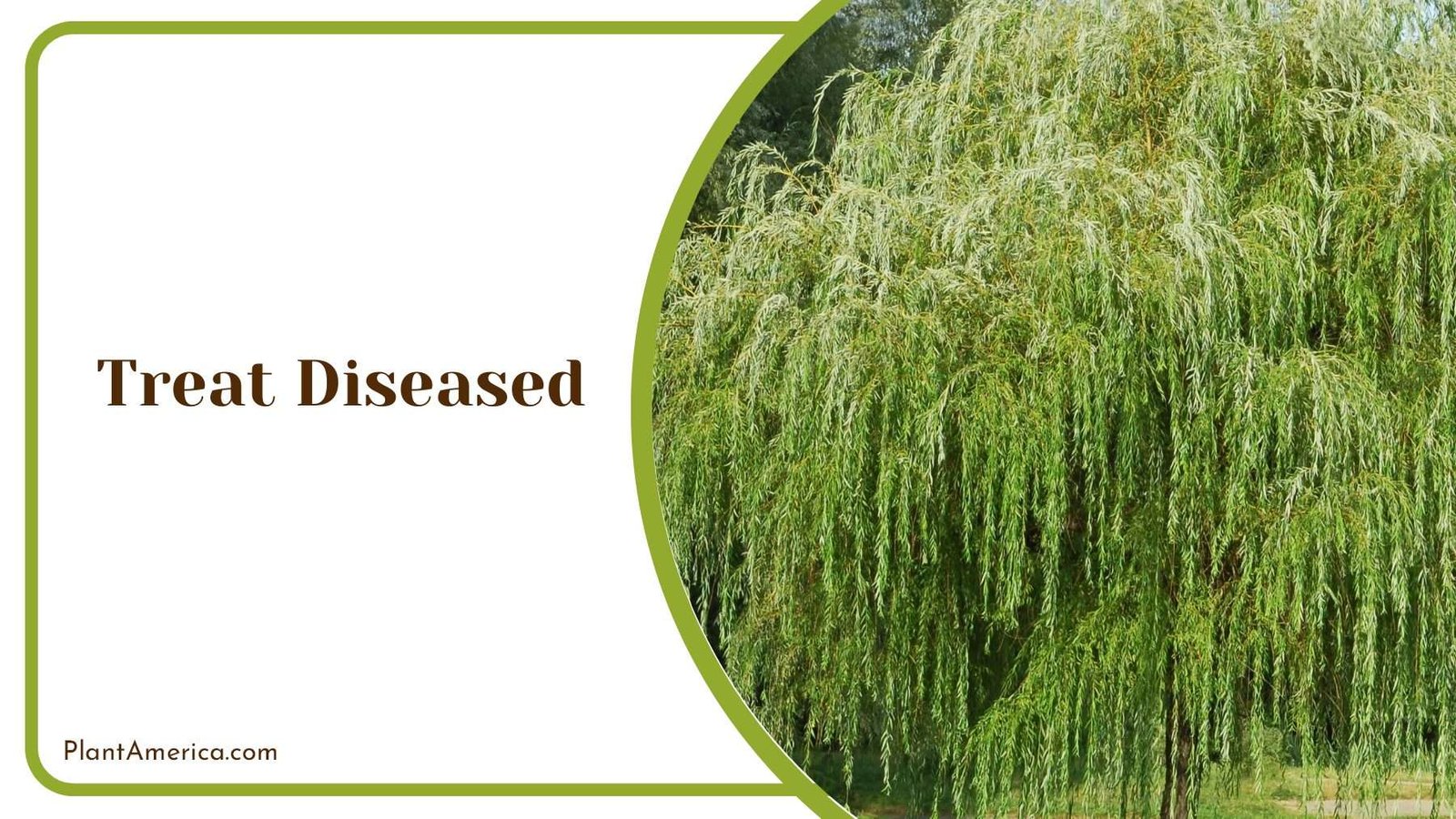
To know the exact disease of your tree, you need to consult a tree expert or expert gardener. Such a person will tell you exactly what is wrong with your trees. If you initially got the tree from a nursery, you can go there and show them the leaves. If not, you can go to any tree-related extension office. They will tell you what’s wrong with your trees as well as give you the solutions.
– Prune Off the Dead Leaves
After treating your weeping willows and fixing the growing conditions so that the trees will no longer get brown or discolored leaf tips, prune off the brown or dead leaves. These leaves will not turn fully green anymore. To keep your trees beautiful, you have to prune them off.

Conclusion
Now, nothing is stopping you from fixing your trees, right? Before you get started, remember these points:
- Check the temperature and other atmospheric conditions to be sure that your trees are growing in suitable places.
- Ensure that your soil quality is good enough for the trees.
- Ensure that your tree stays pest-free.
- Just in case your tree is disturbed by people, prevent people from disturbing it.
- After fixing your willows, prune out the brown parts so that the trees can retain their beauty.
Remember to stick to the willow tree care tips in this article. Go fix your trees right away
References
- ENH-734/ST576: Salix babylonica: Weeping Willow. (n.d.). https://edis.ifas.ufl.edu/publication/ST576
- Weeping Willow. (n.d.). http://www.bio.brandeis.edu/fieldbio/emmae24/Salicaceae/weepingwillow.html