
Salvinia cucullata plants from the Salviniaceae family are floating ferns with hoodlike leaves. Salvinia cucullata and generally the Salvinia genus plants, helps prevent your aquarium fish from jumping out of the tank. Furthermore, it makes them more comfortable in the tank.

Do you want to learn more about this plant before introducing it into your aquarium?
Read ahead and find out everything about this stunning fern!
Salvinia Cucullata Care Tips
While Salvinia cucullata is relatively hardy, it has some needs that you must meet.
You should know that Salvinia cucullata only grows in slow-moving warm waters. To avoid problems, you should introduce your Salvinia cucullata in a tank with very little to no movement at the surface of the water.

When you introduce the Asian Watermoss into your aquarium, you should notice new leaves in less than a week. If your plant is shrinking instead of expanding, remove it and place it on still water to recover.
 Light and Humidity Requirements
Asian Watermoss plants require medium to high light. You should give them 12 hours of light daily. Since their leaves are exposed to the air, you should check the room humidity.

Salvinia cucullata needs more than 60 percent room humidity to recreate the environment of a tropical forest.
 Water Requirements
After introducing Salvinia cucullata into your aquarium, you should pay close attention to the water quality in the first two weeks. Here are the preferred water quality parameters for Salvinia cucullata:
- pH: Salvinia cucullata loves neutral water. The tank water pH should be 6.5-7.5. Anything more alkaline or acidic might affect the growth rate of your Asian Watermoss.
- Temperature: Salvinia cucullata thrives in warm waters. The water temperature should be 68 – 80 °F (20° – 27 °C). The tank temperature should be above 68 °F for optimal Salvinia cucullata growth.
- Hardness: Salvinia cucullata can withstand a wide range of water hardness values.
 Nutrient Requirements
Salvinia cucullata requires nutrient-rich water. If you are introducing your Salvinia cucullata into an aquarium with a lot of fish, you do not have to add extra nutrients to the water. For planted aquariums or aquariums that undergo regular water changes, you should add a medium dosage of fertilizer after every water change.
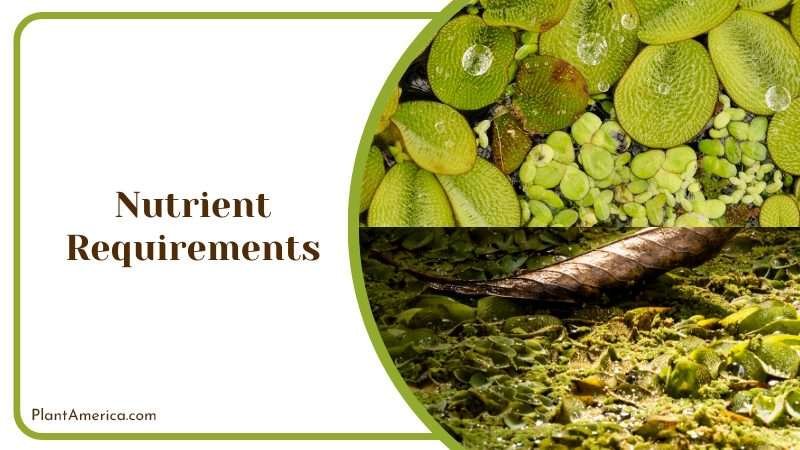
Your Salvinia cucullata will let you know if it needs extra nutrients or not. When new leaves appear smaller and paler than old leaves, you should increase the water nutrients.
Propagation: Colonizing New More Aquariums
Do you have more tanks in need of Salvinia cucullata? You don’t have to buy new plants. All you have to do is propagate the old ones.

To propagate Salvinia cucullata, you should divide the floating mat into multiple clumps. If the water in the new aquarium is from the same source as the water in the old aquarium, you can quickly introduce several Salvinia cucullata clumps into the new aquarium. Your Asian Watermoss will start growing and spreading in less than a week.
If you are transplanting your Salvinia cucullata into another tank with a different water source, it means that the pH and other water qualities might be different from what your Salvinia cucullata is used to. In this case, keep it on the surface of a bowl of the new water to observe its behavior before you introduce it into the new tank.
Problems You Can Encounter
When growing Salvinia cucullata, you can face some challenges on the way. Here are some possible challenges that you might face and some reliable solutions:
– Salvinia Cucullata Mat Shrinking
You may notice that the floating mat of Salvinia cucullata is shrinking. It can be caused by either of the following reasons:

- Low light: When the light is too low, your Salvinia cucullata mat will shrink, and the leaves on the edges will die out. In this case, you should increase the light intensity.
- Deficiency of nutrients: Nitrogen, potassium, phosphorus, and iron are necessary nutrients for Salvinia cucullata. In an aquarium with a lot of fish, your Salvinia cucullata has access to a lot of nutrients. However, you need to add nutrients to the water if there are very few fishes in the aquarium or if you have a planted tank.
- Constant water splashes: Salvinia cucullata loves slow-moving waters. If there are droplets of water on the leaves of your Asian Watermoss for a long time, the leaves may begin to rot.
– New Leaves Appearing Small and Pale
Nutrient deficiency can reduce the size of new leaves. They will also appear pale. Increase the amount of nitrates in the water to solve this problem. You should also make sure that your plants are getting enough light.
– Root Rot
If the leaves of your Salvinia cucullata are withering, collect a clump from the affected region and closely examine the roots. If the roots are brown, it means that your plant is suffering from root rot.
Root rot is usually caused by a lack of oxygen in the water. You should remove every affected part of the plant, change the water, and properly aerate the tank. You can aerate aquariums by installing aerators or introducing green aquarium plants into the water.