
The Philodendron nangaritense is a very rare, exotic, tropical evergreen perennial species that originates from southern Ecuador.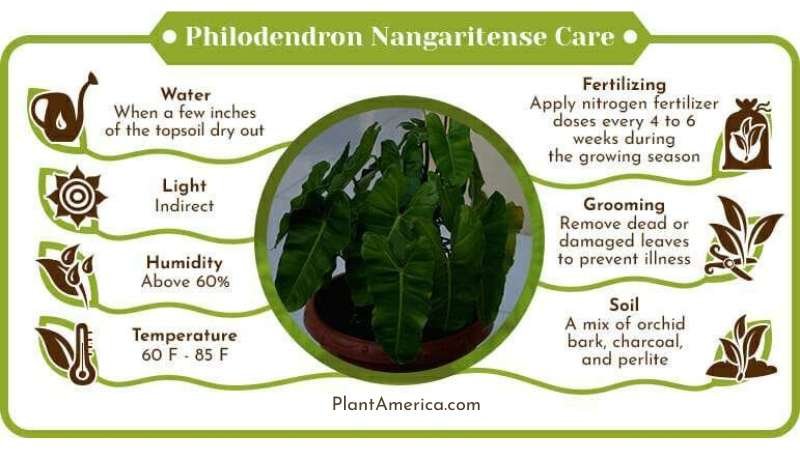
It is from the Araceae family, native to the humid environment of a valley near the Rio Nangaritza. Philodendron nangaritense is considered a lowland crawler and is famous for its distinct bright red fuzzy petioles.
In this care guide, you will learn essential knowledge on how to keep your Philodendron nangaritense in good shape.
What is the Philodendron Nangaritense?
The Philodendron nangaritense is a garden ornamental that grows lush under ideal conditions. It was discovered in 2005 by Dr. Tom Croat of the Missouri Botanical Garden in St. Louis. It boasts thin, glossy, rounded to heart-shaped green leaves, matte undersides, red, fuzzy-textured petioles, and red stems.
Philodendron Nangaritense Care
Philodendron nangaritense requires very specific care as it grows, just like any other plant, but with proper knowledge and guidance, you can prevent your plant from experiencing stunted growth. Read on and simply follow this care guide for step-by-step methods and some tips, and let’s grow this plant successfully.
 Water Requirements
Watering is an important aspect of growing your Philodendron nangaritense. The plant is likely to be affected by root rot, which is a common cause of death when you are over-watering, so you may want to let a few inches of the topsoil slowly dry out before watering your plant again.
You may also want to use a plant pot with drainage holes in the bottom to keep the water flowing and prevent standing water on the roots.
This plant loves moisture because it grows by the bank of a river in its natural habitat, so keeping the soil moist is the general rule. Also, make sure to check the soil before watering.
If you are aiming to grow this plant in a tropical area, it is best to plant it directly in the ground, and water it every other day.
If you live in colder areas, it is best to grow your Philodendron nangaritense indoors, and water it lightly about twice a week during the summer and very moderately during wintertime. If you are using a well-draining plant pot for your Philodendron nangaritense, let a few inches of the topsoil dry out before saturating it again, as mentioned above.
 Light Requirements
The Philodendron nangaritense naturally occurs in the understory of primary rainforests in Ecuador, so it is recommended to ensure its prolonged exposure to indirect sunlight or 70 to 85 percent filtered sunlight. 
You may want to put it in an east-facing or west-facing window to provide bright indirect light. However, it is still easy to care for, even in low-light conditions. If you prefer to grow it indoors, put it under a fluorescent light during the winter season.
It is best to grow it in bright indirect sunlight, and always be mindful when watering it because this might cause problems that might be hard to reverse.
 Soil Requirements
To reach its optimum growth, your Philodendron nangaritense should ideally be grown outdoors and planted directly in the ground as it needs very loose and airy soil, plant it in the ground or in a large wide pot with evenly moist soil.
However, if you want to plant it in a plant pot, use rich, loose potting soil that is high in organic matter, such as a mix of orchid bark, charcoal, and perlite, to provide the roots with plenty of airspaces and something to wrap itself around.
 Temperature Requirements
The Philodendron nangaritense loves warm temperatures, just like where it originated. If you are growing it outside, it needs an ideal temperature that ranges from 60 degrees Fahrenheit during nighttime to 85 degrees Fahrenheit during daytime.

Avoid stressing your plant by putting it in an area with extreme temperature fluctuations as it is sensitive to cold temperatures. Not receiving enough heat from its surroundings might cause your plant to die.
However, if you are living in colder regions, it is recommended to grow your Philodendron nangaritense indoors, providing it with artificial heating. Given that this plant’s leaves are delicate and can be easily torn, keep it away from radiators or air conditioner exhausts. Keep in mind that your plant will be more likely to thrive in warm temperatures.
 Humidity Requirements
Give your Philodendron nangaritense a humidity range of not less than 60 percent. If you are growing it indoors and the humidity is very low, misting your plant is a very good idea. It is actually necessary, as this will keep your plant healthy. By doing so, your plant will be able to absorb as much moisture as possible while keeping the leaves clean from pests and dust.
Remember to focus on the leaves, and do it a couple of times per day, as often as three to four times a week during winter, and use a humidifier during dry months.
You may also want to wipe the plant’s leaves to make them stay fresh and shiny. However, if your Philodendron nangaritense is planted outdoors, you can water the leaves using a sprinkling can during the mornings only.
It is very important to take the humidity of this plant into consideration and to provide it with sufficient humidity requirement because this naturally crawling species was found in the valley near the Rio Nangaritza in southern Ecuador. Collected from roughly 3500 m above sea level, the species is accustomed to a warm yet humid environment and 50 percent shade.
Maintain the ideal temperature range needed for your Philodendron nangaritense by giving it the perfect humidity through misting or using a humidifier while preventing it from being stressed due to environmental shocks, such as strong winds, a radiator, or air conditioner exhausts.
 Fertilization Requirements
It is important to get your Philodendron nangaritense fertilized to let it grow more leaves and more of those extraordinary red petioles that will make it look more stunning while hanging out in your garden.
The fertilizer will serve as its foliage booster. You may want to use a nitrogen fertilizer if your Philodendron nangaritense is planted directly on the ground. This will make your plant larger and healthier and will increase the leaf size.
For potted Philodendron nangaritense, it is very desirable to create a schedule for administering nitrogen fertilizer doses every four to six weeks during the growing season. Take note to avoid feeding the plant during the winter season.
Remember to protect your plant from salt build-ups and over-fertilization by thinning down the concentration of the fertilizer. You may also want to use a liquid fertilizer because it can easily be diluted. When you are propagating, it is still required to fertilize the young plants once their roots are well-established, but use a highly diluted solution.
First, dilute the exact amount of fertilizer with water, pour the mixed solution over the soil, and make sure to avoid getting the solution on the leaves and stems. Continue pouring the solution until you see that it starts to seep out of the drainage holes; that is the indicator to stop pouring it. After an hour, make sure that the pot isn’t sitting in water.
 Pruning Requirement
Conduct pruning consistently, as cutting the dead or damaged leaves will help to prevent the spread of infections. Keep your plant looking healthy and lush by cleaning and drying its leaves regularly to avoid infestations.
The care hack for your Philodendron nangaritense to make it look fuller is to let it just scramble freely along the surface. Other ways include pruning the running stems to encourage branching and giving them a foliage booster that will make them look bigger.
Propagation
If you are a home gardener who wishes to learn more about how to properly care for and propagate a Philodendron nangaritense plant in your home, we’ve got you. Stick around, and you’ll learn exactly how you can successfully grow this plant inside your house.
Plant nurseries usually practice propagation using seeds or through tissue culture. Although these techniques have become common nowadays, they are not applicable for home-growers like you but don’t worry because other successful methods will be feasible for you. Here is a step-by-step guide on how to propagate your Philodendron nangaritense using different methods.
The main rule when propagating your Philodendron nangaritense is that you should only do it during the growing season when the weather is warm and humidity is moderate to high. Another rule is not to let failed attempts keep you from trying.
– Propagate Using Cuttings
The first step is to choose a stem tip that you want to work with. Choose one that has two to three leaves and aerial roots. Cut the stem right under the roots, and set it aside overnight or for about six hours to callous the stem. Cover the stem with aerial roots in sphagnum moss that is evenly moist.
Put it in a plant pot with a mixture of 50 percent peat and 50 percent perlite. Place it in a bright spot with indirect sunlight and high humidity. The Philodendron nangaritense roots will settle for about one to two weeks; all you need to do is always keep the soil moist.
– Propagate Using Basal Branches
Wait for the mother plant to branch out, and that basal branch will grow roots toward the soil. Once that root is established, that will be the sign that you can start working with it. You will know if the roots are well-settled and if they are fixed securely when you try to pull them.
Problems
The philodendron nangaritense can face different problems and some of them are infestation by pests, root rots, yellowing and dropping of the leaves, leaves losing their colors, and even the appearance of brown or darker patches on the leaves.
– Infestation
It is normal for any plant to be disturbed by pests. For the Philodendron nangaritense, the common pests you may encounter are mealybugs, thrips, aphids, moths, fungus gnats, scales, and shore flies.
Do not be bothered by these pests and insects. All you need to have is routine pest control, such as using neem oil and an insecticidal soap once a month. You may also want to sponge wash the leaves and wipe them dry once a week. However, if your plant suffers a severe infestation, it is required that you treat it with chemicals.
– Root Rot
Philodendron nangaritense roots are most likely to be easily affected by root rot, which is commonly caused by overwatering. You may want to prevent this from happening by letting a couple of inches of the topsoil dry out before watering the plant again. Sometimes, fungal infections also affect the roots and cause root rot.
– Yellowing and Drooping Leaves
While root rot is caused by overwatering, similarly, the sudden yellowing and drooping of the leaves of your Philodendron nangaritense may have the same cause.
Thus, it is important not to water your plant frequently, or use well-draining soil or a plant pot with drainage holes to avoid these circumstances that can damage not just the physical appearance of your plant but its life as well.
– Pale Color of the Leaves
The pale color of the leaves is a clear indicator that your plant is receiving insufficient light. Put your Philodendron nangaritense in a brighter spot but with indirect sunlight.
– Curling of Tips
Maintain the proper fertilization to stimulate the best growth conditions. Excessive fertilization might affect the leaves, making their tips curl and, worse, might kill the plant. Also, be mindful of preventing salt build-up due to fertilization.
– Brown Patches on the Leaves
You may notice some brownish or tan patches on the leaves of your plant. The reason could be bacterial infections, which are sometimes seen in the Philodendron nangaritense.
These infections are called the Erwinia blight and the Pseudomonas leaf spot, which are both very destructive and highly infectious. Erwinia blight, also known as Fireblight, is a widespread disease caused by the bacterium Erwinia amylovora, which needs moisture to spread.
To prevent the spreading and worsening of the infection, it is recommended that you isolate the plant, cut the affected leaves, reduce the watering frequency, and avoid misting the plant. Let the leaves dry quickly.
– Dark Patches on the Leaves
Exposure to cold drafts could be the reason why your Philodendron nangaritense has dark patches on its leaves. You may want to cut off the affected leaves and relocate your plant to a warmer area.
– Browning of the Leaves
If you see your plant getting brown, especially on the edges of the leaves, it is because you are underwatering it.