
Monstera borsigiana vs deliciosa of the Araceae family is an often-talked about topic among enthusiasts because these plants look very similar. Although they are both beautiful indoor Monstera genus plants and they look as if they are the same, these plants are different in so many ways.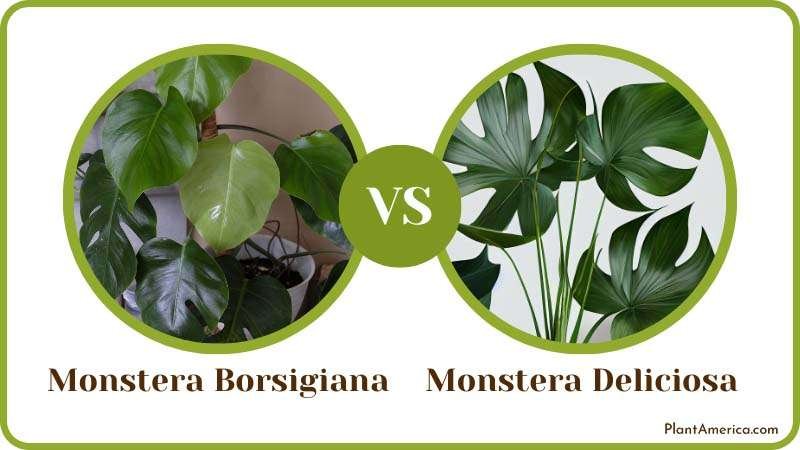
Continue reading to learn everything that you need to know about monstera deliciosa vs borsigiana.
Quick Overview
Here is a table of comparison between these two plants.
| Monstera Borsigiana | Monstera Deliciosa | |
| Taxonomy | Part of the family Araceae and genus Monstera | Part of the family Araceae and genus Monstera |
| Appearance |
|
|
| Growth Rate | Faster growth rate, can grow more than 2.5 feet per year | Slower growth rate, can grow around 2 feet per year |
| Growth Behavior | Grows vertically | Grows across the ground (horizontally) before it climbs upwards or vertically |
What Is the Difference Between Monstera Deliciosa and Borsigiana?
The main difference between monstera deliciosa and monstera borsigiana is in their appearance, growth rate and growth behavior. Even though both plants look very similar and are in the same genus, they are not the same plant. The key differences between monstera deliciosa and monstera borsigiana can be found in this section.
– Taxonomy
Monstera deliciosa and monstera borsigiana are not the same when classifying them scientifically. They are both in the family “Araceae” and genus “Monstera,” but are different species.
This means that they are not interbreeding and they are genetically distinct from each other. Take note that even if horticulturists can produce crossbreeds from both plants, they are naturally distinct and do not interbreed to become one species.
As plants of different species, monstera deliciosa and monstera borsigiana are different in so many ways. For example, they have different appearances and behavior.
– Plant Appearance
There are noticeable differences in the appearance of monstera deliciosa and monstera borsigiana. The following features describe monstera deliciosa:
- Size: Between both plants, monstera deliciosa is the larger one. It usually grows up to 10-15 feet or 120-180 inches and can even grow up to 30 feet or 360 inches. The size of this plant makes it desirable for a lot of people.
- Leaves: Monstera deliciosa leaves are very big when you compare them to that of monstera borsigiana. This will depend on age and growing conditions, but the difference is clear when you grow both plants together. The leaves are heart-shaped, leathery and glossy.
- Flowers: Indoor monstera deliciosa plants rarely bloom because they are not in their natural habitat. In the wild, they produce cream-white flowers during summer or spring.
- Ruffles in the geniculum: Monstera deliciosa plants have a wrinkled and wavy geniculum while monstera borsigiana plants have a smooth, normal one. The geniculum is found between a leaf and a petiole. It helps leaves to move freely when the wind blows.
Take note that even though the deliciosa has a wrinkled geniculum, both plants have a normal and smooth one when they are young. This means that you have to wait until a plant is mature before you will notice the wrinkled geniculum.
Some distinct features of monstera borsigiana plants are:
- Size: Monstera borsigiana plants do not grow as big as deliciosa. They can grow up to 6.5 feet or 78 inches tall.
- Leaves: The leaves of monstera borsigiana are smaller than those of deliciosa. The leaves have the same shape and features as those of monstera deliciosa.
- Flowers: Just like monstera deliciosa, monstera borsigiana flowers rarely bloom indoors. In the wild, however, they do bloom. Unlike monstera deliciosa flowers, monstera borsigiana flowers are small and vaguely visible. They flower during spring or summer.
- Stem Nodes: Another easy way to tell the difference between monstera borsigiana and deliciosa is in their stem nodes. The gaps between each node in borsigiana plants are longer than those in monstera deliciosa. Buds, leaves and stems grow from each node.
As you can see, if you pay close attention to the appearance of your plants, you can easily identify which plant is a monstera borsigiana and which is a monstera deliciosa.
– Growth Behavior and Growth Rate
There is a major difference in the growth behavior of monstera borsigiana and monstera deliciosa. Both plants are climbers and love to grow attached to a stake. Monstera deliciosa, however, grows across the ground (horizontally) before it climbs upwards or vertically. This means that if you study both plants when they are young, you will see monstera borsigiana climbing while monstera deliciosa is crawling.
Even though monstera deliciosa grows larger than borsigiana, monstera borsigiana growth rate is faster than that of deliciosa by a large margin. The growth rate of monstera deliciosa is around 2 feet yearly while monstera borsigiana can grow more than 2.5 feet per year.
When you start growing both plants together, you will notice that:
- Monstera borsigiana will grow faster than monstera deliciosa, but monstera deliciosa later grows to become the larger plant.
- Monstera borsigiana grows vertically and will appreciate a stake when young. Monstera deliciosa, however, crawls on the ground or substrate for a while before it starts climbing.
With these tips, you can easily distinguish between monstera borsigiana and monstera deliciosa.
– Cost and Price
Monstera deliciosa is more desirable than borsigiana, so it has a higher price. Depending on the region, you can get regular deliciosa plants from $20 to $100, while regular borsigiana will cost around $10.
However, there are also rare varieties of both plants. According to the rarity of the variety (such as monstera deliciosa large form), you can buy a plant for up to $1,000. The price difference is huge when compared to regular varieties.
With the tips and tricks above, you can now easily distinguish between monstera borsigiana and monstera deliciosa.
Are Monstera Borsigiana and Monstera Deliciosa the Same?
When you look at monstera deliciosa and monstera borsigiana plants, you may think that they are the same plant. For one thing, both plants are popular indoor plants. They also have the same care requirements.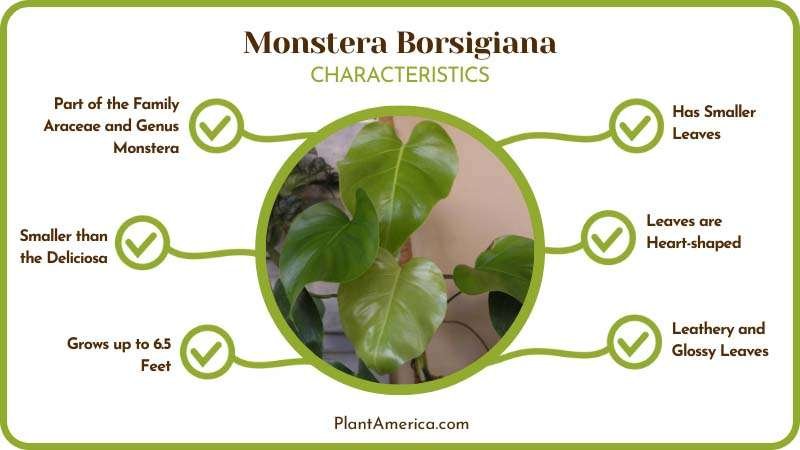
What’s more, they have the same natural distribution and origin, their leaves are perforated, they grow better with a stake, and they are both types of monstera genus. How can these plants be different with all these similarities? In this section, we’ll be going through each of these two plants to find out what makes them unique.
– Monstera Deliciosa Plants
Monstera deliciosa plants, also known as Swiss cheese plants, are the most common species in the genus Monstera. They are prized indoor plants because of their amazing size and beautiful leaves.
This plant originates from the tropical regions of South America and is becoming more popular in every other continent in the world as a beautiful ornamental plant.
– Monstera Borsigiana Plants
Just like monstera deliciosa, people also refer to monstera borsigiana as a Swiss cheese plant. This name comes from the perforations in the leaves of monstera plants and how the leaves look just like Swiss cheese.
Even though monstera borsigiana does not grow as large as deliciosa, it is still a common indoor plant. Just like deliciosa, monstera borsigiana originates from the tropical regions of South America.
How To Grow and Care For Your Monstera Plants
Whether you are growing monstera borsigiana or monstera borsigiana plants, you can follow this guide as they both have similar requirements. For your plants to flourish and grow to become healthy plants, you need to grow them in the right growing conditions.
Here are some monstera care tips for you:
-
Stake or Trellis
You should help your monstera plants to grow upwards by giving them a stake, trellis or cage. As indoor plants, giving them a trellis may not be the best idea as trellises are not very beautiful to see indoors.
If you do not want the growth support to show, use a stake or a moss pole for your monstera plants. If you want the growth support to show and add to the beauty of your home, you should use a plant cage.
Take note that it is not a must to support the plants, but it will surely help them thrive.
-
Suitable Indoor Soil
Monsteras prefer slightly acidic soil and grow best in pH 5.5 to 6.5. The soil should be well-drained and should not retain a lot of water. You can grow your indoor plants in a potting mix from the store, but remember to buy an indoor potting mix with more perlite than vermiculite.
The pot in which you are growing your monsteras is as important as the potting mix. The pot should be 2-4 inches wider than the root ball of your plants. Also, make sure that there are two or three drainage holes at the bottom of the pots to permit water to drain quickly.
-
Light and Humidity Requirements
Monsteras grow best in bright but indirect light. In their natural habitats, these plants receive the brightest sun, but taller trees filter most of the sun’s rays. You should mimic that condition by placing your monstera plants near a windowsill and making sure that they do not receive too much afternoon sun.
Monsteras can withstand a wide range of humidity levels, but you should grow them in a slightly high level of humidity (60 to 70 percent). You can mist water droplets on the leaves of your monstera plants to increase the humidity around the plant. Do not mist too much water on the leaves that they start to drip.
-
Temperature Requirements
Monstera plants prefer warm temperatures and grow best in USDA hardiness zones 10-12. The optimum temperature to grow your plants is 65 to 75 degrees Fahrenheit. Monstera plants can die when the temperature falls to 28 degrees Fahrenheit and below.
You should take your monstera pots indoors before winter. You can grow them indoors using a grow light, and you can also place them close to a windowsill for access to sunlight. Take note that you should always pay attention to the temperatures around your plants.
-
Watering Needs
Watering your monstera plants can be a little tricky. You should water the plants when the top layer of the soil (top 2 inches) is dry. Do not wait for the soil to dry out completely or your plants may die of drought. However, you should also be careful to not overwater the soil.
To help your monstera plant’s watering needs, amend the soil with perlite and vermiculite. Perlite will help the soil to drain quickly while vermiculite will help retain some moisture so that not every drop of water is drained out. Both of them might suffer from Monstera guttation so pay close attention to possible signs.
– Overwatering
Some signs that you are overwatering your monstera plants include:
- Chlorosis: When you notice that the leaves are turning pale or yellow.
- Root rot: If your plant is dying and you notice that the roots are rotting away gradually.
- Weak stem: The stem can no longer hold leaves.
– Underwatering
Some symptoms of a monstera plant suffering from drought are:
- Brown leaf tips: Examine the leaves of your plants if their tips are brown or feel flaky.
- Wrinkling of the stem: If the stem is drying out and looks wrinkled, you need to give your plant more water.
Make sure that you give your monsteras just the right amount of water.
-
Nutrients and Fertilizer
Monstera plants do not require a lot of fertilizer, but it helps to give them some (not too much). You should use indoor plant fertilizers that have a lot of nitrogen to maintain the green leaves of your plants. It also helps to amend your monstera soil with organic matter such as compost and humus.
Some symptoms that your plants are suffering from nutrient deficiency include:
- Chlorosis: Your monsteras lack nitrogen and other nutrients if they are becoming yellow.
- Falling leaves: You should give your plants more nitrogen, potassium and phosphorus when the lower leaves are falling.
- Death: If you are uncertain why your plants are dying, try to recall when you last gave them fertilizer or amended their growing media.
To quickly correct the deficiency of a specific nutrient, you should spray foliar fertilizer on the leaves of your monstera plant.
-
Pruning Your Plants
Pruning is important in monstera plants as it encourages growth. You should carefully choose when and where to prune your plant. For example, if you want your plants to grow taller, you should prune them at the top.
If your monsteras are growing in only one direction, you should prune them at the opposite side while you add extra light. Remember to prune off dead leaves so that they do not decay in the pot and lead to infections.