
Manjula pothos vs marble queen plants of the Araceae family are often mistaken for one another because of their similarities. Very few people can tell the difference between both plants, but although they seem alike, these plants have their unique characteristics.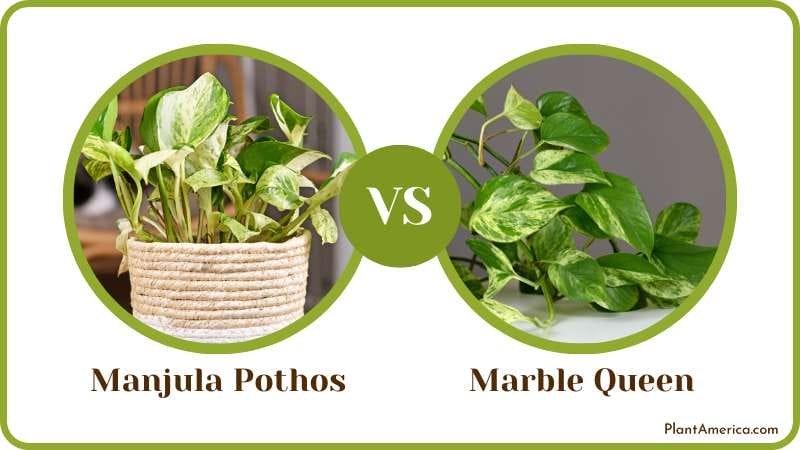
What qualities differentiate marble queen from manjula pothos plants of the Epipremnum genus? Continue reading this comprehensive guide to find out.
Quick Overview – Comparison Table
Here is a quick table of comparison for both plants.
| Manjula Pothos | Marble Queen | |
| Taxonomy | Belongs to the family Araceae and the genus Epipremnum; the Species name is Epipremnum aureum | Belongs to the family Araceae and the genus Epipremnum; the Species name is Epipremnum aureum |
| Leaves | Frilly and wavy, with a mix of light yellow, white and cream that appear in a swirling pattern | Have a splash pattern of green, cream and white; broader and flatter than manjula pothos leaves |
| Flowers | Cylindrical flowers with erect stalks; cream in color with purple spathes | Cylindrical flowers with erect stalks; cream in color with purple spathes |
| Growth Rate | Grows slower; can grow up to 6 feet in height | Grows faster; can grow up to 6 feet in height |
| Origin | Native to places such as Southeast Asia, Australia, France and Polynesia | Man-made by botanists at the University of Florida |
Difference Between Manjula Pothos and Marble Queen
The main difference between manjula pothos and marble queen plants is found in their leaf design and origin as manjula pothos leaves are frilly and wavy while marble queens leaves have a splash pattern of green, cream and white.
Even though both plants may look similar and even come from the same family, they are not the same. They are scientifically distinct plants and have their differences. Here are the major differences between manjula pothos and marble queen plants:
– Taxonomy Classification
Both manjula pothos and marble queen plants belong to the family Araceae and the same genus Epipremnum. They are also plants from the same species Epipremnum aureum.
What differentiates them scientifically, however, is that the Epipremnum aureum species have multiple varieties. This means that both manjula pothos and marble queens are simply different varieties of pothos.
The botanical name of manjula pothos is Epipremnum aureum “Manjula” while the botanical name of marble queen is Epipremnum aureum “Marble Queen”. As plants of different varieties in the same species, they can interbreed to form new varieties but they are still distinct species.
– Leaf Design and Color
The most distinguishable physical difference between manjula pothos and marble queen is found in their leaves. Manjula pothos leaves are frilly and wavy, and they usually have a mix of light yellow, white and cream that appear in a swirling pattern.
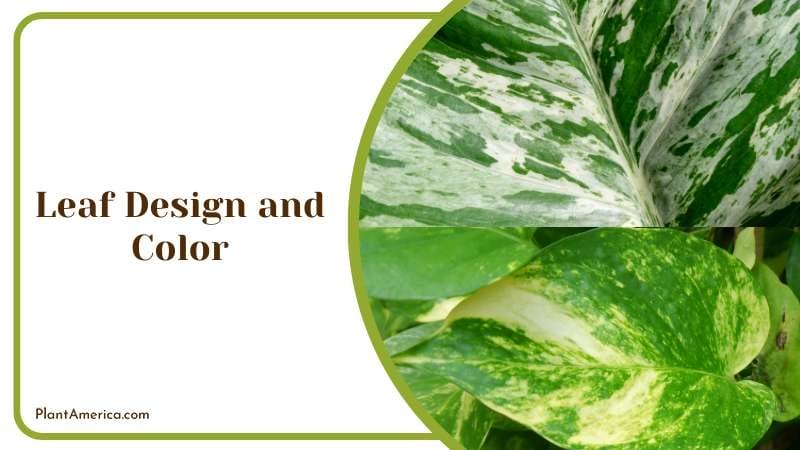
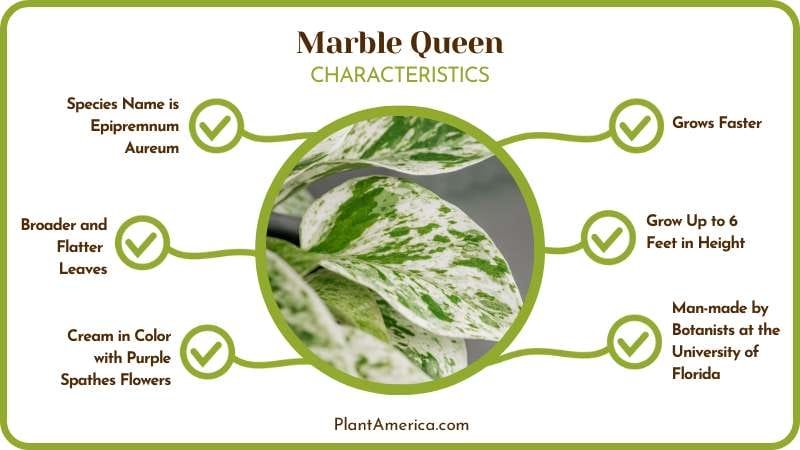
The leaves of marble queen plants, however, have a splash pattern of green, cream and white. Also, if you study the leaves well, you will observe that the marble queen leaves are broader and flatter than the leaves of manjula pothos.
It is only through their leaves that you can distinguish between marble queen and manjula pothos plants when looking at them. However, they also have other behavioral and distribution differences.
– Flowers
As for their flowers, they have no difference. Both plants rarely flower because growing them indoors does not mimic all the environmental factors that they are exposed to outdoors. When they flower outdoors, however, their flowers are cylindrical. They have erect flower stalks and they can be cream in color with purple spathes.
– Distribution and Origin
Another major difference between manjula pothos and marble queen plants is their origin and distribution. Manjula pothos is native to places such as Southeast Asia, Australia, France and Polynesia. You can easily find them in the wild when you go to these places.
As for the marble queen, this variety is a crossbreed that botanists at the University of Florida developed. This means that marble queen plants do not occur naturally anywhere in the world as they are man-made.
The university botanists created this variety for its beauty and with the hopes that it can tolerate a wider range of environmental conditions better than other pothos varieties.
– Growth Rate
There is also a difference in the growth rate of manjula pothos and marble queens. Marble queens grow faster than manjula pothos. If you start growing both plants at the same time, marble queens will grow taller and faster than manjula pothos until they are mature (by then, they will become the same height).
If you have both plants in your home and you are not sure about which plant is manjula pothos and which is marble queen, study their growth rate. Take note that there are some types of large manjula pothos that can grow larger than the average plant.
Aside from discussing the difference between marble queen and manjula pothos, we should also discuss their similarities.
Similarities Between Manjula Pothos and Marble Queen
It is only fair that we also discuss some of the similarities of both plants as they have a lot of similarities and you can either buy one or the other. Here are some similarities between marble queen and manjula pothos plants:
– Good Air-Purifying Indoor Plants
Both plants make great indoor plants. Aside from their beauty, they can also purify the air around your house. These plants collect a lot of carbon dioxide from the air with little effort as long as there is sufficient light. They also release oxygen as a by-product, so growing these plants indoors will surely give you fresh air.
You can grow them in hanging pots or in a cage. No matter how you choose to grow the plants, make sure that they have sufficient light and they will provide you with clean air.
– Height
You cannot distinguish between marble queens and manjula pothos if you use their height to differentiate them. When mature, both plants grow to the same height. They can grow up to 6 feet in height, and their leaves can grow up to a size of around 3 inches in length and about 2 inches in width.
– Toxicity
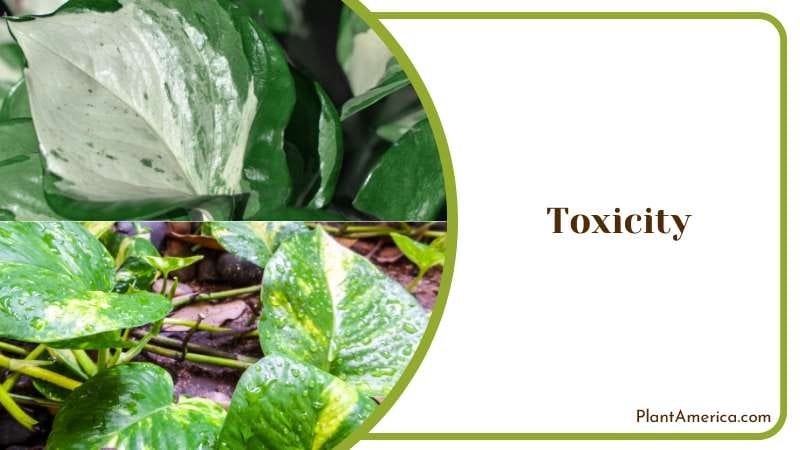
One downside of marble queen and manjula pothos plants is that they are toxic and can cause various health challenges when you consume them. Both plants have insoluble raphides. These raphides can irritate the mouth, cause vomiting and make it difficult to swallow food.
You should grow your indoor plants where your young children cannot reach them. In addition, do not let your pets play with the leaves.
– Easy to Care For
Not only are these plants very beautiful, but they are also low-maintenance plants because they are very easy to care for. So long as you grow them in the right conditions, you do not have anything else to worry about.
Now you know the differences and similarities between marble queen and manjula pothos plants. What are the right growing conditions and requirements for both plants? Continue reading to find out.
Are Manjula Pothos and Marble Queen the Same?
These plants are surely not the same. When you consider their size, species name, air purification qualities and care requirements, you might think that they are one and the same.
Let us discuss what manjula pothos and marble queen plants are individually.
– What Are Manjula Pothos Plants?
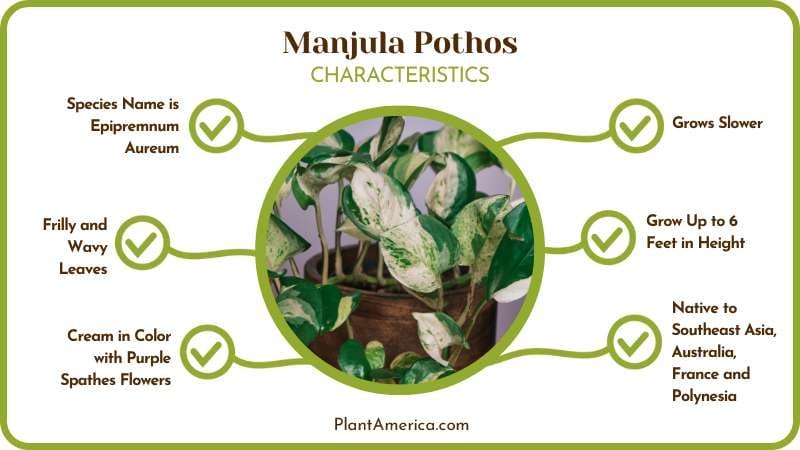
Manjula pothos is a beautiful indoor plant with leaves that can be a mixture of green, white and cream. These plants are native to Asian and European regions but have found their way into many parts of the world because of their beauty. Manjula pothos is a variety of the Epipremnum aureum species.
– What Are Marble Queen Plants?
Just like manjula pothos, marble queen pothos are also a variety of the Epipremnum aureum species.
Marble queens are among the most common varieties in the pothos family and they are also referred to as Devil’s Ivy and Money Plant. Their leaves are mostly white and dark green, but can also come with a mixture of cream. These plants make good plants for hanging baskets.
How To Grow and Care For Your Indoor Pothos Plants
Here are some easy care tips for manjula pothos and marble queen plants:
-
Stake or Trellis
Even though your pothos can grow in hanging baskets with their leaves dropping, they grow healthier if you support them with a stake, trellis, or cage. Trellis is best for plants that you are growing outside. For indoor plants, you can use a cage to boost the beauty of your plants.
-
Suitable Potting Soil
You should buy a suitable potting mix for your pothos from a garden shop near you. To boost the drainage ability of the potting mix, you should mix peat moss and perlite with the potting mix in equal proportion.
You should not use soil from your garden for your pothos as it can suffocate them. The suitable pH to grow manjula pothos and marble queens is 6.0 to 6.5.
As for your containers and pots, make sure that they have 2-3 drainage holes so that water can drain quickly. The pots should be 2 to 4 inches wider than your pothos to permit growth until your plants are ready for repotting.
-
Light and Humidity Requirements
Even though both plants have similar care requirements, they have different lighting needs. Marble queen plants need direct sunlight while manjula pothos need indirect sunlight.
When keeping your plants in your preferred location, keep the marble queens closer to the window. You can easily grow manjula pothos in a well-lit room with indirect sunlight.
If your plants need more sunlight, you will notice that they begin to develop leggy and weak stems. Also, their leaves will become paler.
As for humidity, the plants need around 60 to 75 percent humidity. You can easily increase the humidity of the room by misting water droplets around the pothos. You can choose to water your indoor plants by misting so that you are both watering them and giving them just the right amount of humidity.
-
Temperature Requirements
Your pothos plants love warmer climates. As warmth-loving plants, you should grow your pothos in temperatures ranging from 70 to 90 degrees Fahrenheit. Even though they can tolerate a lower range of temperature, the temperature should not drop below the 50s for too long.
-
Watering Needs
Watering your pothos can be a little bit tricky. You should wait until the substrate is half-dry before you water it. Dip a finger or moisture reader into the substrate. If the upper parts of the soil are dry, your plants are ready for watering. As an extra tip, if you are not sure whether you should water your pothos or not, wait an extra day and then water the plant.
When manjula pothos and marble queens do not receive sufficient water, they will show these signs:
- Weak petioles: If your plant petioles cannot carry the leaves during the day, you should give them water.
- Brown leaf tips: The lack of water can cause your pothos leaves to become brown from the outside.
Your overwatered pothos will show signs of root rot. When your plants are dying and more leaves are decaying, you should repot them into a new pot and reduce your watering rate. Make sure to remove dead roots before you transfer the plant.
-
Nutrients and Fertilizer
You do not need to fertilize your pothos. These plants receive most of their needed nutrients from their substrate and the atmosphere. They are not heavy feeders like other plants, but you should make sure that the soil is nutrient-rich. You can enrich your pothos soil with organic products such as mulch, or you can also use a general-purpose fertilizer for houseplants.
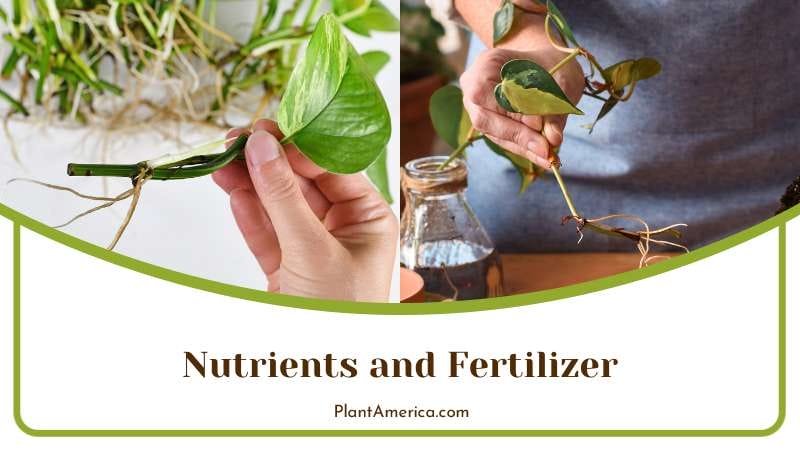
Make sure that you do not over-fertilize your pothos as they can die if there are too many nutrients in the soil.
-
Pruning and Repotting Your Plants
Prune your pothos if you want them to grow faster. Pruning encourages growth, so you decide when to prune your plants. You should repot your pothos plants every 2-3 years into slightly larger pots. The new pot should be 2 to 4 inches larger than your Pothos root balls so that it is not too small or large.
Congratulations! You now know everything that you need to know about caring for manjula pothos and marble queen pothos plants.
Propagating Your Pothos Plants
Propagating your pothos plants is easy; all you need is a stem or branch cutting. Dip the cutting in a rooting hormone and then plant it in a suitable potting mix. Water your pothos cuttings by misting until you notice new growth.
When the young plant has more than two pairs of leaves, you can start watering them by pouring the water into the substrate. Remember to mist your plant leaves to keep their leaves fresh and beautiful.
Final note:
Prune your pothos plants if you want them to grow larger. Prune some stems and branches for more growth.