
Alocasia bulbs are the round ball-like structures near the roots of a mature Alocasia that store nutrients.
These have great growth potential and you can easily grow young Alocasias using these bulbs, which is what this expert guide is all about. Continue reading as we discuss more than one method of growing alocasia bulbs so that you can propagate them as you wish.
How to Grow Alocasia Bulbs
You can grow Alocasia bulbs in three different types of growing mediums: soil, water and moss. First, you need to collect them from the roots of an adult Alocasia. Alocasia bulbs for sale are often of poorer quality and should generally be avoided. Read the in-depth details of all these steps as you scroll through this guide.
– Obtain Healthy Alocasia Bulbs
The first thing you need to do is to obtain healthy Alocasia bulbs for planting. You can buy these bulbs, but a safer option is to get them directly from the plant (make sure that the Alocasia plant is not suffering from a pest like mealybugs). Choose an Alocasia species of your choice and take it out of its pot. Some really gorgeous ones are Alocasia odora and Alocasia corms.
Search the soil for the presence of these elephant ears bulbs. The most probable location where you will find them is near the roots of the parent plant. These are quite tiny and look like tiny little balls. An adult plant probably produces anywhere from around five to ten bulbs.
The more bulbs you collect and start with, the better. This is because not all of them will germinate so it’s better not to take a chance by using just one or two. Press on them gently to make sure they are firm. Very soft and squishy bulbs are rotten and have little chance of successful propagation.
– Grow Alocasia Bulbs in Water
The first method to propagate the night-fragrant elephant ear plant is by placing the bulbs in water. This is one of the simplest methods and one we use quite often. Here is a brief rundown of this process:
- Take a transparent jar or food container and depending on its size, put the collected bulbs inside, making sure they are not too crowded.
- Pour clean water into the container such that only half of the bulbs are submerged in water. This way they will have access to both air and water.
- Cover the lid of the container and place it in an indirectly lit bright room with warm temperatures.
- Every day, remove the lid for one hour to allow the bulbs some breathing space.
- Every week, change the water with fresh, clean water.
- Within a month, you will see slender white roots emerging from the bulb. This is a sign that the propagation has been successful.
- Keep the bulbs in the water a little bit longer until leaves also appear.
- It is best to now transfer the baby plant to a proper growth medium like potting soil or leca. Leca is the best but it will need constant feeding because it lacks nutrients.
– Grow Alocasia Bulbs in Sphagnum Moss
This moss is the most widely used nutrition medium and soil amendment used in horticulture. You can totally use a good quality one to grow your Alocasia bulbs in.
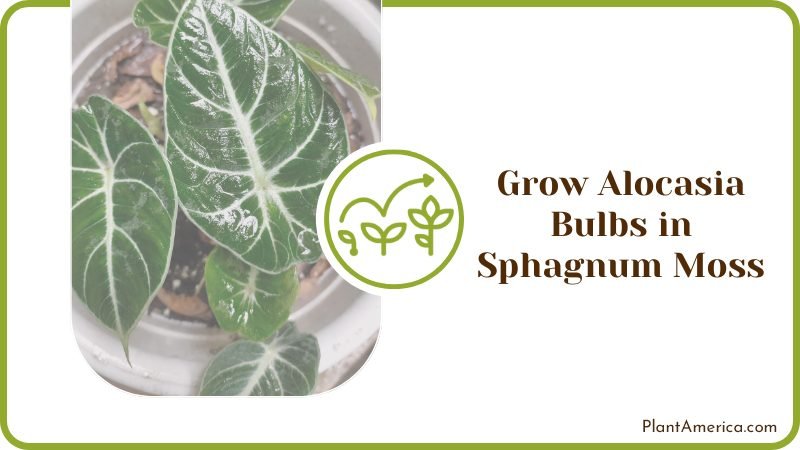
Here are the steps of this process described in a brief manner:
- Buy the best quality moss that you can come across. Put it in water one night beforehand so that it can soak up as much moisture as possible.
- Again, take a transparent jar or plastic container with a lid and place moss inside. Take a fistful of moss and squeeze it gently to drain all the water out first. Ideally, the moss should be slightly damp and not soggy or dripping.
- Carefully place one or two of the bulbs over the moss. Take note that they should not be buried within it, then cover them with a light quantity of squeezed moss.
- Take the jar or the container to a room that is lit with intense indirect light for at least half the day. If natural light is not available, then artificial grow lights installed overhead will work just as well.
- Keep sprinkling some water in the moss every day to keep it from drying up.
- Within one to one and a half months, the newly sprouted baby plant will be ready enough to be transplanted in proper potting soil and pot.
– Propagate Them Directly in Soil
Elephant ear bulbs can also be grown directly in the soil. This method has the primary disadvantage that you will not be able to see the bulbs sprouting roots and shoots right in front of your eyes. Another difficulty you might encounter is providing the perfect levels of humidity.
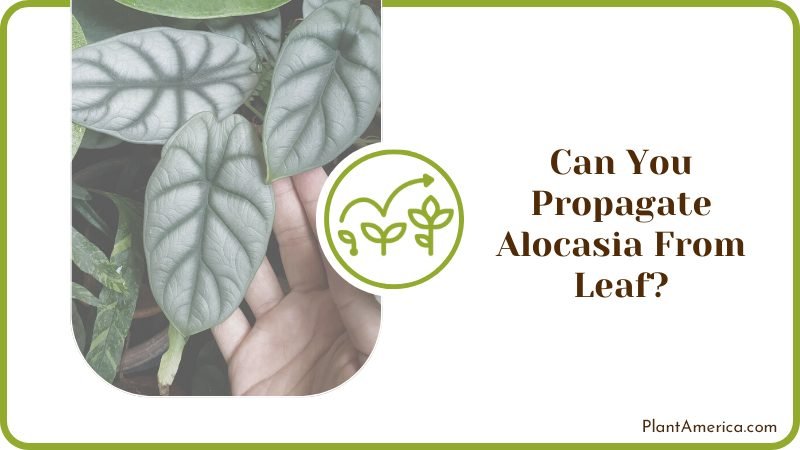
Here are the steps that you need to go through:
- Take a small pot and fill its bottom with an appropriate potting medium. Make sure that the medium you use is rich in both organic matter and drainage elements.
- Place the bulbs over this layer at some distance from one another, then spread another layer of medium over them evenly.
- Sprinkle some water on the soil such that it is slightly damp but not actually moist.
- Take the pot to a greenhouse where it can get the levels of high humidity that it needs to grow.
- If the greenhouse is not available, you can cover the pot with a transparent plastic wrap instead. Just don’t forget to lift this wrap up every second or third day. This is to provide air to the growing bulbs and sprinkle some more water on the potting medium.
- In four to six weeks, poke the top layer of the soil to see if the bulbs have germinated. So far, we have had no problems with this method of growing Alocasia.
– Grow Alocasia Plant Bulbs in a Ziploc Bag
Yes, you read that right! Growing bulbs and seeds in Ziploc bags is one of the cleanest and quickest methods of propagation used by plant lovers all over the world. Here is how a Ziploc bag comes in handy when growing bulbs:
- Take a paper towel of the highest quality that you can find and dampen it with water.
- Wrap the Alocasia frydek bulb or any other bulb that you have in this paper towel.
- Careful place it inside the ziplock bag and then close it.
- Every second or third day, open the bag for one hour to let the bulb breathe.
- If you find the paper towel becoming dry, sprinkle water over it to dampen it some more.
- In six to eight weeks, you will see your Alocasia bulb sprout into a tiny Alocasia plantlet that is now ready to be planted in a pot.
Final note:
That is why we recommend creating the perfect soil yourself using one part potting mix with one part each of perlite and peat. You can substitute perlite with one part of sand too as it integrates better with the potting medium.