
Types of ash trees planted in backyards offer a wide range of options for residential landscapes, and they come in many species, shapes, sizes, and colors, providing shade, seasonal interest, and wildlife habitat benefits.

There are numerous ash tree varieties suited for North American yards and gardens, and you can choose an ash tree based on several characteristics.
Overall, ash trees represent an excellent option for those seeking to add height, shade, and visual interest to their yards and gardens.
Their variations in size, form, foliage, and growing requirements mean that one can likely find the perfect ash tree for their specific landscape needs and conditions with careful consideration.
Types of Gorgeous Ash Trees To Consider for Your Landscape
1. White Ash

- Growing season: Spring, Summer.
- Leaf shape: Opposite, Pinnately Compound.
- Specific needs: Full Sun, Regular Water.
- Common pest: Emerald Ash Borer, Mites.
The white ash (Fraxinus americana) is a medium-sized deciduous tree native to eastern North America. It typically grows to between 60 to 80 feet tall at maturity with a gray-brown bark and attractive oval crown form.
White ash produces pinnately compound leaves with five to nine leaflets that emerge in springtime with a purple tinge before darkening to glossy green. In spring, the tree also produces clusters of small greenish flowers.
White ash wood is prized for its straight grain and strong, resilient properties that make it ideal for tool handles, baseball bats, furniture, and other items requiring toughness and durability. The tree takes well to pruning and shaping, typically forming a stately pyramidal form.
The appeal of white ash trees lies in their symmetrical, pyramidal habit of growth, lovely yellow to orange fall foliage colors, and relative resistance to most insects and diseases that plague other tree species.
However, the emerald ash borer beetle has become an increasingly serious threat to white ash. Homeowners should choose cultivars from nurseries specializing in emerald ash borer-resistant varieties.
During periods of drought or hot weather, white ash trees benefit from regular deep watering throughout their root zones. Mulch should also be applied and maintained around the base of the tree to help retain soil moisture and protect roots.
White ash is valued for its sturdy wood, ornamental qualities, and resistance to many common pests and diseases. The tree’s classic pyramidal form, attractive fall foliage, and ability to thrive in many landscape settings make it a desirable choice for home gardens, parks, and municipal plantings.
However, homeowners should keep in mind the threat posed by the invasive emerald ash borer and choose resistant cultivars when possible. With proper irrigation and mulching during dry, hot weather, white ash trees can grow to become majestic specimens, rewarding landscapes for decades.
2. Green Ash

- Growing season: Spring, Summer.
- Leaf shape: Opposite, Pinnately Compound.
- Specific needs: Full Sun, Average to Wet Soil.
- Common pest: Emerald Ash Borer, Mites.
The green ash (Fraxinus pennsylvanica) is native to riparian areas and floodplains across central and eastern North America.
It has attractive dark green compound leaves of 7 to 11 leaflets that turn yellow in autumn before dropping. The green ash is a fast-growing deciduous tree, reaching heights between 60 to 80 feet at maturity with a broad rounded canopy shape. It typically has a gray-brown furrowed bark marked by shallow ridges.
Green ash makes an ideal shade tree for yards and larger properties because of its rapid growth rate and ability to thrive in moist soils and seasonal flooding.
It can tolerate various adverse conditions, including heavy clay soils, high pollution levels, and saline soils. However, the invasive emerald ash borer beetle has killed many green ash trees, so homeowners seeking to plant one should buy a cultivar known to resist this pest from a reputable nursery.
The green ash’s tolerance for urban conditions, fast growth, and fall color make it an attractive choice for yards and parks, provided the proper borer-resistant cultivar is selected.
Its rounded shape and lustrous leaves provide desirable shade and visual appeal in the landscape.
3. Black Ash

- Growing season: Late Spring, Summer.
- Leaf shape: Pinnate, Compound.
- Specific needs: Wet Location, Poor Soil.
- Common pest: Emerald Ash Borer, Mites.
The black ash (Fraxinus nigra) is a medium-sized deciduous tree native to wet sites across northern North America from Canada to the central United States. It typically grows between 50 to 70 feet tall at maturity with a rounded crown shape.
The black ash has dark green compound leaves of 7 to 11 leaflets that turn brilliant shades of yellow, orange, and purple in autumn before dropping. The bark is pale grayish-brown and often somewhat furrowed.
The Black ash prefers wet soils and is commonly found growing in swampy areas, floodplains, and other locations that remain saturated for the year.
Thanks to its ability to tolerate flooding and poor soil conditions with high acidity and low oxygen, the black ash is well-suited to difficult landscapes that other trees struggle in. Native Americans have traditionally used the black ash wood to craft products like snowshoes, baskets, and canoes.
However, the invasive emerald ash borer beetle has devastated black ash populations, killing many trees. Homeowners seeking to plant black ash should purchase a cultivar known to resist this pest from a reputable nursery.
The black ash also requires relatively little care once established. However, it should be watered deeply but infrequently to mimic its natural wetland environment, particularly during heat waves or periods of drought. Owners should also closely monitor the tree for emerald ash borer infestation signs.
4. European Ash

- Growing season: Spring, Summer.
- Leaf shape: Pinnate, Compound.
- Specific needs: Full Sun, Average Soil.
- Common pest: Emerald Ash Borer, Mites.
The European ash (Fraxinus excelsior) is a large deciduous tree native to most of Europe and Western Asia. It has attractive blue-green pinnate compound leaves consisting of 7 to 13 oval leaflets and produces clusters of small greenish flowers in spring, followed by winged seeds. The European ash typically grows to mature heights between 120 to 160 feet and can live for 300 to 400 years, making it among the longest-lived of all ash trees.
The European ash is an excellent choice as a fast-growing shade tree, forming a broad rounded crown of branches that provides dense shade within a relatively short period. It tolerates various soil and moisture conditions and urban pollution, making it a resilient landscape option.
However, the invasive emerald ash borer beetle has spread to European ash populations in North America and Europe, posing a serious threat. Homeowners growing European ash should monitor their trees closely for signs of emerald ash borer infestation, such as bark splits, woodpecker damage, and dieback of branches.
If the pest is detected, treatment with insecticide may be required. Additionally, choosing a borer-resistant cultivar of European ash from the nursery can help reduce the risk of severe infestation.
With proper care and monitoring, the European ash’s desirable characteristics, like its majestic stature, fast growth, and winter silhouette, still make it an attractive option for large landscapes seeking a hardy shade tree with longevity.
5. Blue Ash

- Growing season: Spring, Summer.
- Leaf shape: Pinnate, Compound.
- Specific needs: Moist soil, Well-drained soil.
- Common pest: Emerald Ash Borer, Mites.
The blue ash (Fraxinus quadrangulata) is a medium-sized deciduous tree native to the Midwest and Southern United States.
It reaches mature heights between 60 to 80 feet tall and has attractive blue-green pinnate compound leaves of 7 to 11 leaflets and pale gray, furrowed bark. In spring, the blue ash produces clusters of small greenish flowers.
Blue ash prefers moist, well-draining soils and thrives when planted in average landscapes and yards.
Once established, the blue ash grows moderately and tolerates drought conditions and high heat fairly well for an ash tree. Blue ash wood is highly valued for tool handles due to its straight grain and ability to flex without fracturing, making it excellent for purposes requiring strength and resilience.
Treatments with insecticides may also be required if signs of infestation appear, such as bark splits, woodpecker damage, and dying branches. Proper care, like mulching around the tree’s base during hot spells, can help preserve moisture and boost the blue ash’s defenses against emerald ash borer larvae attack.
The blue ash’s attractive form, moderate growth rate, and valuable wood qualities make it a worthwhile addition to amenity plantings and larger landscapes when grown responsibly and monitored closely for infestations.
6. California Ash

- Growing season: Spring, Summer.
- Leaf shape: Pinnate, Compound.
- Specific needs: Full Sun, Average to Dry Soil.
- Common pest: Emerald Ash Borer, Mites.
The California ash (Fraxinus dipetala) is a small to medium-sized deciduous tree native to California and Baja California.
It typically grows to 30 to 50 feet tall at maturity with blue-green compound leaves and gray-brown deeply furrowed bark.
The California ash is drought tolerant once established, thriving in well-draining soils found in dry canyons and slopes. It is a slow growing, very long-lived tree, making it a good choice for small yards and tight spaces.
The California ash’s purple spring blooms and fall colors of gold, red and purple leaves make it an attractive ornamental tree. It typically forms a vase-shaped crown with a rounded top and weeping branches.
Amending soil with organic matter and mulch around a California ash’s base can help it withstand drought.
Water the root zone deeply but infrequently during dry spells. Irrigation should not exceed the tree’s needs once established.
California ash offers qualities valued in small ornamental trees, including drought tolerance, slow growth rate, ornamental flowers, and fall foliage.
The tree’s weeping branches and vase-shaped crown give it a graceful silhouette, making California ash a distinctive choice for native or water-wise gardens.
Though threatened by the emerald ash borer, California ash trees have shown more resistance than other ash species. Choosing borer-resistant cultivars and managing soil fertility and moisture can help ensure the long-term health of this resilient native tree.
7. Oregon Ash

- Growing season: Spring, Summer.
- Leaf shape: Pinnate, Compound.
- Specific needs: Full Sun, Well-drained soil, Moist soil.
- Common pest: Emerald Ash Borer, Mites.
The Oregon ash (Fraxinus latifolia) is a medium-sized deciduous tree native to western North America from British Columbia to California.
Typically growing between 50 to 80 feet tall at maturity, it has simple bright blue-green pinnate compound leaves consisting of 7 to 11 leaflets and pale gray, furrowed bark. In spring, the Oregon ash produces clusters of small greenish flowers.
The Oregon ash prefers moist, well-draining soils and is commonly found growing along streams, riverbanks, floodplains, and gullies.
The tree is fast-growing when young and can live for over 100 years, making it a good choice for larger gardens and properties seeking a shade tree with longevity. The fall foliage of the Oregon ash often turns spectacular shades of orange and purple, adding seasonal visual interest.
However, the invasive emerald ash borer beetle has severely damaged Oregon ash populations in parts of its native range. Homeowners seeking to plant one should choose a cultivar with resistance to this pest available commercially from a reputable nursery. The Oregon ash will also require close monitoring for signs of infestation, such as bark splits, unusual woodpecker damage, and dying branches.
Insecticide treatments may be needed to control an emerald ash borer outbreak. Fertilizing the Oregon ash once annually in early spring with organic or slow-release granular fertilizer can help keep the tree healthy and boost its defenses against this pest.
When grown responsibly and properly monitored, the Oregon ash’s fast growth, fall color, and adaptability to wet soils make it a worthwhile choice for large landscapes seeking a hardy shade tree.
8. Manna Ash

- Growing season: Late Spring, Summer.
- Leaf shape: Pinnate, Compound.
- Specific needs: Full Sun, Well-drained Soil.
- Common pest: Emerald Ash Borer, Mites.
The manna ash (Fraxinus ornus) is a medium-sized deciduous tree native to southern Europe and southwest Asia.
It has blue-green compound leaves and smooth gray bark. The manna ash typically grows 30 to 50 feet tall and produces fragrant clusters of white flowers in late spring.
The manna ash is drought tolerant once established and thrives in well-draining soils and warm climates.
It is prized as an ornamental tree due to its flowers and interesting bark texture with age. The manna ash’s English name comes from the sweet substance produced on its leaves that can be collected and used as food.
While not native to North America, manna ash tolerates many common tree pests and diseases.
With appropriate care, the manna ash can thrive in gardens across hardiness zones six to nine. Water your manna ash regularly for the first few years until it becomes established, then only during extended drought.
9. Pumpkin Ash

- Growing season: Late Spring, Summer.
- Leaf shape: Pinnate, Compound.
- Specific needs: Full Sun, Moist Soil.
- Common pest: Emerald Ash Borer, Mites.
The pumpkin ash (Fraxinus profunda) is a medium-sized tree native to the southeastern United States.
It has blue-green compound leaves that turn orange to red in the fall. The pumpkin ash typically grows 50 to 80 feet tall and produces clusters of small greenish flowers in spring.
The pumpkin ash prefers moist, well-draining soils and thrives in humid environments. It is a fast-growing tree when young and long-lived, making it suitable for large landscapes. The pumpkin ash’s brilliant fall foliage and unusual pumpkin-shaped buds give it high ornamental value.
Unfortunately, the emerald ash borer has affected pumpkin ash populations. Choose a borer-resistant cultivar from the nursery and monitor your pumpkin ash for signs of infestation.
Apply organic, slow-release fertilizer in spring to boost your pumpkin ash’s health and vigor. Water deeply during drought and apply two to four inches of mulch around the base to conserve soil moisture.
10. Velvet Ash

- Growing season: Late Spring, Summer.
- Leaf shape: Pinnate, Compound.
- Specific needs: Full Sun, Average to Dry Soil.
- Common pest: Emerald Ash Borer, Mites.
The velvet ash (Fraxinus velutina) is a medium-sized tree native to the southwestern United States and Mexico.
It has blue-green compound leaves and smooth gray bark that can develop an interesting pattern with age. The velvet ash typically grows 30-60 feet tall and produces clusters of small greenish flowers in spring.
The velvet ash is drought tolerant once established and thrives in well-draining alkaline soils found in desert canyons and slopes. It is slow-growing, which makes it suitable for smaller landscapes.
The common name velvet ash refers to the finely hairy underside of its leaves, giving it a soft texture.
Unfortunately, the emerald ash borer poses a threat to velvet ash trees. Choose a borer-resistant cultivar from a reputable nursery when buying your velvet ash. Monitor the tree closely for signs of infestation and treat it with insecticide if needed.
Amend your velvet ash’s soil with organic matter and mulch to help it withstand seasonal drought. Water deeply and infrequently during dry periods.
11. Manchurian Ash

- Growing season: Late Spring, Summer.
- Leaf shape: Pinnate, Compound.
- Specific needs: Full Sun, Moist Soil.
- Common pest: Emerald Ash Borer, Mites.
The Manchurian ash tree comes from woodlands in Northeast Asia. It grows into a large, rounded canopy up to 80 to 100 feet tall over many decades in good conditions.
Its dark gray bark develops interesting layers and plates that stand out against the lustrous blue-green leaves it grows every year.
In the spring, it bears small yellow-green flowers in modest clusters on the branches before producing winged seeds.
In its native habitat of moist, fertile soil it thrives well in American landscapes too, as long as the drainage stays consistent and nutrients are replaced regularly.
When young, it establishes its ambitious spreading crown quickly through fast growth before leveling out at maturity.
It lives much longer than many other trees, as evidenced by centuries-old specimens that have persisted resiliently. The characteristic layered bark texture gets more beautiful as it ages.
However, monitor new plantings carefully for the invasive emerald ash borer, as its susceptibility is still unknown.
Report any suspicious symptoms right away so treatments can begin swiftly to contain its spread proactively. Whenever possible, select cultivars that have proven resistant to sustainably protect trees.
Water diligently during seasonal droughts to adequately hydrate the shallow root systems, as infrequent watering can be fatal. Apply generous mulch around the bases to lock in precious moisture and nourish the trees while blocking competing plants beneficially.
Fertilize judiciously in spring simply to supplement recovered nutrients, boosting the trees’ natural defenses and fortifying resilience against current or potential future stresses. With diligent care over generations, the Manchurian ash rewards abundantly as a sound, enduring landscape choice.
12. Carolina Ash

- Growing season: Late Spring, Summer.
- Leaf shape: Pinnate, Compound.
- Specific needs: Full Sun, Moist Soil.
- Common pest: Emerald Ash Borer, Mites.
The Carolina ash tree, native to Southeastern forests, develops a graceful rounded canopy reaching 60 to 80 feet tall over several decades of steady growth.
Its pale gray furrowed bark highlights the lush new blue-green compound leaves that emerge in spring.
In early spring, it produces small yellow-green flower clusters before the foliage, followed by characteristic winged seeds carried individually.
It prefers moist, nutrient-rich soils with good drainage, simulating the conditions of its woodland habitat.
When young, its growth remains notably fast, deliberately establishing a broad spreading crown in suitable open spaces. It lives longer than many trees, reliably achieving a dignified stature over centuries.
Monitor plantings carefully for the invasive emerald ash borer, which is currently devastating other ash species without prejudice.
Whenever possible, select cultivars from knowledgeable nurseries that have proven resistant, as a protection against future inevitable local infestations.
Check diligently for telltale signs like increased leaf drop, bark splits sprouting, or D-shaped entry holes, and promptly report any suspicions to authorities to better contain the spread urgently. Treat confirmed attacks swiftly to minimize harm to surrounding trees.
Water deeply and consistently during seasonal droughts to ameliorate moisture deficits, as shallow watering will not adequately address the needs. Mulch generously around the base to retain valuable moisture while barring competing plants, preserving the trees soundly.
Fertilize judiciously in spring simply to provide extra nutrition, bolstering natural defenses against current or future threats. With proactive care, the Carolina ash rewards stewards gloriously for generations, remaining unscathed and enduring.
13. Arizona Ash

- Growing season: Late Spring, Summer.
- Leaf shape: Pinnate, Compound.
- Specific needs: Full Sun, Average Moisture.
- Common pest: Emerald Ash Borer, Mites.
The Arizona ash cultivar (Fraxinus velutina ‘Arizona’) originates from the arid Southwestern U.S., forming an upright oval canopy when mature. Its gray bark exfoliates in thin plates, revealing shades of mahogany underneath.
Delicate blue-green compound foliage emerges annually, disguising its true drought tolerance until established. Small clusters of insignificant greenish flowers appear in spring, followed by wispy paired winged seeds.
Once rooted in well-draining alkaline soils matching its native desert habitat, the Arizona ash requires minimal supplemental irrigation. Water infrequently but deeply to mimic seasonal rainfall patterns it evolved under.
Enhance the underlying soil with organic matter like compost to boost water retention and nutrients naturally.
Apply generous mulch around the base to lock in soil moisture and reduce evaporative losses. These low demands make it perfectly suited to modest yards and xeric landscapes.
Growth remains stately yet leisurely, reaching 30 to 50 feet tall over decades. Monitor closely for signs of emerald ash borer, an invasive beetle decimating other Fraxinus species. Report any excessive leaf drop, bark cracks with sprouts, or telltale D-shaped entry holes right away.
Prune lightly after spring flowers to maintain structural form. Apply organic or granular fertilizer annually in spring only to provide extra nutritional support. Overall low demands allow worry-free enjoyment of this tough drought-defying Southwestern native epitomizing minimal maintenance.
14. Gregg’s Ash
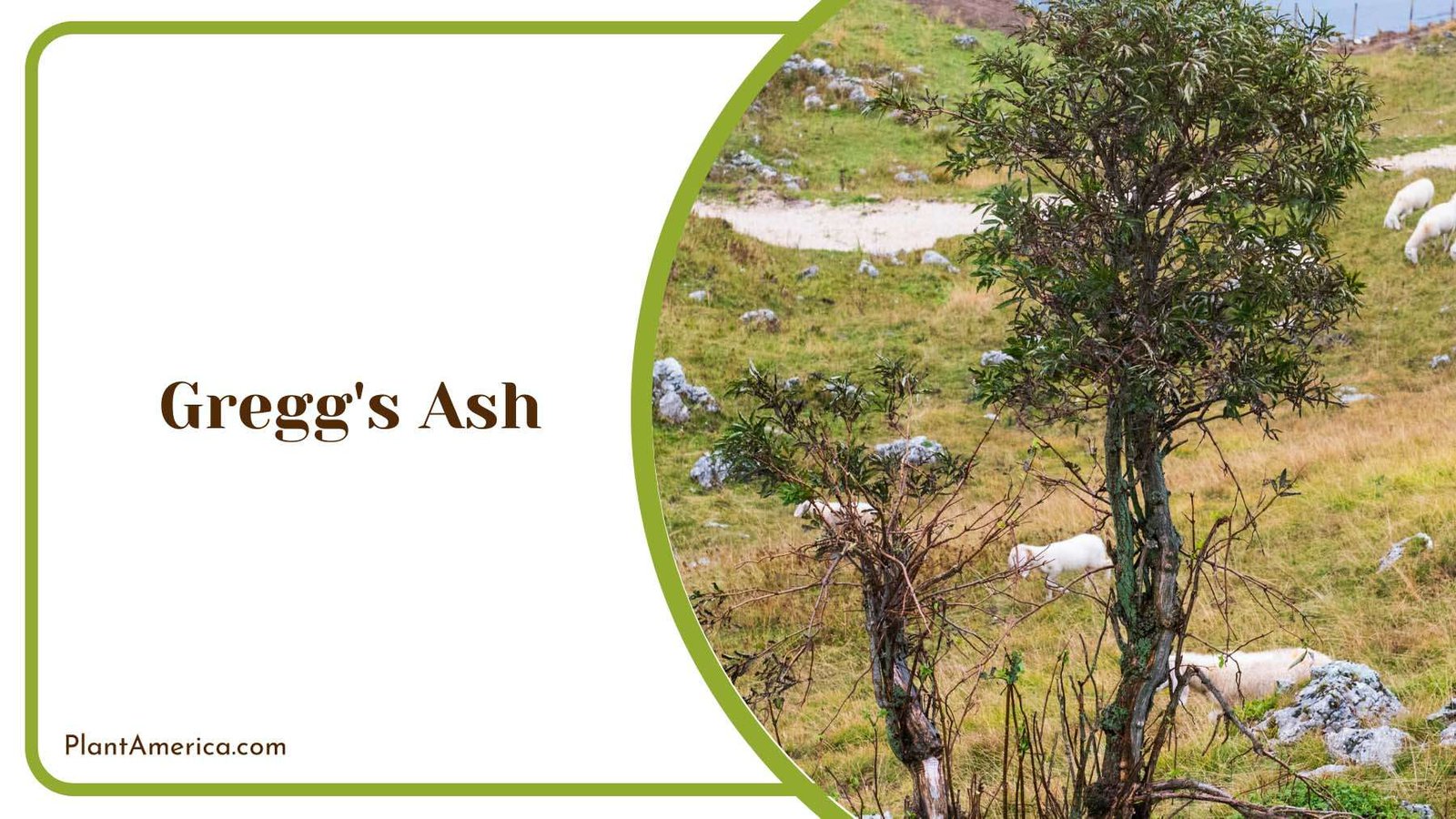
- Growing season: Late Spring, Summer.
- Leaf shape: Pinnate, Compound.
- Specific needs: Full Sun, Average Moisture.
- Common pest: Emerald Ash Borer, Mites.
Gregg’s ash is a small deciduous native tree of western North America. It has gray-green compound leaves and pale gray, furrowed bark.
Gregg’s ash typically grows 20-30 feet tall, producing fragrant yellowish-green flowers in late spring.
It thrives in well-draining alkaline soils and warm climates. Once established, it can withstand drought due to its small stature and shallow root system. The bark develops an attractive layered texture as it matures.
Unfortunately, the emerald ash borer poses a threat. Choose a borer-resistant cultivar from a reputable nursery and monitor closely for signs of infestation.
Water regularly when young to establish healthy roots, then reduce watering as it matures. Apply organic or slow-release fertilizer in spring and prune lightly after flowering to maintain an attractive form.
Ash trees offer many options for residential landscapes. There are numerous ash varieties suited to North American yards and gardens. Ash trees come in various species, shapes, sizes, and colors, providing shade, seasonal interest, and wildlife benefits.
One can choose an ash tree based on characteristics. Some work well as small ornamental trees, while others provide yard shade. Many ash trees also feature spring or fall flowering displays. Ash trees also vary in hardiness, growth rate, and maintenance requirements.
Conclusion
Many beautiful varieties of ash trees are suitable for adding to your backyard landscape. Each species has distinct characteristics that make them a worthwhile addition to the right garden.
- The blue ash (Fraxinus quadrangulata) is a medium-sized deciduous tree native to the Midwest and Southern United States.
- Gregg’s ash is a small deciduous native tree of western North America that has gray-green compound leaves and pale gray, furrowed bark.
- The Oregon ash prefers moist, well-draining soils and is commonly found growing along streams, riverbanks, floodplains, and gullies.
Despite threats from pests like emerald ash borer, ash trees remain a practical and often picturesque choice for your garden when selecting borer-resistant varieties. So why not consider adding an ash tree’s unique shape, fall color, or adaptability to enjoy for years?