
If you’ve ever asked yourself, “Why do roses have thorns?” then you should know that roses have thorns on their stems to defend themselves from predatory animals, pests, and insects. Apart from these, thorns also serve other specific purposes, aiding in the plant’s overall survival.

Every living thing on this planet subconsciously uses specific strategies to live, and the rose plant is no different; hence, this article answers the most commonly asked question: “Why do roses have thorns amidst their beauty and fragrant scents?”
Our experts also dive deeper, exploring the role of these prickly and tiny thorns that are often frowned upon, along with some information on thornless roses!
Why Do Roses Grow Thorns?
💥 Roses grow thorns to defend themselves from invaders such as insects, animals like deer and rabbits, and sometimes even from us humans. Apart from this, thorns also keep away sap-sucking garden pests from the attractive blooms, making sure that they can grow without obstacles.
This encourages the climber roses to develop above their support and expand their area to soak in as much sunlight as possible for better photosynthesis.
– Protection From Herbivores
For herbivores, bushes and shrubs are an attractive piece of a meal and often a primary food source. You may often find some animals, such as rabbits, goats, and deer, destroying shrubs and bushes and uprooting them from the soil.
Such predators can even attack rose bushes, ripping them off in their entirety, chewing the juicy leaves, and feasting on the several whorls of the flower. Hence, to deter such animals from attacking the rose bushes, there are several thorns on the stems.
Thorns are present to prevent such herbivores — animals that consume plants — from destroying the leaves that the plant expended so much energy producing.
They won’t attack the plant because of the thorns as it acts as a caution to stay away from it. The rose plant physically protects itself by stinging herbivores, known as physical defense, warning the animals not to consume or approach any part of the plant.
So for animals that adore the rose blossom, it might be difficult as it might easily get pricked with one stalk of a rose flower containing many thorns.
– Keeps Insect Invaders Away
Roses have thorns for essential reasons such as survival and defense against potential invaders like insects. The undeniable splendor of roses attracts a lot of garden insects to them, such as ants, caterpillars, mites, bees, slugs and bugs.
These pests can chew on leaves, weave a web to lay their eggs, and damage stalks and blooms by sucking out their sap. Hence, roses had to find a strategy to defend themselves and live against these invaders.
They created thorns, those nasty sharp protrusions, piercing creatures among the lovely roses, thereby deterring the ants and caterpillars that tend to feast on the leaves and the stems. These stinging prickles keep unwelcome admirers away.
The survival of the shrubs, especially those that grow as a wild rose, depends on the thorns amidst the roses, which shield the bloom for the best chance of survival. Several thorns make it difficult for the pests to climb up stalks, lay eggs or survive in its foliage.
– Act as Hooks
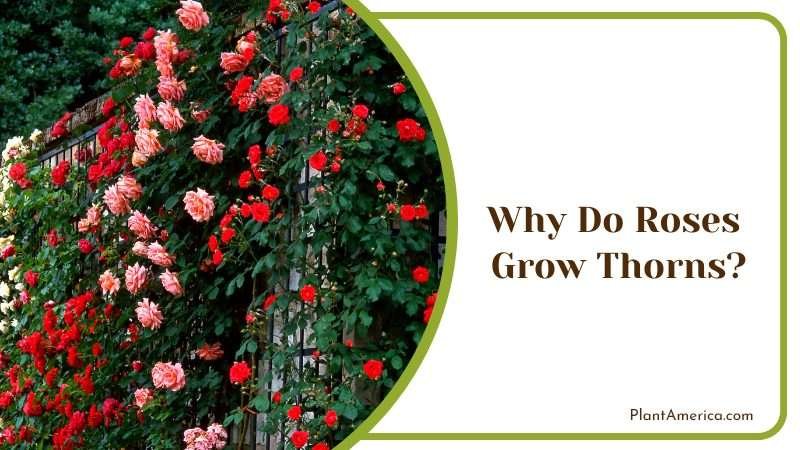
The majority of rose prickles are curved downward for another significant reason. Roses climb over other plants as they get bigger.
In such a scenario, these prickles act as hooks to help the rose branches anchor onto the nearby unfortunate plant foliage. Once hooked, the rose can climb over other plants and grow taller to obtain as much sunshine as it requires.
The flip side is that as the roses develop, they may dominate the sunlight, starving and killing the plants they grow over due to their apathetic nature.
Roses benefit from ample sunshine in a row of plants if grown together. But they tend to easily monopolize other plants for the sunlight by rising to the position of a dominant plant. After some time, the nearby plants perish as a result of starvation.
– Aids in the Process of Photosynthesis
Simply put, photosynthesis is how plants eat, and a rose thorn aids the flowering plant in producing more food. So apart from protection from invaders, the sharp pointed projections likewise serve another crucial purpose on the rose flower stalks’ bark.
As the rose bloom develops, each stem offers a grasp on the outside of other plants, gaining support from them in the process, as mentioned in the above section.
The thorns are at an angular bump of almost 0.30 inches long, along with a downward arch, which helps the rose stems grow in the direction of more sunlight.
Therefore, they expand the portion of the plant’s surface to reach out for more sunlight, which is a necessary thing in the process of photosynthesis. This is how thorns assist the rose plant in several other ways besides serving as a predator deterrent.
– Keeps the Rose Plant Hydrated
The thorns on a rose plant may still be an inconvenience for growers, gardeners, and designers even though they have a purpose to serve. Apart from the reasons mentioned above, did you know the thorns’ downward-sloping curvature serves another vital function?
This fantastic natural design allows water or moisture in the air to drop directly toward the roots, and this is highly beneficial to the plant, especially in dry seasons.
Although it can be hard to believe, the downward orientations of the spines help water to be directed to the soil. Water in the form of tiny droplets is quickly redirected from the top to the base by the downward slope of the prickles, helping to hydrate the plant instantly.
So whether it is the mist, tree drops, or the moisture in the air, the thorns help indirectly provide additional water straight to the root system, significantly when the plant is being grown in an arid zone.
– Protects the Blooms
The prickles also help to prevent spoilage or injury to the flowers. The downward-sloping rose thorns protect the blooms from common garden pests, which crawl up to eat the leaves and buds. The thorns take on this shape to help the flower adhere to the surfaces of other plants, especially for a climbing rose species.
The purpose of thorns is to shield the flower from pests drawn to aromatic flower bulbs and aid in preserving the flower’s potent scent. The vibrant colors, tasteful petal arrangement, and appealing aroma of rose carnations make them attractive. Thorns, however, can be found among these lovely blooms and have evolved to cause their admirers harm.
– Safeguards the Plant
Thorns are those sharp protrusions that occur on the rose blossom stalks, correct? No, it isn’t precisely so!
Thorns are thorns to people like you and me, who are not experts in botany. However, roses have prickles rather than thorns or spines and botanists have discovered slight changes in each one of these, even though they appear identical to the untrained eye.
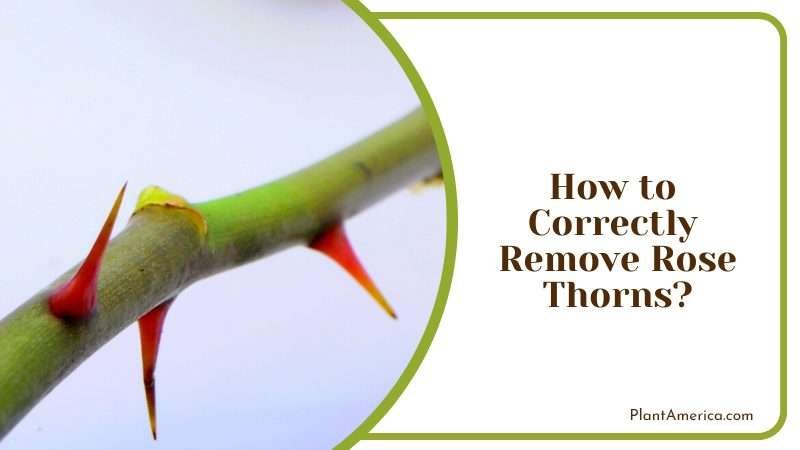
Prickles, as they are known in roses, are growths of the stem’s bark and have no internal tissue linked to the plant, making them simple to remove, whereas thorns can be seen in the bougainvillea-like trees and are more durable than prickles since they are bent branches.
These sharp projections on a rose shrub are, in fact, modified epidermal cells (similar to human skin cells), much like coarse hair.
The nodes’ bristles cannot be seen, and they are softer than the thorns overall, but they safeguard the plant. In terms of their origins and tenacity, thorns and prickles are distinct; however, both function to deter predators from attacking the plants.
Are Thorns Present on All Roses?

No, thorns are not present in all types of roses. Some rose varieties have very few thorns on a single stalk, while others even have none. In fact, a tiny percentage of the world’s roses — more than 30,000 different varieties — do not have prickles.
There are many different kinds of roses; some are tiny, standing no taller than 8 inches, while others scale on a surface and can grow up to 50 feet in length. Yet, each bloom has undergone vigorous breeding, resulting in several variations.
Some hybrid roses, such as climbing, English, Grandiflora, and hybrid tea varieties, are grown primarily for their non-prickle characteristics. Thornless roses are frequently hybrid plants produced due to spontaneous mutation. Here are the types of roses without thorns:

– Thornless Climbing Roses
Have you ever wondered how many thorns a rose has? Climbing roses have none, which makes them much sought after, especially by those often bogged down by the presence of thorns on stems.
Bush or hybrid tea roses have undergone mutation to become climbing roses. They are noted for their exceptionally long canes, which keep becoming longer.
Fortunately, most of the varieties of climbing roses are thornless, growing up to 12 feet tall and bearing enormous, fragrant pink blossoms. This makes it a pleasure to grow in your garden.
– Thornless English Roses
This thornless English rose was first introduced by David Austen, an English hybridizer, in 1969. This is why this plant is also called David Austen Roses. This thornless rose is unique because it combines the exciting features of traditional roses with more contemporary ones.
– Thornless Heirloom Roses
Heirloom roses are an antique rose hybrid variety produced around 1867, and they tend to grow taller and bushier each year than modern hybrids. These open-pollinated garden roses are simple to grow and, of course, are entirely thornless. They are commonly planted in children’s gardens or on sidewalks as they are thorn-free.
– Thornless Hybrid Tea Roses
In 1867, two different rose types were crossed to create hybrid tea roses, which are thornless. They can reach heights of 3 to 7 feet and widths of 3 to 5 feet, but they need USDA hardiness zones of 5 to 9 to develop well. These are very popular in cut flower arrangements as there aren’t any thorns to be removed.
How to Correctly Remove Rose Thorns?
To correctly remove a rose’s thorns without hurting yourself, first you have to make sure that you have the right materials for it, and you also have to make a clean cut on the rose. Removing thorns without the necessary precautions can lead to cuts, so be extra careful.
Now that you have the answer to the pertinent question of why roses have thorns and an idea about their primary function, let’s explore how to remove this powerful foe from a lovely and vibrant flower if you desire to.
There are easy methods to remove a thorn if you’ve decided to get rid of them and just retain the flower’s beauty. In that case, you should know how to eliminate an unyielding thorn.
– Get Yourself the Right Gear
To begin with, you’ll need a pair of scissors and some thick gloves. The thorns will pierce even the majority of all-purpose gardening gloves, so if you want to pick a rose without bleeding, you’ll need special gloves, or you will need to be very careful.
– Place a Clean Cut
Remove the thorns while causing the least amount of tissue damage. The simplest way to get rid of them at home is to break them off by hand and push them aside. For a cleaner cut, remove the prickly section of the thorn and work your way down to the base.
Doing so will give you a much safer stem to work with. A thorn cutter or stripper is recommended if your project is more challenging. To avoid damaging the stem, be careful not to pull it apart when taking the thorn away.