
Types of yew trees provide abundant benefits for your landscape design, from structural beauty and evergreen privacy to attracting wildlife and excellent resistance to cold temperatures.
Whether you seek stately hedge rows, vibrant foliage colors, or sculptural tree shapes to transform isolated areas, yew trees offer a diverse selection for creating an English garden sanctuary within your outdoor space.

If you wish to incorporate some eye-catching yew varieties that will beautify your landscape for many years to come, consider the various options for withstanding the elements while adding year-round natural charm. So read on to discover these beautiful but budget-friendly types of yew that can bring charm and beauty to your yard all year round.
Types of Yew You’ll Love for Their Beauty and Versatility
1. English Yew

- Growing season: Evergreen
- Leaf shape: Linear, Flat needles
- Specific needs: Moist, Acidic soil
- Common pests: Spider mites, Aphids
The English yew, a classic evergreen with a dense, pyramidal shape, can grow up to 40 feet tall outdoors or remain dwarfed when potted. Its linear leaves form spiraling, upright branches that become dense and knobby with age. Thriving in moist, well-draining soil enriched with organic matter, these yews require regular watering for their shallow roots, especially during dry spells. Occasional fertilizer and pruning are recommended for new growth, ensuring a compact shape.
To combat spider mite infestations, horticultural oils can be sprayed, preventing issues before they take hold. If left unpruned, English yews naturally develop into pyramid shapes. Regular shearing, however, produces tight spheres or column shapes, making them versatile for garden hedges, foundation plantings, or thematic topiaries.
The English yew’s resilience to brutal pruning and hard clipping has solidified its status as a reliable landscape choice for centuries, often serving as living sculptures in English manor gardens.
The fine-textured, lance-shaped foliage of English yews creates an intimate sense of enclosure when massed as a hedge or individual plantings. Consider underplanting yew foundations with spring bulbs or shade-loving perennials for added visual interest. With proper care, English yews face minimal pest problems, and regular inspection and removal of affected leaves help minimize issues. Pruning also improves air circulation to ward off fungi and mildew.
Traditionally gracing classic English gardens, the handsome forms of English yews have been a staple for centuries. Their dense, mounded shapes not only provide structure and formality but also offer privacy and a sense of separation. The architectural appeal of the English yew further enhances its ability to define different garden spaces.
2. Japanese Yew

- Growing season: Evergreen
- Leaf shape: Linear, Flat needles
- Specific needs: Partial shade, Well drained soil
- Common pests: Spider mites, Bagworms
With an upright, narrow form and delicate foliage, Japanese yews are evergreen and can reach up to 20 feet in height, whether cultivated indoors or outdoors. Characterized by linear needles emerging from upright branches, these yews create narrow, columnar shapes.
Thriving in moist, acidic soil with consistent moisture, a layer of organic mulch helps retain soil moisture and insulate shallow roots from temperature fluctuations. Pruning after flowering is essential to maintain their distinctive shape.
Japanese yews, known for their bright red berries, are relatively pest-free when cared for properly. Spraying horticultural oils can address occasional spider mites or scale insects, while fertilizing in spring boosts berry production.
Their vertical, spire-like form makes Japanese yews ideal for tall, narrow hedges, privacy screens, or accent plants. Mass planting them together creates a living fence with an orderly texture, while pruning lower branches transforms individual specimens into narrow topiary trees.
The linear foliage of Japanese yews lends an open, airy texture, making them unique among yews. Consider interplanting them with flowering perennials that complement their berry display, and spring bulbs at their base enhance their vertical forms. Regular pruning maintains a clean, spare silhouette, projecting an ordered sense of formality.
Japanese yews rely on bright red berries to stand out in the winter garden. Maximizing berry production involves exposing branches to full sun, moistening roots regularly, and pruning after flowering. Both male and female plants are needed for pollination, and fertilizing again in late summer increases berry yields the following winter.
With their narrow, columnar form and two-toned effect from brightly colored berries, Japanese yews serve as sculptural choices for framing entryways, oriental gardens, and modern landscape designs.
Lined in a row, they transform traditional spaces into ornamental corridors, evoking a sense of ceremony and procession. Left unpruned, they naturally develop tall, narrow columns, while regular pruning maintains shorter hedges suited for contemporary outdoor rooms.
The statuesque silhouettes of mature Japanese yews lined in a row transform traditional gardens into ornamental colonnades that frame vistas, soften rectilinear structures, and provide shelter for perennial displays. Their two-toned contrast of dark green columns punctuated by crimson dots offers visual balance and Zen-like simplicity.
Regular care, including fertilizing, pruning, and pest control, ensures Japanese yews’ health, longevity, and berry production, ensuring their sculptural forms and ornamental berries retain visual appeal for many cold winter seasons. Maintaining high vitality and vigor ensures these decorative yews remain lush, complete, and vivid for years of winter delight.
The architectural symmetry, orderly texture, and bright winter fruit of Japanese yews imbue simple geometric forms with complex layers of meaning. When properly cultivated and pruned, these versatile evergreens become living metaphors for discipline, formality, and enlightened simplicity in the garden.
3. Golden Irish Yew

- Growing season: Evergreen
- Leaf shape: Narrow, Columnar
- Specific needs: Moist, Full sun
- Common pests: Scale insect, Spider mites
The Golden Irish Yew, a highly sought-after ornamental evergreen shrub, is cherished for its dense, compact growth habit and striking yellow and gold foliage. Originating from Western Europe and North Africa, this shrub has found global popularity as an accent plant in landscapes. Despite its slow growth, the Golden Irish Yew is robust, gradually forming a bushy, rounded structure that typically stands 4 to 6 feet tall and spreads at maturity.
In early spring, hardy twigs give rise to new growth, adorned with small clusters of pale yellow flowers. Although these blooms are inconspicuous and short-lived, they play a crucial role in the shrub’s lifecycle. By mid-summer, the faded petals transform into vivid crimson red arils, or false fruits, each containing 1 to 3 pyramid-shaped seeds within its succulent interior.
As autumn arrives, the arils dry on the shrub, their once-plump skins hardening and cracking open to expose the securely held seeds. A closer look reveals that each seed is attached to an intricate membranous wing, poised for wind dispersal. With the onset of fall, gusts of wind catch these fragile winged seeds, launching them away from the parent plant.
Some seeds travel only short distances, settling nearby or onto neighboring flora, while others journey much farther on unpredictable air currents. The hardier seeds, deposited in locations with suitable soil moisture and environmental conditions, overwinter before potentially germinating in the warmth of spring.
This natural wind-driven propagation allows Golden Irish Yews to steadily expand their presence and range independently, devoid of human intervention. The shrub’s self-perpetuating and durable characteristics have contributed significantly to its ability to thrive as a favored ornamental plant across the globe.
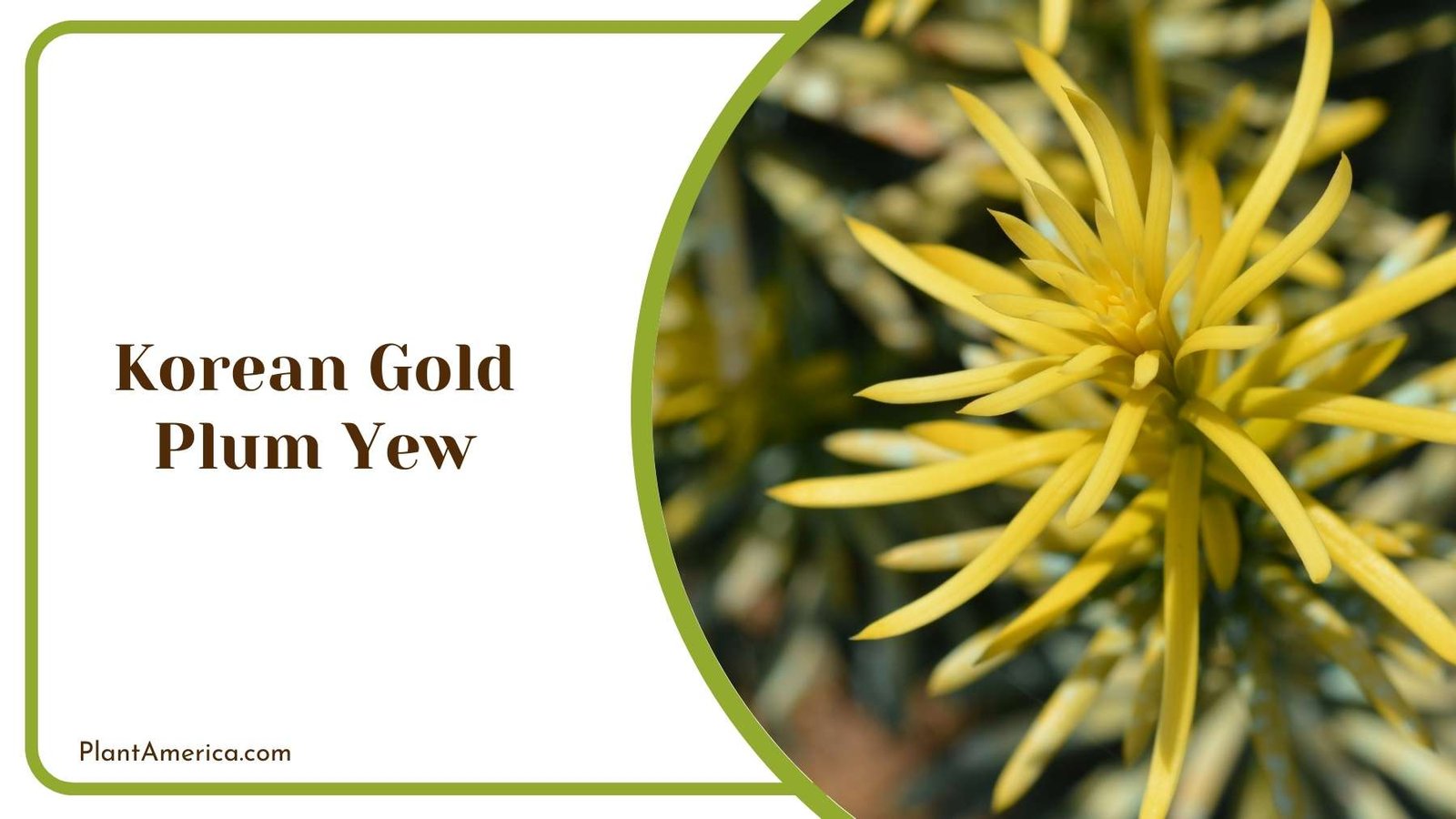
4. Korean Gold Plum Yew
- Growing season: Evergreen
- Leaf shape: Linear, Flat needles
- Specific needs: Moist, Well drained soil
- Common pests: Bagworms, Scale insects
The Korean Gold Plum Yew stands as an elegant evergreen shrub, celebrated for its vibrant foliage. Indigenous to eastern Asia, this plant has gained global popularity as an ornamental gem.
Its gradual growth over the years results in a dense, rounded habit, typically reaching 3 to 5 feet in both height and width at maturity. The thick branches bear small leaves that emerge in a captivating bronze-purple hue each spring, transitioning to shades of gold, orange, and red as winter approaches.
In early spring, alongside the emergence of new growth, the Korean Gold Plum Yew produces inconspicuous yet vital yellow flowers. These flowers play a crucial role, developing into decorative fruit as summer progresses. By late summer, the flower petals give way to crimson berries, each containing 1 to 3 hard, plum-colored seeds within a juicy pulp.
As autumn unfolds, the berries dry on the branches, their plump skins hardening and cracking open to reveal the seeds nestled within. A closer look shows each seed attached to a papery wing—an ingenious adaptation for wind dispersal. With the arrival of fall breezes, these winged seeds are released from aging berries and carried away from the mother shrub, their membranous wings acting as helicopter blades for extended windborne travel.
Some seeds settle only a short distance away, landing among leaf litter or at the bases of other plants. Yet others catch stronger updrafts, dispersing their DNA across neighborhoods, parks, and forests. If these windborne seeds find suitable soil conditions, a percentage may take root and germinate in the following spring.
This method of wind-driven propagation enables the Korean Gold Plum Yew to naturally colonize new areas over decades and generations. Its low-effort, self-distributing quality has likely contributed to its success as an ornamental plant worldwide.
This hard-working shrub can thrive where planted without reliance on animal vectors or human cultivation. For landscaping purposes, the Korean Gold Plum Yew stands as a carefree choice, dynamically sustaining itself through environmental stresses with the simple assistance of seasonal breezes.
5. Irish Yew

- Growing season: Evergreen
- Leaf shape: Linear, Dark green needles
- Specific needs: Well-drained soil, Full sun to shade
- Common pests: Aphids, Scale insects
Irish Yews, characterized by their short and dense stature, boast twisted branches and vibrant red berries. These overgrown, tidy shrubs reach a mature height and width of six to eight feet. Linear needles spiral densely around their woven branches, creating a whimsical and unpredictable appearance. Thriving in moist, acidic soil and partial shade, Irish yews benefit from occasional pruning and shaping while young, along with an annual spring fertilization.
Relatively pest-free when cared for properly, Irish yews can be safeguarded against rare mite or aphid infestations through dormant horticultural oil spraying. Leaving berries for winter bird sustenance minimizes issues, and regular inspection and removal of diseased leaves help maintain a healthy environment. Their compact form and playful woven branches make Irish yews ideal for accentuating doorways, softening architectural edges, or creating low hedging.
Bright red berries enhance their textural appeal in winter, especially when mass-planted to form informal hedges or screens. Underplanting with shade-loving perennials and bulbs further enhances their charm. The tangled, contorted branches of Irish yews bring a sculptural effect to formal landscapes, adding an element of organic movement.
Pruning can develop a chaotic yet tidy shape, creating a contrast with controlled ornamental plants. Shearing them into tight, knotted spheres transforms them into miniature topiary specimens. Their small stature and brightly colored berries make Irish yews perfect for brightening winter gardens. Maximizing berry production requires full sun exposure, regular pruning, a mix of male and female plants, and providing berries for bird feeding.
New growth emerges from chartreuse before darkening, introducing unexpected color to shady landscapes. Irish yews infuse a sense of enchantment into modern gardens with their diminutive stature, twisted branches, bright scarlet berries, and ambiguous spatial forms. Use them sparingly alongside taller evergreens for visual contrast and a touch of whimsy. Tucking Irish yews around larger structures adds an element of secretive magic, delighting the imagination.
Pruning Irish yews hard after flowering in spring accentuates their fairy-like charm with dense, knotted branching. Heavy pruning improves airflow, reducing disease risks. Regular feeding and watering during summer enhance their health and cold hardiness for winter.
With their compact size, informal shape, and color variations, Irish yews offer enormous versatility in landscape design. Whether on slopes, in stone planters, among perennials, or under taller evergreens, their diminutive stature brings enchantment to hidden corners. No formal garden is complete without at least one aged Irish yew, adding a touch of the fantastic and otherworldly.
6. Sumatran Yew

- Growing season: Evergreen
- Leaf shape: Lance shape, Flat needle
- Specific needs: Partial to full sun, Well drained soil
- Common pests: Scale insects, Spider mites
The Sumatran yew, a majestic evergreen tree native to the montane tropical rainforests of Indonesia, stands tall at maturity, reaching heights of 50 to 80 feet. With a cylindrical trunk and an intricate branching system forming a wide canopy, its dark grey-brown bark contrasts with the glossy green leaves arranged spirally along the stems.
In early summer, inconspicuous reddish-purple flowers grace the foliage, transforming into distinctive tiny fruit by late summer. These bright red berries, about five to seven millimeters in diameter, house one to three shiny brown pyramid-shaped seeds within their juicy flesh.
As autumn arrives, the berries dry and shrivel on the branches, exposing the seeds stored inside. Each mature seed is delicately attached to a membranous wing, a simple yet ingenious adaptation for wind dispersal.
As fall winds pick up, they catch these winged seeds, lifting them high into the air. The papery wings act like helicopter rotors, enabling seeds to spin great distances from the parent tree upon prevailing breezes. Some seeds land close by in the forest soil, while others catch thermals that carry them miles across mountains and lowlands.
Seeds settling in conditions conducive to germination and growth may put down roots and sprout anew the following spring. Through this natural propagation via wind dispersal over generations, Sumatran yews have thrived and proliferated widely without direct human involvement.
This carefree, self-perpetuating reproductive strategy has undoubtedly contributed to the widespread distribution and abundance of Sumatran yews throughout their homeland rainforests. Their elegant stature and durable nature make ornamental cultivars a worthy choice for low-maintenance landscapes.
Conclusion
While yews do require some specific care, like moist, acidic soil and regular pruning to maintain their forms, these resilient evergreens can bring beauty to your garden for decades with minimal effort.
- Japanese yews are an evergreen shrub or small tree featuring dense, spiral branching that bears thin, linear leaves and grows to a height of 15-20 feet, ideal for privacy hedges or living fences.
- Golden Irish yews are a compact, dwarf broadleaf evergreen sporting graceful arcs of golden yellow, needle-like foliage and thriving as a thickly bushy accent shrub up to 6 feet tall.
- English yews are evergreen, growing up to 40 feet tall outdoors or remaining dwarf when potted with their linear leaves form spiraling, upright branches that become dense and knobby with age.
- The Irish yew is a slow-growing, dense evergreen shrub prized for its rigidly vertical, broad-columnar form defined by branching spirals that emerge clockwise, bearing dark green needle-like foliage in tight spirals along stems while maintaining compactness even at maturity.
- The Korean Gold Plum Yew is an attractive, slow-growing dwarf evergreen shrub valued for the gorgeous profusion of its rigidly upright, compactly rounded branches that become densely needled all over in bright, rich gold-colored foliage.
Ultimately, the right yew for you comes down to matching the perfect variety to your vision for the specific spot in your landscape. Whether you want privacy, structure, year-round color, or simply a dose of evergreen contrast, there is a stunning yew out there waiting to transform your outdoor space.