
If you are curious about Snow Queen vs Marble Queen pothos and want to know which plant of the Araceae family is a better option for your garden, then you have come to the right article.
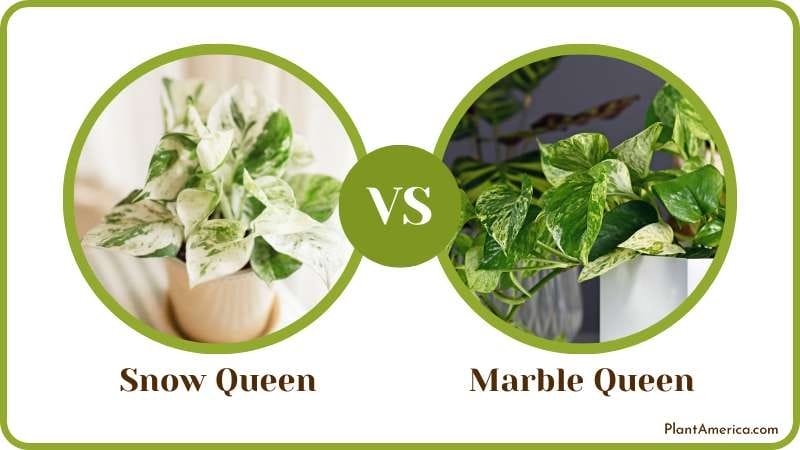
These Epipremnum genus plants are similar yet have distinct differences. Continue reading to know more about them.
Quick Overview
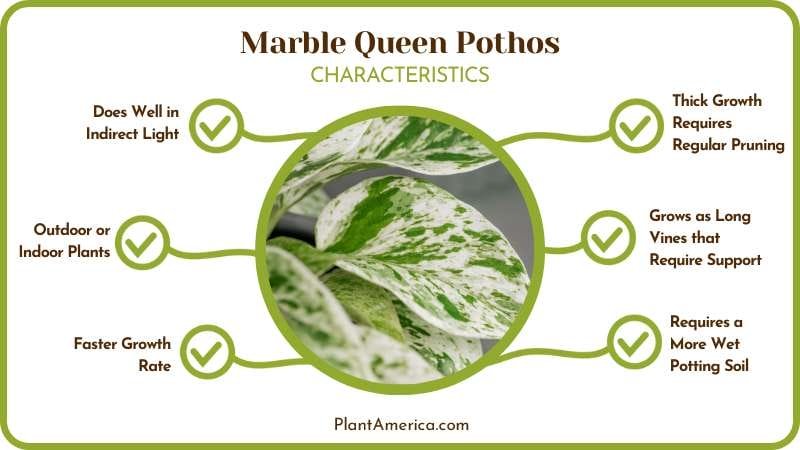
Take a look at this table of comparison illustrating the difference between marble queen and snow queen pothos.
| Snow Queen Pothos | Marble Queen Pothos | |
| Leaves | White with tinges of light green with slightly pointed tips | More green with cream-colored variegations that do not taper much |
| Environment | Outdoor or indoor plants | Outdoor or indoor plants |
| Light | Needs four hours of direct light or artificial light | Does well in indirect light |
| Growth | Slow growth rate and will stay the same way for long. | Faster growth rate, requiring pruning more often |
| Care | Easy to care for with limited pruning | Thick growth requires regular pruning |
| Propagation | Grows easily without support | Grows as long vines that require support |
| Water and Soil | Uses less potting soil and requires less moisture | Requires a more wet potting soil |
Difference Between Snow Queen and Marble Queen Pothos
The main difference between these plants is that the Snow Queen has much whiter leaves than the Marble Queen, and Marble Queen plants also grow taller than Snow Queens.
Both the Snow Queen and Marble Queen plants belong to the family of Epipremnum Aureum. Both are varieties of pothos plants, but there are some easy to identify differences between the two.
Find the visual cues listed below t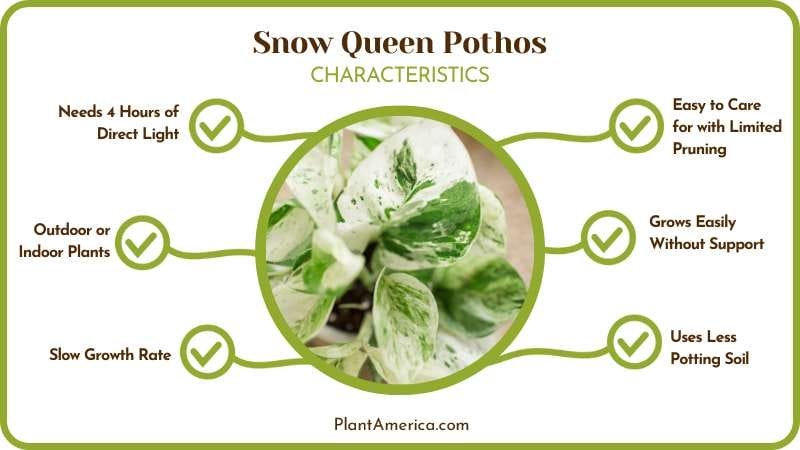 o easily identify them.
– Leaf Markings
The Snow Queen has much whiter leaves in comparison to the Marble Queen pothos. The variegation present on Snow Queen is white with tinges of light green on it. You will find the Marble Queen pothos with cream-colored variegations that are more distinct.
The variegations of Snow Queen pothos are in general 80 percent white and 20 percent green. Marble pothos variegations are 50 percent white and 50 percent green.
– Leaf Shape
Both pothos plants may have heart-shaped leaves, but there is a slight notable difference between them. The leaves of the Snow Queen plant have slightly pointier tips that taper down when compared to Marble Queen leaves.
– Growth Rate
The growth of Snow Queen is slower than Marble Queen Pothos. The plant will require less pruning in comparison to Marble Queen, which has a higher growth rate. The Snow Queen stays the same way for a longer time.
– Size
In comparison to the Snow Queen, the Marble Queen plant grows taller as it can reach over twenty feet high. The Snow Queen plant reaches a maximum height of about three feet.
In case you wish to confine the growth in height of your marble pothos, you can stay away from replanting it into a larger pot. Keeping the plant in a smaller pot will confine its roots a bit, thus restricting its height.
– Growth Speed
Marble Queen pothos is a more vigorous plant. The leaves contain more chlorophyll and thus, the competition for nutrition is better. They grow faster, and their foliage can even reach larger heights because of the presence of more chlorophyll.
If you are looking for a fast-growing and vigorous plant then Marble Queen pothos would be a perfect choice.
Snow Queen pothos, on the other hand, is the more compact plant. They take time to grow as well. If you want slow-growing plants, then the Snow Queen is a good option.
– Potting Soil Requirements
Because Marble Queen pothos plants are more vigorous in their growth, they will require more potting soil. You will thus be required to keep them in a larger pot or container. If planted in the soil, they will occupy more space as well.
Snow Queen pothos occupy lesser soil space. All you need is a small pot or container to raise this compact plant.
– Susceptible to Diseases
The Snow Queen plant is more susceptible to fungal and bacterial diseases. This is because the plant contains less chlorophyll. The plant is especially vulnerable to fungal spore damage that causes brown spots on the leaves.
The Marble Queen pothos has a stronger immunity due to a large presence of chlorophyll. They are more resistant to fungal infections.
– Light Requirements
As discussed above, the Marble Queen plant is more vigorous with more chlorophyll present. Because of this, the plant requires more light to thrive. The plant grows well in the sun, but not in harsh direct rays.
Place them on the east or west facing side if indoors and they will develop well. Under an insufficient amount of sun, the Marble Queen will tend to be less variegated, which means its leaves will turn green and not white.
The Snow Queen needs light but not as much as the Marble Queen does. With just the right amount of sunlight, the variegation on the leaves will become more pronounced. The right location to place the Snow Queen is on the south side of your house. This amount of sun is perfect for the plant to thrive.
– Water Requirements
Marble Queen needs more water than Snow Queen pothos. During the spring season, the Marble Queen needs to be watered daily. Summer will require more watering and wet seasons much less. Check the soil moisture to decide if you have to water the plant or not.
The Snow Queen dries out its soil slowly, so on average, it requires less water than the Marble Queen.
Do not overwater both varieties, especially the Snow Queen, as this plant is more susceptible to diseases. Overwatering can lead to root rot and the plants may eventually die.
– Fertilizer Requirements
Marble Queen requires an additional amount of fertilizers. Being a plant that grows aggressively, its nutritional requirements are more pronounced as well. Fertilizers will provide the nutrients that this plant needs.
The best product to use would be slow-release fertilizer. Add this in early spring.
Snow Queen plants do not require the use of fertilizers. With limited chlorophyll in it, it doesn’t grow fast or vigorously, so the usage of fertilizer will not make any difference to its plant growth.
– Pruning Requirements
It is obvious here that the plant that grows faster and thicker foliage will need more pruning.
Snow Queen plants do not need pruning. The plant grows slowly and seldom results in thick, unmanageable foliage. You will, however, have to remove old and diseased leaves when you see them.
Marble Queen is a fast-growing plant and will require more frequent pruning.
Caring for Snow Queen Philodendron
Snow Queen Pothos is often referred to as the Snow Queen philodendron too. The plant is an evergreen vine and comes with white or yellow variegated streaks. It is a common indoor plant as it is easy to grow. Here is how you can care for this plant properly.
– Soil
Snow Queen plants thrive in different kinds of soil. The best one to use would be an all-purpose potting mix. It is a hardy plant and manages well as long as the soil drains well.
Ensure the soil is just moist enough, neither too dry nor too wet. Wet, soggy soils cause root rot. Use a pot with big holes that permit easy draining of water.
– Light
Snow Queen is a type of philodendron that can grow well indoors. They do not require much light. Four hours of direct light or artificial light is all that it needs.
The best practice would be to place them in a spot where they receive the morning sun. Keep them away from harsh sunlight as too much sun exposure can turn their leaves yellow.
– Watering
As mentioned above, the soil of the Snow Queen plant needs to be just moist. Do not overwater them. Water the top-soil only after the soil has completely dried out.
If your Snow Queen develops brown spots, this could be a sign of overwatering.
– Temperature
Snow Queen pothos are hardy plants. However, they grow best at 65 to 75 degrees Fahrenheit. They predominantly need to be in a warm environment.
– Humidity
The plant requires adequate humidity to stay healthy. Maintain humidity levels between 50 percent to 60 percent. The leaves of the Snow Queen will turn brown at a low humidity level.
– Fertilizer
The plant does not require much fertilizing, but you can use a low-nitrogen fertilizer once a year. Alternatively, you can also use a slow-release potting mix to keep the plant going for months.
– Pruning
Even though pruning is not a necessity for this plant, you will still need to do so occasionally. Pruning will help new shoots produce more leaves. You also need to carefully cut dried and decayed leaves off the plant.
Snip away wilting brown stems or infected ones. The best time to prune the Snow Queen pothos will be during early spring.
– Repotting Snow Queen
It is necessary to repot your Snow Queen plant when it outgrows the container it is currently in. The right time to repot the Snow Queen is at the beginning of spring as this is the beginning of the growth phase of the plant. Water the soil well as soon as it is repotted.
– Snow Queen Pothos Disease Control
Snow Queen pothos plants are more prone to fungal diseases compared to other varieties. If your Snow Queen pothos gets infected with fungal disease, spray a good quality fungicide as soon as possible.
You can find fungal disease in the form of light spots on its leaves. Spray the fungicide consistently as one single spray will not remove it completely.
The best way to prevent a fungal disease is to keep the plant in a spot where it receives good air circulation. If the plant is indoors, ensure the room it is in is well ventilated. Air is the best way to control the spread of disease on the plant.
Marble Queen Pothos Care
The white Marble Queen pothos with their green variegated foliage makes for a great indoor plant. The plant is native to French Polynesia and with the right care, it can adorn your indoor spaces and yard. Here is how you can take proper care of this plant.
– Light
Marble Queen pothos plants do well in indirect light. Keep the plant for some time during the day in the sun, but avoid harsh and direct sunlight. White Marble Queen pothos can get sunburned if left under the hot sun for a long time.
– Soil
Marble Queen pothos require well-drained loamy soil. You can also use a soil mixture consisting of one part potting soil along with perlite and orchid bark. This will make the soil airy and make the pothos develop well.
– Water
Marble Queen pothos are drought tolerant. However, you will still need to keep them watered. Water the plant to keep the topsoil moist, but do not overwater as it will make the soil soggy.
– Temperature
Marble Queen pothos thrives well at 55 degrees Fahrenheit. This makes them ideal houseplants. The plant cannot tolerate frost and cold conditions, so keep them in a warm environment to see them grow and develop well.
– Fertilizer
As Marble Queen pothos plants are vigorous in their growth, providing them with regular fertilization will bring about better growth of the plant. The right time to fertilize the plant is in the growth phase during the spring season. Fertilize with a balanced liquid fertilizer.
– Provide Support
The vines of the Marble Queen Pothos grow long. When provided with support, they can scramble up a tree or wall. You can then have them standing tall and erect.
– Increasing Variegation
To grow and maintain the best variegation for your pothos plant, you need to provide the best light conditions for it. The most important factor for increasing variegation for the pothos and making them look good as indoor plants is to give them light.
Provide them with indirect or artificial light and see your plant having more distinct variegations.
– Marble Queen Pothos Growth Rate
The Marble Queen pothos grow vigorously, which means that this plant can grow to great heights in a short amount of time. The foliage of the plant can produce many stalks shooting upwards.
– Fastest Growing Indoor Plant
Marble Queen is one of the fastest-growing house plants. With adequate care, it can grow at least twelve inches per month.
– Height
The Marble Queen pothos can grow to a maximum height of twenty feet. If you are shaping your plant with pruning, you can keep them small. Mature indoor pothos can have their leaves growing longer than three feet each. These leaves turn dark green at their base upon complete growth.
– Trailing Vines
Marble Queen pothos are trailing plants. Their vines hang and grow long as well. You will have to prune these vines if you want to keep them short and curtailed.
Better Soil or Water?
Both Snow Queen pothos, as well as Marble Queen pothos, grow faster in the soil in comparison to water. The roots tend to develop faster in water, but the growth rate is higher in soil. You can enhance their growth by following certain practices.
Grow Faster
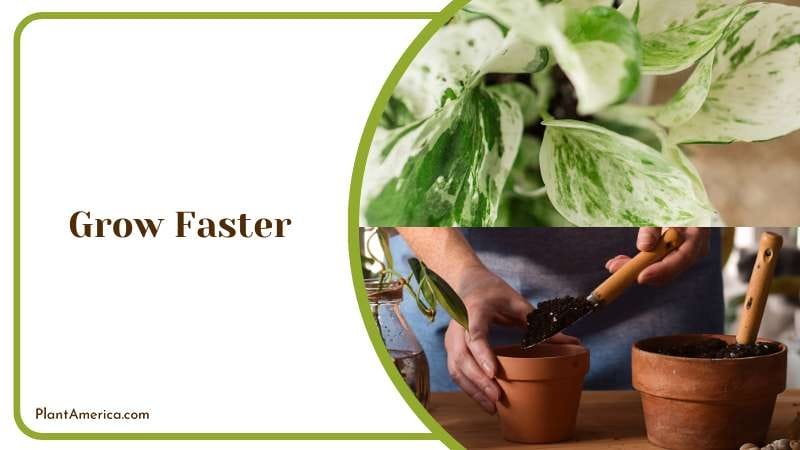
Whether you have a Marble Queen or Snow Queen pothos, you can make them grow faster by providing them with the basic needs and care they require.
– Watering Routine
Keep a close look at their watering. A good watering routine under semi-bright light can do wonders for the growth of pothos. It can even prevent root rot that may bring in fungal disease.
– Keep Your Soil Fresh
You can choose to either repot or mix nutrients with fresh soil regularly. This will help your pothos plants thrive well and grow faster.
– Bright Sunny Spots
Pothos plants need light. Place them on the brighter side of your home or yard and avoid direct sunlight.
What you need to provide them with is mild direct sunlight, preferably morning or late afternoon sun. Keep them near a window where the vines can get their fill of light.
– Rotate the Pot
For uniform and even growth, frequently rotate the pot in which the pothos plants are. This will ensure the entire plant gets a uniform amount of sunlight.
– Monitor the Temperature
Pothos may be hardy plants, but they can seldom tolerate frost and cold climatic conditions. Their growth tends to get slower when temperatures fall below their comfort range.
You also need to make sure you protect your pothos from frequent and sudden temperature changes. Maintain temperatures between 70 degrees to 90 degrees Fahrenheit for optimal growth.
– Humidity Levels
For faster growth of your pothos plant, provide it with more humidity. Pothos are predominantly tropical. Warm and humid conditions are the best for them. 
To increase humidity in the area around the pothos, you can use air humidifiers or create pebble trays.