
Landscaping with roses of the Rosaceae family may be simple or complicated, but the elegance that comes with each idea is what matters the most. One of the simplest styles that you can use to furnish your rose garden is by growing other plants between one type of rose.
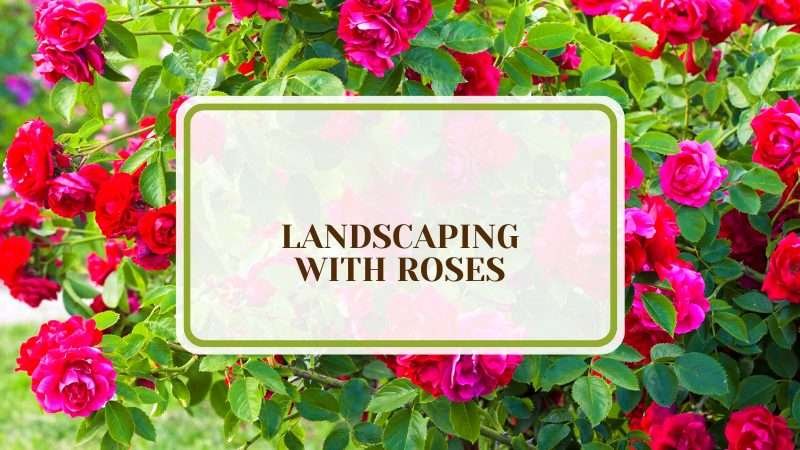
However, there are many other ways through which you can use roses to give your spaces an extra beautiful look. For more suggestions on how to design your outdoor area using roses, continue to read this article.
Amazing Schemes for Landscaping With Roses
Do you feel like you are running out of rose garden ideas? This article is an answer to your concerns – it will unleash fabulous ideas that you can apply in your rose garden at home. You will also be taught the advantages and specific care needs for each style.
1. The Random and Informal Style

| Types of roses used |
|
| What it looks like |
|
| Advantages |
|
| Specific care needs |
|
This landscaping idea is for those who love appearances that are relatively more organic, laced with a natural touch.
The easiest way to create the random and informal look is by getting as many types of roses as you can. Plant roses of different colors close to each other but make sure that you leave enough space between the plants.
You can then fill in the gaps between the rose plants with summer bulbs or herbaceous plants to give the look the finishing touch that makes it unique.
2. Potted Roses Style

| Types of roses used |
|
| What it looks like |
|
| Advantages |
|
| Specific care needs |
|
When space is a problem, a container garden will still give you the opportunity to enjoy the beauty of your roses. Once you have your big pot in place, spread bidem on its bottom, prior to adding a layer of stones.
You can then put your rose, which you will support using a shrub mix that has washed sand. Be sure to change the growing medium annually when you carry out the pruning procedure.
3. Rose-covered Arches

| Types of roses used |
|
| What it looks like |
|
| Advantages |
|
| Specific care needs |
|
It’s difficult, if not impossible, for one rose plant to completely cover the arch. This is why you should plant rose beauties on either side of the arch, keeping in mind that more plants will produce more flowers.
Control the way the stems of the climbing roses grow around the arch by twining and tying them around the structure.
Here is a million-dollar tip to take home一mixing different types of rises will give you unique combinations of blooms and you will never regret the effort.
4. The Borderline Style

| Types of roses used |
|
| What it looks like |
|
| Advantages |
|
| Specific care needs |
|
You can grow rose bushes at the edges of your flower beds. It is possible to grow these plants in an informal way, so that rises of different types, forms, and colors may interact and unleash a new ping of beauty.
If you are one of the people who prefer a more formal outlook, you can also achieve that by growing the roses in a more predetermined manner. In a formal layout, we recommend that you exclude other shrubs and flowers so that the appearance of the roses is less distracted.
5. The “Shelter” Style
| Types of roses used |
|
| What it looks like |
|
| Advantages |
|
| Specific care needs |
|
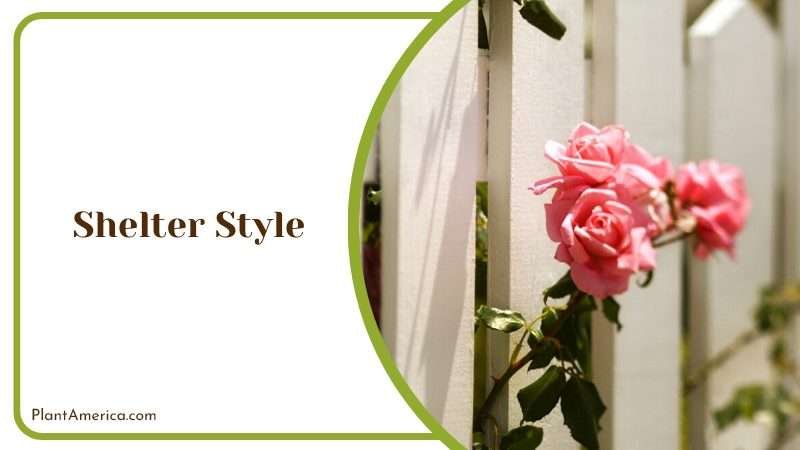
Some of the roses that can be used for the “shelter” style have exceptionally great fragrances, especially the Rose “Iceberg.”
The blooms themselves have a soothing effect, specifically when you feel low. This landscaping idea is an easy way to surround yourself with nature when you need to.
6. The Horizontal Wire Style

| Types of roses used |
|
| What it looks like |
|
| Advantages |
|
| Specific care needs |
|
This method of landscaping also applies if you desire to grow your plants along trellis or walls. Did you also know that growing your roses against a horizontal wire tends to increase flower formation?
This will see you have a more decorated space with roses that grow horizontally. If you don’t prune the sporting branches regularly, the design might be ruined as the irises become bushier.
7. The “Cottage Garden” Style
| Types of roses used |
|
| What it looks like |
|
| Advantages |
|
| Specific care needs |
|
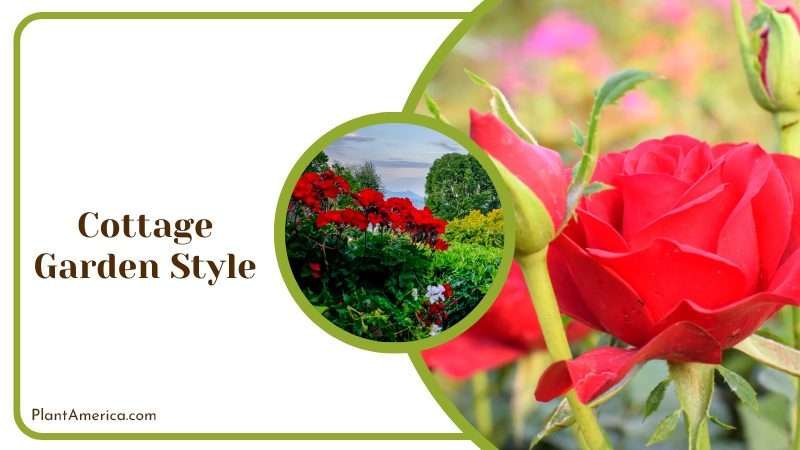
Low-growing perennials are preferred in this style because they will not overtake the growth of the roses. This way, the roses will dominate while these perennials support the look.
8. The Hedge Style
| Types of roses used |
|
| What it looks like |
|
| Advantages |
|
| Specific care needs |
|
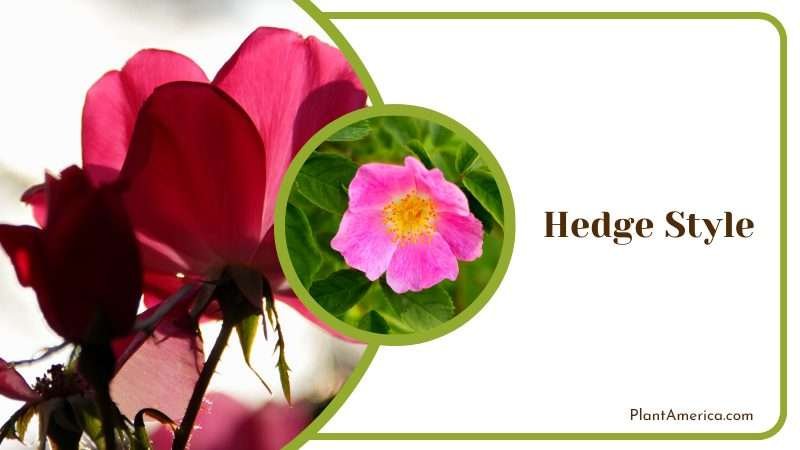
Each time you irrigate your hedge roses, please do so thoroughly so that the plants get enough water. We recommend that you only water these flowering beauties only when the soils feel dry upon touching them.
When you prune the plants, be sure to do so during the dormancy periods. By the way, pruning exposes the rose plants to more resources like air and light, thereby enhancing the production of more blooms.
9. The Ground Cover Style

| Types of roses used |
|
| What it looks like |
|
| Advantages |
|
| Specific care needs |
|
This is one of the elegant home garden schemes that will completely transform your space. Due to their growing habits, the roses that are used to ground cover designing are also referred to as “rose bushes.”
Please note that some of the plants give a bushier appearance than others. So, be aware of this as you make your choices.
10. Foundation Planting Style

| Types of roses used |
|
| What it looks like |
|
| Advantages |
|
| Specific care needs |
|
If you decide to use roses for foundation planting, be sure to grow them a little away from the walls. Also, make sure that there is enough space between the plants themselves.
This precautionary measure is vital because roses are highly susceptible to fungal attacks. Good spacing allows for adequate aeration, a scenario that keeps fungal diseases at bay.
11. Mixed Borders

| Types of roses used |
|
| What it looks like |
|
| Advantages |
|
| Specific care needs |
|
When you select plants to include in your mixed borders, never include companion plants that grow too fast; otherwise, they will compete with your roses. If this happens, it will distort the intended appearance as the other plants begin to dominate the space.
Please note that it is possible to update your border by adding new plants and removing the ones you no longer like. Here is a bonus point 一 you should plant between five to ten roses in a mixed border.
References
- Faris Karahan. The Use Diversity of Bush Roses in Garden Design and Plantings. Academia.
Retrieved from https://www.academia.edu/70440426/The_Use_Diversity_of_Bush_Roses_in_Garden_Design_and_Plantings - Speaking roses. Speaking Roses Get the Gardening Tips You Need To Get Growing. Academia.
Retrieved from https://www.academia.edu/32640626/Speaking_Roses_Get_the_Gardening_Tips_You_Need_To_Get_Growing - Larry A. Sagers. Roses for Utah Landscapes. USU Cooperative Extension.
Retrieved from https://digitalcommons.usu.edu/cgi/viewcontent.cgi?article=2347&context=extension_histall - Tina M. Waliczek, Dave Byrne and Don Holeman. (December 2018). Opinions of Landscape Roses Available for Purchase and Preferences for the Future Market. American Society for Horticultural Science.
Retrieved from https://journals.ashs.org/downloadpdf/journals/horttech/28/6/article-p807.pdf - Rose Gardening in Containers. Aggie Horticulture.
Retrieved from https://aggie-horticulture.tamu.edu/archives/parsons/publications/roses/container.html