
Kalanchoe Thyrsiflora of the Crassulaceae family is unique for its flat, paddle-shaped leaves laced with a unique color combination. If you are a succulent lover and need something eye-catching to spice up your Kalanchoe collection and satisfy your cravings for uniqueness, this Kalanchoe genus plant will do just that.
This article is a reservoir for all the care information of this plant as gathered from professional, experienced plant caregivers. Get all you need to know and care for your Kalanchoe Thyrsiflora like an expert.
Kalanchoe Thyrsiflora Care
This section will give you all the nitty-gritty on caring for this unique beauty.
 Water
Water
Each time you water your Kalanchoe Thyrsiflora, do so thoroughly until the water starts dropping out of the drainage holes of your plant. Allow the upper two inches of the soil to dry out before you can offer the next drink to your plant—too frequent watering results in soggy soils, which exposes your plant to root rot.

Another rule of thumb when watering the paddle succulent is never to let water touch the surface of the leaves when you water. There are two ways through which you can achieve this. First, simply water directly on the potting mix. Second, you can water your plant from the bottom.
Don’t use cold water for quenching your plant’s thirst because this can shock it. Always use room temperature water.
 Light
Light
Kalanchoe Thyrsiflora grows well if you provide it with full, bright, but indirect sun. It also thrives well in partial shade. There is no harm in giving your plant some direct sunlight, sometimes. When grown under full sunlight, the plant’s leaves turn from green to red.

If you are growing your paddle plant indoors, be careful not to place it on a spot that exposes it to direct sunlight that passes through the glass of a window. Unlike the full sunlight outdoors, the light that passes through the glass of a window will burn the leaves of your Kalanchoe Thyrsiflora.
Quarterly Turn
Give your Kalanchoe Thyrsiflora a quarterly turn on a weekly basis toward the light source. This idea allows all sides of the plant to have equal exposure to sunlight. This helps your plant have an even and balanced growth that will showcase its beautiful outlook.
Please note that the Kalanchoe paddle plant can tolerate low light conditions for limited periods of time, but its leaves may wilt and start turning yellow.
 Soil
Soil
The paddle succulent is happy when it’s grown in well-draining soil. Adding sand to your potting mix helps create the typical potting soil that Kalanchoe Thyrsiflora will certainly enjoy.
The pH of the soil should be between 6.1 to 6.5, which is slightly acidic. Ranges of pH that are between 6.6. And 7.3, which are neutral, are also fine.
 Temperature
Temperatures between 60 F and 85 F are conducive for the growth of Kalanchoe Thyrsiflora during its growing season. In winter, maintain temperatures around 60 F.
If the temperatures fall below 50 F during winter, it is best to keep your plant indoors. The same applies to cold nights. If you decide to move your paddle leaf succulent outside for summer, make the process as gradual as possible to allow the plant to safely adapt to the warmer temperatures. An abrupt transfer to the outside sunlight can scorch your plant’s leaves.
 Pruning
Kalanchoe Thyrsiflora is not so demanding when it comes to grooming and maintenance. Just be on the lookout for withered or dead leaves. These are the ones that require pruning whenever they are present on your plant.
You might also need to clean up your plant after its flowering period to maintain its “in-point” appearance.
Be sure to wear your gloves during all grooming and maintenance procedures. Also, disinfect your equipment, like the pruning shears, using 70 percent alcohol to prevent infection by bacteria and fungi.
Propagation
Kalanchoe Thyrsiflora can be propagated through offsets, seeds, or leaf cuttings. Let’s look at how you can multiply the plant through cuttings.
– Cuttings
Using your shears or knife, cut the stems of the mother plant. A knife comes in handy when dealing with tight spots where it is difficult to freely open the shears. Be sure to cut the stems as close to the soil as possible.

After cleaning your cuttings, allow them to dry. Let the cut end develop some calluses. This can take about two to three weeks.
Place the cut end in a rooting hormone before planting the cuttings in new pots. The soi in the pots should be very light and well-aerated to allow for proper root development. Adding perlite or pumice to the soil will help you achieve that with much ease.
Place the cuttings in the shade and water them lightly, allowing the topsoil to dry between waterings.
Problems
It is less likely that you will encounter problems with pests and diseases as long as you maintain proper care procedures for your plant. However, keeping your plant healthy also requires you to be aware of the problems to look out for when caring for your plant.
– Toxicity
All parts of Kalanchoe Thyrsiflora are toxic when consumed. Please keep them out of the reach of children and pets. Alternatively, put the plant in rooms that have monitored access.
Always wear long-sleeved clothes whenever you handle your paddle leaf succulent. Be sure to wash immediately after working on your plant.
– Pests
Spider mites, plant scale, and aphids are the main invaders of Kalanchoe Thyrsiflora if they have the chance. Aphids are the most difficult to control because of their ability to multiply rapidly. It is, therefore, always best to prevent these pests than treat them.

Once you notice that your paddle succulent has been infected by scale, aphids, or spider mites, isolate it from the rest of your plants to avoid cross-contamination. Don’t forget to clean the space where the infected plant was sitting.
Interventions
Wash the plant using a strong stream of water using, say, a garden hose. Isopropyl alcohol (70 percent) helps deal with the pests either as a spray or wetting agent for cotton balls that you can use to dab the pests.
Commercial insecticidal soaps are also effective in destroying aphids, spider mites, and scale. You can even prepare your own insecticidal soap at home by mixing vegetable oil, dishwashing soap, and water. Organic pesticides like Neem oil will never disappoint you.
– Diseases
One of the possible problems you can encounter as you take care of your Kalanchoe paddle plant is powdery mildew. This is a fungal infection that appears like some white powder or flour has been poured on the leaves of your plant. The powdery mildew affects the stems and flowers as well.
Overwatering and too high humidity conditions are the major causes of powdery mildew in Kalanchoe Thyrsiflora. Avoiding these two care discrepancies is an effective preventative measure.
Interventions
Spraying your paddle-leaved beauty with vinegar that contains acetic acid works well against powdery mildew because it changes the pH of the fungus. To prepare the spraying solution, add four tablespoons of vinegar to a gallon of water and use this to spray your plant after every three days.
You can also use a bicarbonate soda solution that you can prepare by adding a teaspoon of horticultural oil, a tablespoon of baking soda, and a teaspoon of dishwashing soap in a gallon of water. Test the solution on a small part of your plant before spraying the whole plant.
Facts About the Kalanchoe Thyrsiflora
– Leaves
The leaves of Kalanchoe Thyrsiflora are grey-green and are arranged in a beautiful rosette with their dusty outlook. The margins of the leaves are tinged with bright red color.

These leaves of Kalanchoe Thyrsiflora are flat and rounded, assuming a paddle shape, which is why it is sometimes called the Kalachoe Paddle plant. The leaves of the Kalanchoe Paddle Succulent can grow up to six inches in size.
– Flowers
As your Kalanchoe Thyrsiflora matures, it becomes characterized by a spoke of fragrance.
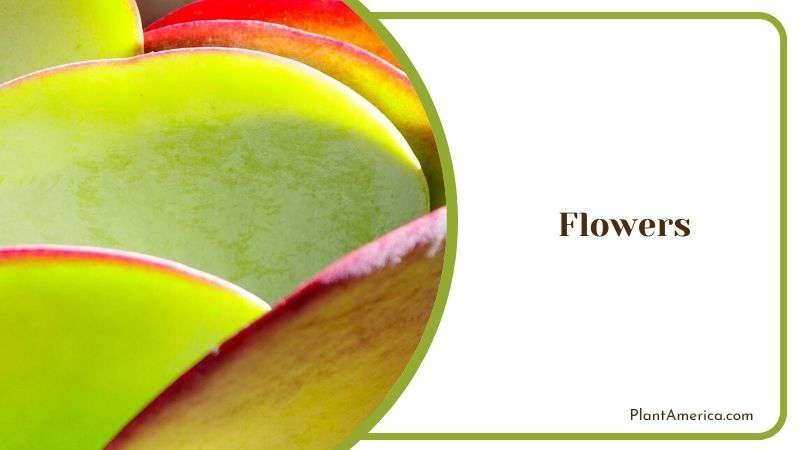
The Kalanchoe Thyrsiflora flower is bright yellow, cylindrical, and fragrant. The blooming period of the paddle leaf succulent is between mid-summer and mid-winter.