
If how to save an oak tree that is dying is your major concern, worry no more, as we have it covered for you. A dying oak tree can be saved if you detect the early symptoms and act quickly.
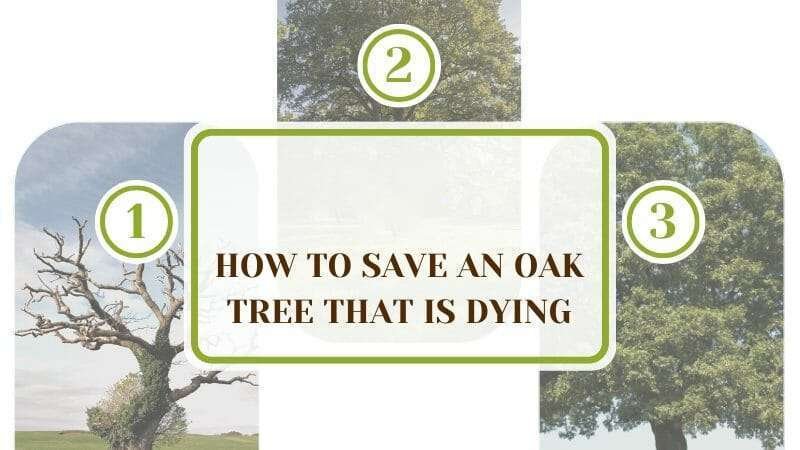
Oak trees may seem hardy but still be impaired by diseases. Our gardening experts are here to help you save that dying tree through a simple, step-by-step process.
How To Save an Oak Tree That Is Dying in 7 Simple Steps
To save an oak tree that is dying you have to follow seven simple and easy steps that can give you a healthy oak at the end. Oak trees are hardy but may be subjected to diseases even with inconveniences as minor as watering in excess of its needs.
Fungal infections, branch breakage, color shift of green leaves to yellow and then eventually brown, and foliage loss are some symptoms that suggest that you have a dying oak on your hands. However, you can always save a diseased tree from turning into a dead tree through following the following easy steps:
– Get Rid of the Diseased Branches
Symptoms of an ill oak tree are unavoidably visible. Cutting off or pruning the diseased branches is an extremely rational means of saving a dying oak tree.
Hence, the first and foremost step that you will take to help you save your dying oak tree is the removal of diseased, dead, or decayed branches through a sharp pair of pruning clippers or a pruning saw.
The pruning targets immediate symptoms such as the tree’s poor structure, deadwood, and weak joints. These symptoms immediately come to the notice of plant owners.

Pruning the diseased branches will help the tree halt the spread of the disease to another healthy part. Simply put, if the unhealthy branches are neglected and not dealt with on time, it can greatly compromise the rest of the tree’s wellness. Also, remember that every part of a tree requires a different pruning technique.
An important consideration to keep in mind is that the trees should be kept from being pruned between April and July as it is their growing season, and doing so might hinder their remaining growth chances.
You can save your tree from more trauma and disease by using a pruning seal spray to blanket the tree wounds left after the tree has been pruned to reduce the chances of attracting a hungry sap beetle.
Wearing gloves while dealing and working with unwell trees is an essential precautionary measure. Make sure to clean your pruning tools with alcohol so that the diseases do not spread to other plants and trees.
– Discard the Dead Branches and Leaves
By now, you might have noticed that the green leaves have turned yellow and have close-to-green veins. This change can be a sign of malnutrition. Excessive falling of leaves indicates that your tree might go through something serious, like a fungal infection.
Furthermore, if you notice new growth only on the lower branches while the upper branches bear yellow to brown leaves, your tree is likely dying. A quick soil test will let you know if your tree lacks nutrients and is suffering from a disease.
The next immediate step that needs to be done is gathering and getting rid of the branches you pruned and any surrounding fallen leaves.
The cuttings and the fallen leaves need to be discarded as soon as possible as green waste or can be burned while keeping in mind your local guidelines, especially when the tree is stricken with oak leaf blisters, as you never know what the debris may still be carrying that could harm your tree.
– Spray Fungicide on the Diseased Areas
Trees and fungi often have a beautiful symbiotic relationship until the wrong fungi strain arises.
If your tree is infected with fungal diseases that have permeated through the trunks, leaves, or branches, then even proper pruning will not be able to save it solely. It is time for you to tackle the fungus with an anti-fungal spray.

Combine and use the anti-fungal products as per the directions on the label. The fungicide must contain one of these active ingredients: tradition, benomyl, dinocap, sulfur, or fenarimol. Please do not deal with these products without protective gear, such as gloves, goggles, and masks, and ensure that your children and pets are not exposed to them.
A robust anti-fungal product will lash out at the disease weakening your tree, providing it with the optimum chance to recover. Use caution when dealing with such concentrated products.
– Inject Fungicide Into the Tree
Even if, after spraying fungicide, your tree trunk bark is diseased or falling off, it is time to inject fungicide into the tree.
Armillaria root rot, known as oak root fungus, is the most common fungal infection outcome. Fungal infections can pose serious threats to the oak tree trunks by altering the water transportation and nutrients up the tree. If the infections are left untreated, they will leave you with a dead tree in your hands.
The solution rests in injecting a strong fungicide designed specifically for this purpose, using tree injectors. It will kill the fungus ambushing your tree below the bark. Inject the fungicide as per the directions of the manufacturer.
You might be required to drill a hole in the tree, just enough to allow the tip of the injector to enter. Drilling a small hole will allow you to inject the fungicide that will free your tree from the disease without causing any lasting damage.
After successful injection, your tree will be back to transporting water and nutrients from the roots to the branches and leaves and will thrive again.
– Fertilizing Your Oak
Now that your oak is disease free, it is time to help it return to its previous health. For this purpose, a 10-10-10 fertilizer is fit for the job . It is an all-purpose, balanced fertilizer for all plants and conditions.
The 10-10-10 represents the content of Nitrogen (N), Phosphorus (P), and Potassium (K), commonly known as NPK, in the fertilizer. It is a fast-release formula that can feed your tree for up to two weeks.
The fertilizer works best if reapplied every thirty days to provide the essential nutrients your tree needs. Follow the product application guide and be careful not to over-fertilize as it may cause your tree to wilt, have burned spots on leaves, and have a salt-like crust on the soil.
The roots of an oak tree spread nearly two or three times as wide as its branches. Therefore, add fertilizer to the area beneath the branches to support the roots and ensure the successful delivery of nutrients to the roots.
– Mulch Around the Tree but Not Excessively
Mulch application is a healthy practice in gardening and tending to diseased plants. However, it becomes unhealthy when you go overboard with the amount.
To protect and save root health and avoid potential infections, spread mulch at the tree’s base. Mulch can double your tree’s growth rate when used correctly and can moderate the soil temperature.

Use organic mulch containing wood chips, bark, or leaf waste around your oak trees. Leave a twelve-inch mulch free in a donut shape around the tree trunk for best results. This across-the-board mulch helps in root protection and weed suppression.
Mulch piled up against the tree trunk can contain moisture and lead to repeated fungal infection, or similar diseases, to take advantage of the suffering tree and cause trunk and root damage.
For this reason, never mound mulch so close that it touches the tree’s trunk. The mulch ring must be at least four to six feet in diameter, and its depth should be no more than two to four inches. Consider thinning the mulch areas that have built up with time.
– Ensure Proper Drainage
With all the important and necessary steps to save your dying tree being taken care of, your tree is now in the recovery phase.
Tree diseases can also result from inadequate drainage and excessive water in that area. It can cause the trees, prone to disease, to struggle and wilt, and can cause tree decay.
Carefully observe the area surrounding the tree after watering or after it has rained. If the water remains stagnant or marshy ground, it can breed diseases and may cause fatal problems with oak root fungus or crown rot.
The standing water can be cared for by digging a drainage ditch around your tree trunk and allowing the water to drain naturally. If the tree is planted where it receives ample sunlight during the day, it can speed up water drainage and prevent waterlogging.
References
- Cavender-Bares, Jeannine; Sapes, Gerard ; Pinto Ledezma, Jesus N.; Guzman Q., J. Antonio ; Juzwik, Jennifer ; Yang, Anna ; Nguyen, Cathleen ; Schweiger, Anna Katharina ; Montgomery, Rebecca ; Gholizadeh, Hamed ; Gamon, John; Townsend, Philip. (December 2021). Detection of Oak Wilt Disease from Tree to Landscape Scales. The SAO/NASA Astrophysics Data System.
Retrieved from https://ui.adsabs.harvard.edu/abs/2021AGUFM.B21A..04C/abstract - Dr. Dave Clement. (June 8, 2023). Why Oak Trees are Declining or Dying. University of Maryland Extension.
Retrieved from https://extension.umd.edu/resource/why-oak-trees-are-declining-or-dying - Mary Wilson. (April 30, 2013). Stop pruning oak trees now to avoid oak wilt. Michigan State University Extension.
Retrieved from https://www.canr.msu.edu/news/stop_pruning_oak_trees_now_to_avoid_oak_wilt