
Calathea white fusion of the Marantaceae family is a pretty plant with leaf patterns that will surely stun you and your visitors.
You can grow this plant without problems as long as you supply its care requirements. Continue reading to learn about the peacock plant of the Calathea genus and how you can grow it.
What is the Calathea White Fusion?
The Calathea lietzei, calathea white fusion, or peacock plant is a type of a tropical houseplant that is native to central Mexico and other tropical areas of South America.
Other names for this plant include zebra, peacock, or rattlesnake plant. This is a natural beauty with variegated leaves that can have a mixture of green, white, pink, and purple.
Calathea White Fusion Care
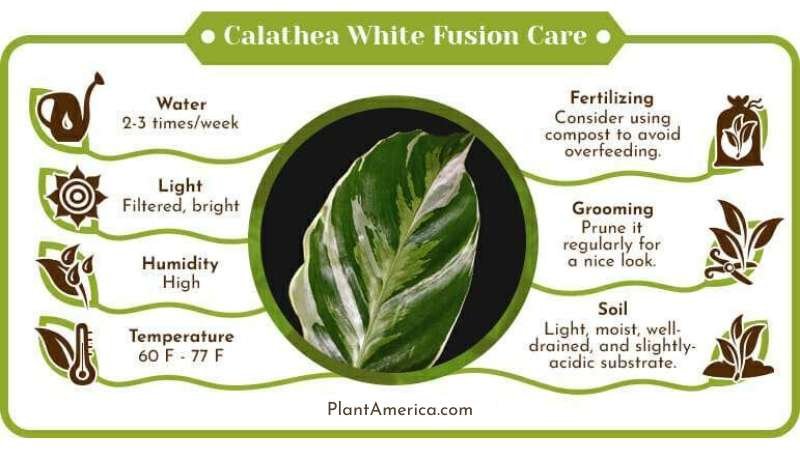
Even though this is a low-maintenance plant, you still have some work to do if you want it to be very beautiful as you see in shops and photos. Here are the general requirements and care guide for calathea white fusion plants:
 Soil Requirements
After selecting the best plant to start your calathea white fusion journey with, it is very important that you consider the type of substrate to grow it in.
First of all, you must know that as a potted plant, your peacock plant cannot grow in regular garden soil. Its roots can quickly become bound in garden soil, so you must use something lighter like a potting mix.
The suitable potting mix for peacock or zebra plants can retain moisture yet be well-drained. The mix should have a below-neutral pH as this plant prefers a slightly-acidic substrate.
If you can find a calathea-specific substrate, it is best. You, however, can still use a mix of African violets combined with perlite and orchard bark to grow your calathea white fusion.
The potting mix should not be as airy as mixes for succulents because you want a substrate that can retain some amount of moisture so that your peacock plant does not lack water. Also, if you do not have time to regularly fertilize your peacock plant, you should consider adding compost to the mix.
 Water Requirements
Water is more like the source of life for your peacock plant. If you want your plants to stay alive and have firm and beautiful leaves, you need to give them water when they need it. A peacock plant without proper watering will have bad-looking leaves. How much water do peacock plants need?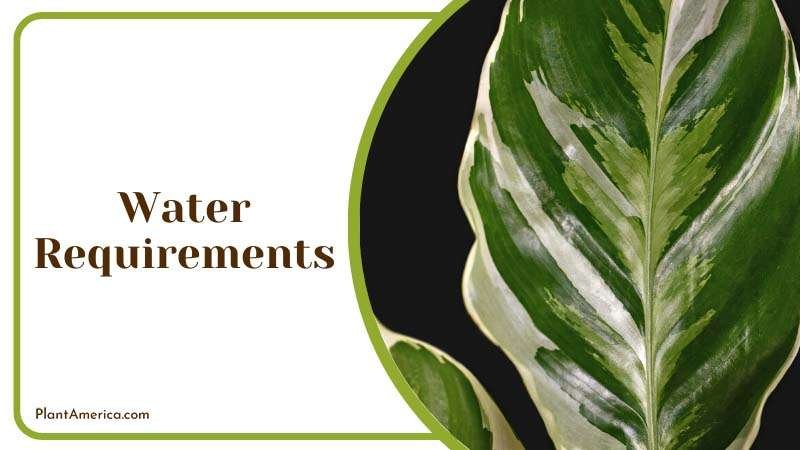
You should make sure that the substrate of your calathea white fusion is consistently moist. To achieve this, you should water your peacock plants two or three times per week.
Also, it would help to mix some vermiculite with the substrate. Never wait until the substrate is dry, though you can wait for the top two or three inches of the substrate to become dry before you water again.
To help prevent overwatering, make sure that the container or pot in which your peacock plant is growing has multiple drainage holes. The pot needs two or three drainage holes so that every excess water in the substrate can easily drain off.
If you are growing your peacock plant indoors, try to place its pot on a pan or saucer to prevent the excess water from destroying your home or office furniture.
 Light Requirements
Calathea white fusion plants love dappled or filtered bright light. This means that you should place them in shaded parts of the room that receive sunlight. As a shade-loving plant, make sure that the room in which you are growing your peacock plant has six hours of daily sunlight.
If you expose your calathea white fusion plants to too much sunlight, their leaves will look burnt, and start curling from their edges and they might wither.
If the plant does not have enough daily light, you will notice etiolation of the petioles and stem, general weakness of the plant and the plant might die. Make sure that you give your peacock plant just the right amount of light.
One reason why your plant may or may not be growing as quickly as you expected is the light availability. Just like every other plant, peacock plants need light for energy as well as growth. Therefore, you need access to sunlight if you are to grow your peacock plant without problems.
 Humidity Requirements
One very important factor that people tend to forget when growing plants is humidity. Humidity helps regulate the water and nutrient absorption and transpiration rates of every plant. Plants cannot collect water from their substrate if the environment is too humid for them. Luckily for you, peacock plants love a humid room.
As plants that originate from tropical regions, peacock plants love high humidity. You should grow your calathea white fusion plants in a room with humidity levels higher than the average.
For optimal growth, however, the room should have humidity levels around 75 percent. High humidity levels can damage furniture quickly, so make sure that the room has good ventilation.
If the room should be well-ventilated, how can you achieve high humidity for your peacock plants? Well, consider buying portable humidifiers for your plants. Additionally, you only need above-average humidity for your plants to grow. If the peacock plants need more humidity, you can tell by their very quick rate of water consumption.
 Temperature Requirements
Always remember to first consider the temperature requirement of a plant before you decide to bring it home. You cannot grow a plant that cannot grow in the temperature of your home, so the temperature requirement of every plant is very important.

Temperature helps to regulate every process in plants. The ideal temperature for calathea white fusion is 60 to 77 degrees Fahrenheit.
You do not need to always check the temperature with a thermometer to know if it is right for your plant or not. What is an option is to check your USDA hardiness zone. Note that peacock plants grow best without problems in USDA hardiness zones 11b-12b. So long as you live in any of those zones, you have nothing to fear.
Remember that calathea white fusion plants are tropical plants, so you can kill them if you expose them to winter. These are not frost-hardy plants, so never leave them outside when winter is approaching. You can take them inside and grow them in any window. You can also support the light by installing a grow light for your plants.
 Fertilizer Requirements
Just like you, peacock plants need food to grow. These plants may not be heavy feeders but they surely do not grow well in nutrient-depleted substrate. You can tell that your plant is well-fed according to the variegation of its leaves as plants with quality fertilizer are usually more beautiful than those lacking nutrients.
In the growing period of your peacock plants, you want to fertilize them once or twice monthly. The growing period starts in early spring and stops in mid-autumn.
You should use a liquid or water-soluble fertilizer for your peacock plants. If you don’t seem to have time to frequently fertilize your calathea white fusion, you can use a slow-release fertilizer.
If your peacock plants are lacking in nutrients, you will see them losing their green pigmentation, their leaves will become weak and they can start to die.
If the peacock plants are overfed, you will see that their leaf edges will start turning brown and the leaves will start to curl up. To prevent overfeeding your peacock plants, consider using compost.
 Pruning
The zebra or peacock plant is one with a lot of foliage, hence if you do not prune it regularly, it will grow a lot of leaves and you may not see its beauty anymore.
To help maintain your calathea white fusion plant’s beautiful appearance, you will need to prune it regularly. You can prune it once or twice annually according to your schedule.
To prune your calathea white fusion plants, all you need is disinfected scissors or a knife. Use the tool to cut off excess leaves and petioles. You can give your peacock plant any shape that you want. You can also prune the plant based on the color. Do this by keeping leaves with a specific color and removing leaves with colors that you do not want.
Note that the color of your plant’s leaves directly affects how your plant can photosynthesize. If you are retaining leaves with more white than green parts, you may need to give the plant access to more sunlight because white leaves photosynthesize poorly when compared to green leaves.
Propagation
It is so easy to propagate peacock plants. So long as you have a healthy mother calathea white fusion, you can propagate the plant. Here are the different methods through which you can propagate your peacock plants.
– Root Division
This method is a bit technical, but you can easily do it without problems so long as your peacock plant is healthy. Only use matured healthy plants if you want to propagate by root division. To propagate your peacock plant, carefully remove the plant from its substrate to reveal the entire root system.
Use a sterilized knife to divide the plant so that each part of the plant will have an equal amount of roots. After you have divided the plant, keep both parts exposed to the air and wait for a day until the wound is dry then plant them in new pots. Please use a new potting mix or bake the old one before you reuse it.
– Leaf Node Cutting
This is by far an easier way to propagate your calathea white fusion plants. You do not need to remove the plant from its substrate in this method. All you need to do is use a disinfected tool to cut off a healthy part of the stem that has some leaves. Remove the lower leaves of this cutting afterward.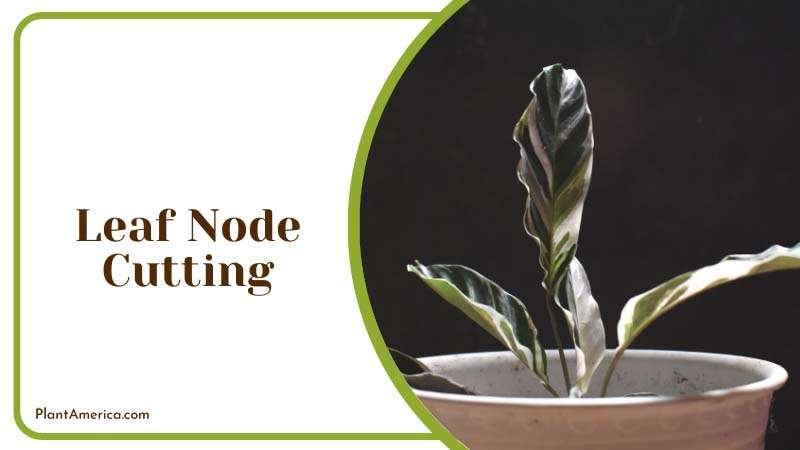
When the cutting wound is dry, you can plant it in a new substrate or potting mix. After watering the cutting and waiting for two or more weeks, you should see new beautiful leaves growing. Even though the cutting does not grow quickly, do not lose hope as it might still be developing roots.
– Seed Planting
Well, you can only use this method if you live in a tropical region or you are ready to mimic the natural habitat of your plant. It is rare for calathea white fusion plants to produce flowers, but if they do, they can produce seeds after successful pollination. You can get new plants by planting the seeds.
When you get your peacock plant seeds, wait until mid-spring and then plant them in a new potting mix and cover them with sand, just a thin layer. Water the peacock plant seeds by misting them until they germinate. When the seedlings’ roots have anchored, you can water them the normal way.
Common Problems to Watch Out
Now you know how to grow and propagate your peacock plants. Here are some avoidable challenges you can encounter when growing these plants:
– Pests
Some common pests that can attack your peacock plants are fungus gnats, spider mites, and aphids. You can easily repel spider mites and aphids by applying neem seed oil or insecticidal soap on the plant leaves regularly. Cure your peacock plant of root rot and water the plant regularly to prevent fungus gnats from attacking the roots. 
Make sure you watch out for the pests growing in your calathea white fusion because they might have different consequences for your plant, which might be harmful or even fatal.
– Leaves Turning Brown
You may sometimes notice that the beautiful leaves of your zebra plant are turning brown. Here are some reasons:
- Watering problems: Overwatering and not watering the plant enough can make the leaves turn brown.
- Overfeeding: If you give your peacock plant too many inorganic nutrients, the leaves will start to burn.
- Water drops on the leaf: Do not allow water drops to stay on the peacock plant leaves for long because they can encourage bacterial growth on the leaves.
You can easily prevent the leaves from turning brown if you use the tips listed in this article so that it won’t leave your plant in danger.
– Leaves Drooping or Wilting
Leaves drooping is a clear sign that your peacock plants either need more water or you are overfeeding them. In this case, give them clean water. Remember that the peacock plant container should have a lot of drainage holes.
– Leaf Patterns Disappearing
The light conditions of your calathea white fusion can affect the leaf variegation and pattern. White leaves cannot photosynthesize like green leaves, so your plant may want to produce more green leaves when the light is not enough.
This in turn can reduce the size of white patches on the leaves. Every problem listed here is avoidable so long as you properly care for your plant.
Final note:
Mulch is important for indoor plants, especially for aesthetics. Mulch helps to add beauty to your plant, cage, and pot. Mulch also helps to prevent weeds and pests from growing in your peacock plant substrate. Well, peacock plants can grow with or without mulch, but it is advisable to add mulch for optimal beauty.